Highlight
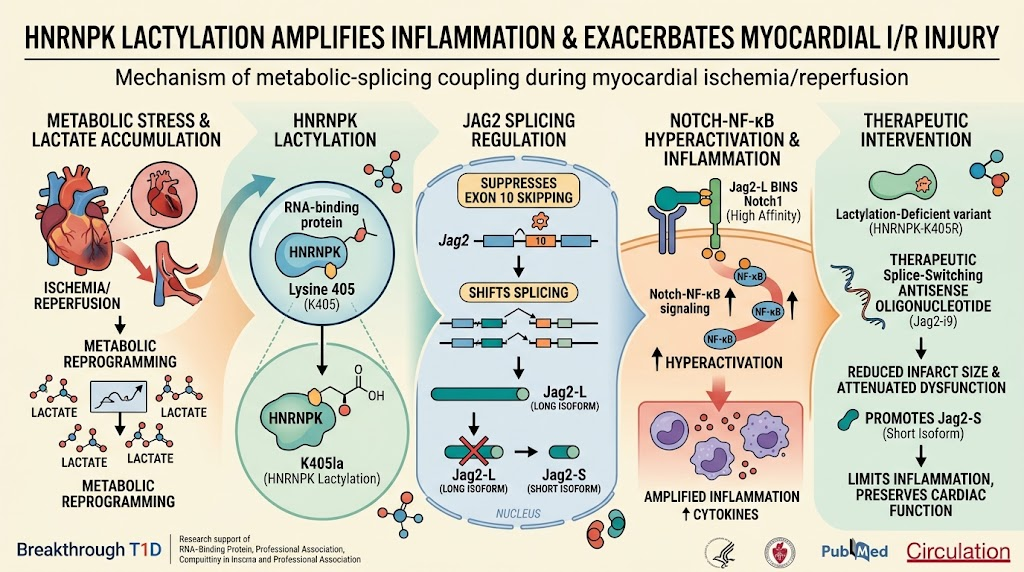
- Myocardial ischemia/reperfusion significantly increases protein lactylation, especially on the RNA-binding protein HNRNPK at lysine 405.
- Lactylation of HNRNPK alters splicing of Jagged2 pre-mRNA, promoting a Jag2-L isoform that hyperactivates Notch-NF-κB signaling.
- This aberrant splicing leads to amplified cardiac inflammation and worsened infarct size after ischemic injury.
- Pharmacological disruption of HNRNPK-Jag2 interaction or genetic blockade of lactylation protects against ischemia/reperfusion injury, offering therapeutic potential.
Background
Myocardial ischemia/reperfusion (I/R) injury is a common clinical challenge, particularly relevant during acute myocardial infarction management and cardiac surgeries involving cardiopulmonary bypass. Reperfusion, although essential for restoring blood flow, paradoxically exacerbates myocardial damage through complex metabolic, inflammatory, and molecular pathways. Lactate accumulation due to metabolic reprogramming is one hallmark of ischemic myocardium, but how this metabolic state translates into inflammatory gene expression changes has remained elusive. Understanding mechanisms that couple metabolic stress to maladaptive inflammation may identify novel therapeutic targets to mitigate cardiac injury.
Study Design and Methods
This investigation combined human atrial tissue samples from patients undergoing cardiopulmonary bypass with murine cardiac I/R models to assess the dynamics of protein lactylation. Proteomic analyses with lactylation-specific enrichment identified target proteins, focusing on the heterogeneous nuclear ribonucleoprotein K (HNRNPK). Crosslinking and immunoprecipitation followed by quantitative PCR (CLIP-qPCR) defined RNA targets of lactylated HNRNPK. Mechanistic validations employed site-directed mutagenesis creating a lactylation-deficient HNRNPK-K405R variant, isoform-specific overexpression of Jagged2 variants, and splice-switching antisense oligonucleotides (ASOs) targeting the HNRNPK-Jag2 splicing axis in mice and cultured cardiomyocytes.
Key Findings
The study found that reperfusion robustly increases global protein lactylation in both human and mouse myocardial tissues, pinpointing HNRNPK as a critical lactylated protein at lysine 405 (K405la). This lactylation modification enhances HNRNPK binding affinity to Jag2 pre-mRNA, favoring inclusion of exon 10 and shifting splicing towards the Jag2 long isoform (Jag2-L) over the short isoform (Jag2-S).
Functional analyses revealed that Jag2-L has a significantly higher binding affinity for Notch1 receptor, leading to hyperactivation of Notch-NF-κB inflammatory signaling pathways. This cascade results in amplified inflammatory responses and increased infarct size following ischemia/reperfusion injury.
Genetically engineered mice expressing the lactylation-deficient HNRNPK-K405R showed marked protection against myocardial I/R injury, demonstrated by reduced infarct size and attenuated inflammation markers.
Therapeutically, administration of a splice-switching antisense oligonucleotide (Jag2-i9) that prevents HNRNPK interaction with Jag2 pre-mRNA reduced Jag2-L isoform levels, diminished Notch-NF-κB signaling activation, and preserved cardiac function in I/R models.
Expert Commentary
This study introduces a novel metabolic-splicing regulatory axis in myocardial I/R injury, highlighting lactylation, a recently characterized posttranslational modification derived from lactate metabolism, as a key mediator linking metabolic stress to inflammatory gene regulation via RNA splicing.
The findings broaden our understanding of ischemia-induced molecular remodeling beyond traditional epigenetic and transcriptional controls, emphasizing RNA-binding protein modifications that modulate alternative splicing. Identifying HNRNPK lactylation at K405 as a molecular sensor refines the pathogenic paradigm by which metabolite accumulation directly influences RNA processing, thereby modulating the inflammatory milieu.
Limitations include the focus on Jagged2 and Notch signaling as downstream effectors; other lactylated targets and pathways may also contribute to pathology. The translational potential is promising, but clinical applicability of antisense therapies targeting splicing requires extensive validation, dosing optimization, and safety profiling.
Conclusion
HNRNPK lactylation serves as a critical nexus integrating metabolic cues and RNA splicing in myocardial ischemia/reperfusion. By promoting pathogenic Jag2-L isoform expression and excessive Notch-mediated inflammation, this mechanism exacerbates cardiac injury. Targeting this metabolic-splicing axis with splice-switching antisense oligonucleotides or lactylation blockade represents a precise and innovative therapeutic strategy to limit inflammation and improve clinical outcomes in ischemic heart disease.
Funding and Clinical Trial Registration
This research was registered with the Chinese Clinical Trial Registry (ChiCTR) under identifier ChiCTR2400091959.
References
- Chen S, Shen S, Su W, et al. HNRNPK Lactylation Amplifies Inflammation and Exacerbates Myocardial Ischemia/Reperfusion Injury by Regulating Jag2 Splicing. Circulation. 2026 Sep 8; PMID: 42708184.
- Zhang D, Tang Z, Huang H, et al. Metabolic regulation of gene expression by histone lactylation. Nature. 2019;574(7779):575-580.
- Hausenloy DJ, Yellon DM. Myocardial ischemia-reperfusion injury: a neglected therapeutic target. J Clin Invest. 2013;123(1):92-100.
- Luco RF, Allo M, Schor IE, et al. Epigenetics in alternative pre-mRNA splicing. Cell. 2011;144(1):16-26.