Metabolic Dysfunction Following Initiation of Androgen Receptor Pathway Inhibitors in Prostate Cancer: Clinical Implications and Risks

Highlight

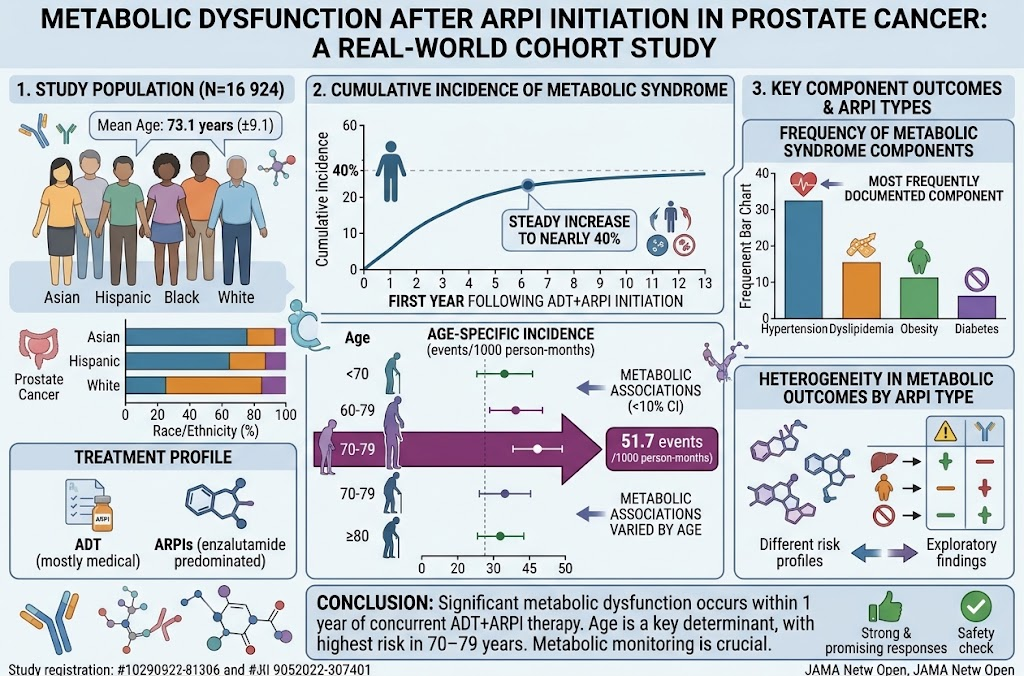
This investigation highlights that nearly 40% of men with prostate cancer receiving concurrent androgen deprivation therapy (ADT) and androgen receptor pathway inhibitors (ARPI) develop metabolic syndrome within the first year. The incidence is highest among those aged 70-79 years, with hypertension as the most prevalent metabolic complication. The study emphasizes metabolic monitoring beyond cancer management and suggests the need for proactive cardiometabolic interventions.


Study Background

Prostate cancer remains one of the most common malignancies in men worldwide. Androgen deprivation therapy (ADT), which suppresses testosterone, is a cornerstone for advanced disease management. More recently, androgen receptor pathway inhibitors (ARPIs) such as abiraterone acetate, enzalutamide, apalutamide, and darolutamide have become standard adjunctive treatments to enhance oncologic outcomes. However, ADT is well known to increase risks of metabolic syndrome (MetS), a cluster of disorders including obesity, insulin resistance, hypertension, and dyslipidemia, which collectively elevate cardiovascular risk.

Despite recognition of metabolic sequelae from ADT alone, less is known about the impact of concurrent ADT and ARPI initiation on metabolic dysfunction and its temporal dynamics. Additionally, it remains unclear how age and specific ARPI agents modulate this risk. Understanding these patterns is crucial to optimize holistic care for men with prostate cancer, who often have multiple comorbidities.

Study Design

This retrospective cohort study utilized the Epic Cosmos national, deidentified health records database, capturing data from January 2014 to September 2025. The cohort included 16,924 adult men with prostate cancer who started combined ADT and ARPI treatment without preexisting metabolic syndrome or its components. The ARPIs studied included abiraterone acetate, enzalutamide, apalutamide, and darolutamide. The index date was defined as the first day where ADT and ARPI overlapped. Patients were followed up for up to 12 months after initiation.

The primary outcome was new-onset metabolic syndrome within 12 months after starting combined therapy. Secondary outcomes included analyses of individual metabolic abnormalities such as hypertension, dyslipidemia, obesity, and insulin resistance. Subgroup analyses were performed by age groups and ARPI type to characterize heterogeneity in metabolic risks.

Key Findings

The study population had a mean age of 73.1 years (SD 9.1); racial composition was 65.5% non-Hispanic White, 21.0% non-Hispanic Black, 5.4% Hispanic, and 3.0% Asian individuals. Enzalutamide was the most commonly used ARPI, with the majority receiving medical ADT.

Over the 12-month follow-up, the cumulative incidence of metabolic syndrome progressively increased, reaching almost 40%. Age-stratified analyses revealed the highest rate among men aged 70-79 years, at 51.7 events per 1000 person-months (95% CI, 50.7-53.9). Among MetS components, hypertension was documented most frequently, consistent across age groups.

Exploratory analyses indicated variability in metabolic outcomes by ARPI type, suggesting differential metabolic profiles linked to individual agents. However, the study did not provide conclusive causal associations or mechanisms underlying these differences.

Notably, these metabolic dysfunctions emerged relatively early after therapy initiation, underscoring the rapid impact of combined ADT-ARPI on metabolic homeostasis.

Expert Commentary

This large-scale investigation extends our understanding of the metabolic liabilities accompanying modern prostate cancer therapies, emphasizing that metabolic syndrome develops in a substantial fraction of men within the first year of combined ADT and ARPI use. The predominance of hypertension aligns with known androgen deprivation effects on vascular and renal regulation.

Given the profound cardiometabolic implications, oncologists and primary care providers should anticipate and screen for metabolic abnormalities early in the treatment course. The observed age dependence highlights the need for heightened vigilance in older patients, who are more vulnerable to cardiovascular events.

Potential mechanisms may include ARPI-related changes in lipid metabolism, insulin sensitivity, and adrenal steroidogenesis. However, the study’s retrospective design limits causal inference, and confounding factors such as baseline cardiovascular risk or concomitant medications were not fully accounted for.

Future research could investigate whether specific ARPIs confer differential metabolic risks and whether mitigation strategies, such as lifestyle interventions or pharmacologic therapies, could reduce adverse outcomes. Additionally, multidisciplinary collaboration involving oncology, endocrinology, and cardiology specialists is critical for comprehensive management.

Conclusion

The initiation of concurrent ADT and ARPI therapy in men with prostate cancer is associated with a high and early incidence of metabolic syndrome, particularly affecting those aged 70-79 years. Hypertension emerges as the most common metabolic abnormality. These findings underscore the importance of integrating metabolic monitoring into prostate cancer care frameworks and developing scalable interventions to curb cardiometabolic risks.

Clinicians should incorporate multidisciplinary care models and prioritize early detection and intervention strategies for metabolic dysfunction to improve long-term outcomes in this high-risk population.

Funding and ClinicalTrials.gov

The original study did not specify funding sources or clinical trial registration. Further inquiries into funding disclosures or prospective trials in this domain are warranted.

Reference

Shaver AL, Zarrabi KK, Nikita N, Sharma S, Wen KY, Lu-Yao G. Metabolic Dysfunction After Initiation of Androgen Receptor Pathway Inhibitors in Prostate Cancer. JAMA Oncol. 2026 Aug 13:e262790. doi: 10.1001/jamaoncol.2026.2790. Epub ahead of print. PMID: 42593785; PMCID: PMC13474095.

Comments

No comments yet. Why don’t you start the discussion?

Leave a Reply