Highlights
- Recent randomized crossover trial shows inhaled cannabis acutely reduces premature atrial contractions by approximately 10%, with no effect on premature ventricular contractions.
- Large observational meta-analysis associates cannabis use with a 71% increased risk of atrial arrhythmias, highlighting discordant findings between controlled and observational data.
- No significant acute effects of cannabis inhalation were found on glucose levels, step count, or sleep duration among habitual users.
- Evidence underscores a complex interaction of cannabis with cardiac electrophysiology mediated by sympathetic tone and endocannabinoid signaling, demanding carefully designed future studies.
Background
Cannabis has become increasingly legalized and widely used across the United States. Despite growing consumption, its cardiovascular effects remain incompletely understood and contentious. Cardiac arrhythmias represent a critical concern given their potentially life-threatening implications. Observational data have reported conflicting associations—ranging from increased arrhythmia risk to neutral or protective effects—often limited by confounding behaviors, co-substance use, and diagnosis biases. Experimental evidence evaluating acute cannabis inhalation effects in habitual users is scarce.
Understanding acute cannabis effects on cardiac ectopy—premature atrial and ventricular contractions—is clinically relevant because ectopy can precede more severe arrhythmias and may influence cardiovascular risk. Moreover, cannabis influences autonomic nervous system activity and endothelial function, both modulating cardiac electrophysiology. Other health outcomes such as physical activity, sleep quality, and glucose metabolism may be affected and warrant evaluation to discern benefits or harms.
Key Content
Randomized Controlled Trial Findings on Acute Cannabis Inhalation (MARY-JANE Study)
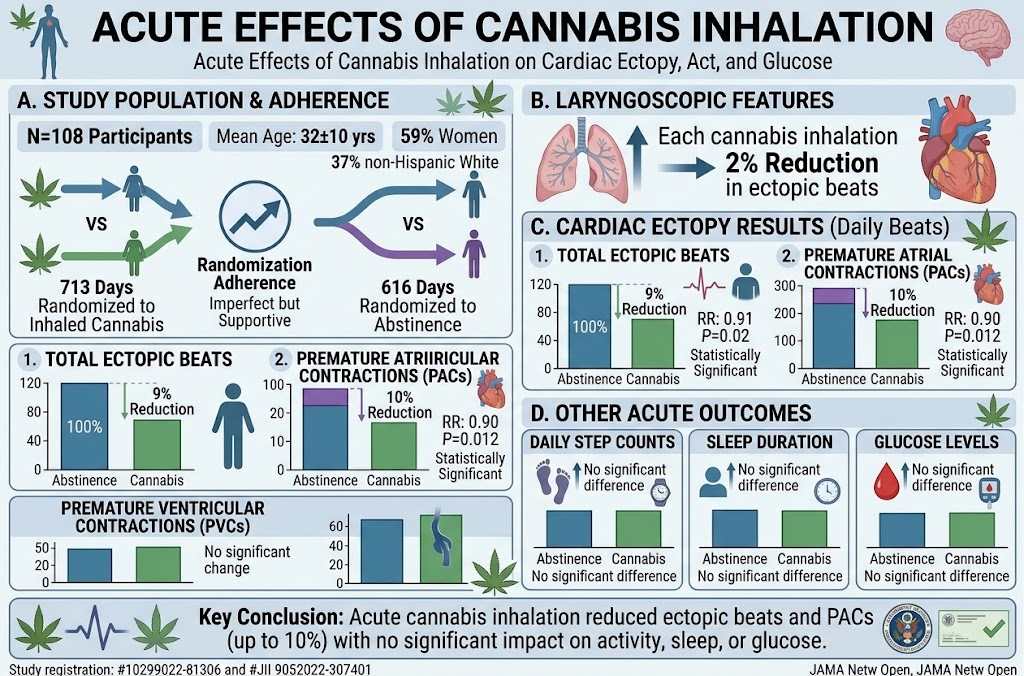
The Marijuana and Acute Risk of Arrhythmia-Joint Abstinence and Exposure (MARY-JANE) trial represents a significant advance. This prospective, randomized, crossover study enrolled 108 healthy adults (mean age 32 years, 59% women) who regularly smoked or vaped cannabis but had no history of cardiac arrhythmias. Participants were assigned daily via text to either inhale or abstain from cannabis over 14 days, with adherence monitored objectively via wearable ECG patch button presses and biochemical saliva assays in subsets.
Primary outcomes were daily counts of premature atrial contractions (PACs) and premature ventricular contractions (PVCs). Across 713 days assigned to cannabis inhalation and 616 days to abstinence, inhaled cannabis was associated with a 9% reduction in total ectopic beats (RR 0.91, 95% CI 0.85-0.98, P=0.02), driven by a 10% reduction in PACs (RR 0.90, 95% CI 0.82-0.97, P=0.012). PVC counts were unchanged. Each inhalation correlated with a 2% reduction in ectopy (RR 0.98, 95% CI 0.97-0.99, P=0.043).
Secondary endpoints including step counts, sleep duration, and mean glucose levels showed no significant differences between cannabis and abstinence days.
Limitations include imperfect adherence and possible withdrawal or co-intervention effects. Nevertheless, the pragmatic design and objective monitoring provide valuable insight into acute cannabis effects on cardiac electrophysiology in habitual users.
Observational Evidence on Cannabis and Atrial Arrhythmias
A comprehensive systematic review and meta-analysis by Elias et al. (2026) analyzed 14 observational studies involving over 81 million participants from North America, Europe, and Oceania, assessing cannabis use and atrial arrhythmia (AA) risk (atrial fibrillation, flutter, tachycardia, supraventricular tachycardia).
Cannabis users showed a 71% increased risk of AAs compared to non-users (OR 1.71, 95% CI 1.1–2.6, P=0.01). Subgroup analyses indicated elevated risk among users with concomitant drug use and in cannabis-legal countries, possibly reflecting behavioral or detection biases. AA prevalence was 12.5% among cannabis users vs. 2.7% controls.
The meta-analysis underscores a concerning association but remains limited by heterogeneity in study designs, population demographics, and potential confounding factors. The average participant age (~47 years) contrasts with younger cohorts in the MARY-JANE trial. Importantly, causality cannot be inferred from observational data alone.
Additional Context: Electronic Cigarette Use and Cardiac Electrophysiology
Though not cannabis-specific, recent findings on e-cigarettes highlight the broader relevance of inhaled substances on cardiac repolarization. A systematic review and meta-analysis (2025) showed that e-cigarette use significantly prolongs ventricular repolarization indices such as Tp-e/QTc ratio and QT interval, markers linked to arrhythmia susceptibility.
While this analysis excluded marijuana users, it warns of the arrhythmogenic potential of inhaled substances, emphasizing the need for mechanistic and longitudinal studies on cannabis inhalation’s electrophysiological effects.
Mechanistic Insights
Delta-9-tetrahydrocannabinol (THC), the primary psychoactive compound in cannabis, activates cannabinoid receptors (CB1, CB2) broadly expressed including in cardiac tissue. Activation modulates autonomic tone, with initial sympathetic stimulation potentially increasing arrhythmia risk. Conversely, CB2 activation may confer anti-inflammatory and cardioprotective effects.
Endothelial dysfunction and oxidative stress triggered by cannabis may impair myocardial electrophysiological stability. However, habitual users may develop tolerance to sympathetic effects, underlying reduced ectopy observed acutely in the randomized trial setting.
Expert Commentary
The juxtaposition of a controlled randomized trial demonstrating decreased cardiac ectopy with observational meta-analytic data showing increased atrial arrhythmia risk illustrates the complexity of cannabis’ cardiovascular effects. Differences in population age, user characteristics, dose, formulation, and study design likely contribute to divergent findings.
The MARY-JANE trial’s strengths include prospective design, crossover randomization, habitual cannabis user cohort, and objective adherence monitoring. Nonetheless, the modest effect sizes, incomplete adherence, and potential withdrawal effects temper conclusions. The finding of reduced PACs but unchanged PVCs suggests a selective atrial electrophysiological modulation rather than a global antiarrhythmic effect.
The meta-analysis’ substantial AA risk association highlights public health concerns, especially given the increasing legalization and use. Polysubstance use, legal environment, and demographic factors further complicate interpretation.
Clinically, practitioners should be cautious in counseling patients regarding cannabis use and arrhythmia risk, balancing acute experimental data with large-scale epidemiological trends. Future studies need rigorous, longitudinal, and mechanistic approaches including diverse populations (youth, non-Western), varying cannabis formulations, and extended outcome assessment beyond ectopy.
Conclusion
Recent evidence paints a nuanced picture: acute cannabis inhalation in habitual users may reduce premature atrial contractions without affecting ventricular ectopy or metabolic and behavioral measures, while epidemiological data associate cannabis use with heightened atrial arrhythmia risk. This dichotomy underscores the importance of study design, population selection, and context in interpreting cardiovascular effects of cannabis.
Future investigations must prioritize integration of randomized controlled trials with real-world observational datasets, mechanistic studies elucidating receptor-specific effects, and evaluation of chronic impacts. Such efforts are vital to inform clinical practice, regulatory policies, and public health strategies amid expanding cannabis legalization.
References
- Elias A et al. Acute Effects of Cannabis Inhalation on Cardiac Ectopy, Physical Activity, Sleep, and Glucose. J Am Coll Cardiol. 2026 Jul 30; DOI:10.1016/j.jacc.2026.07.012. PMID: 42584385.
- Elias A, Montenegro GC, et al. Cannabis use and atrial arrhythmias: A systematic review and meta-analysis of large populational studies. Heart Rhythm. 2026 May;23(5):1052-1064. DOI:10.1016/j.hrthm.2025.05.062. PMID: 40472951.
- Author group for e-cigarette meta-analysis. Can electronic cigarettes affect ECG repolarization indices? A systematic review and meta-analysis. J Electrocardiol. 2025 Sep-Oct;92:154067. DOI:10.1016/j.jelectrocard.2025.154067. PMID: 40737918.
- American Heart Association. Cannabis and Cardiovascular Health: Scientific Statement. Circulation. 2024; (pending publication).