Highlights
- Transitions of care (TOC) represent high-risk periods for medication errors among older adults, often driven by misaligned patient-healthcare system engagement.
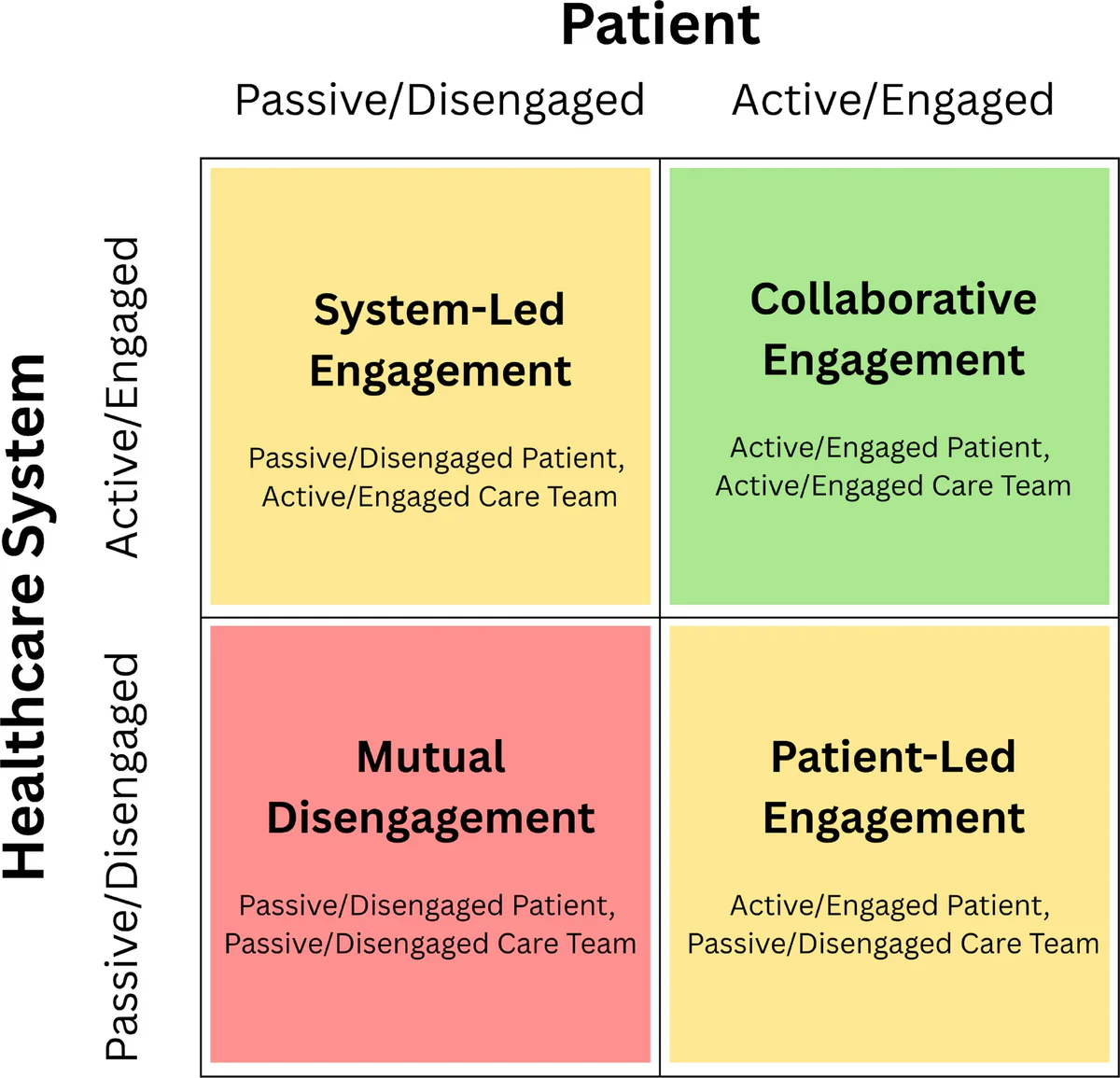
- The ALICE framework categorizes engagement into four patterns—Collaborative Engagement, Patient-Driven Engagement, System-Driven Engagement, and Mutual Disengagement—offering a structured approach to modeling interactions influencing medication safety during TOC.
- Key factors impacting medication safety include communication quality, discharge planning, patient involvement, social determinants of health, care coordination, and treatment comprehension.
- Patient-centered alignment between engagement and system responsiveness emerges as a crucial determinant for safe medication use post-discharge, offering targets for intervention.
Background
Transitions of care (TOC) from hospital to home or community settings are well-recognized vulnerable episodes, particularly for older adults who often have complex medication regimens. The risk of medication errors, adverse drug events, and preventable readmissions escalates during this period due to miscommunication, inadequate discharge planning, and insufficient patient involvement. Despite the prevalence of medication-related safety concerns at discharge, most interventions have focused on health system processes, with limited attention to how patient engagement and healthcare system responsiveness interrelate to influence outcomes. Older adults frequently encounter challenges in understanding medication changes, coordination among multiple providers, and navigating social determinants that complicate adherence, such as financial constraints and health literacy. Prior systematic reviews highlight communication breakdown and care coordination deficits as key contributors to medication safety lapses during TOC (Forster et al., 2003; Kripalani et al., 2007). In this context, the qualitative study by Lattimer et al. (2026) addresses a critical gap by exploring patients’ perspectives and developing the ALICE framework to conceptualize engagement patterns shaping medication safety.Key Content
Qualitative Methodology and Patient Population
Lattimer et al. conducted a rapid qualitative analysis (RQA) of semi-structured interviews with 26 adults aged ≥60 years from two urban safety-net clinics, discharged within three months. This population reflects significant sociodemographic diversity and vulnerability, relevant to understanding social determinants impacting medication safety. The inductive thematic analysis identified themes spanning communication, discharge process, patient involvement, social determinants, care coordination, and treatment understanding.Emergent Thematic Insights
- Communication: Clear, timely, and empathetic communication between healthcare providers and patients is foundational. Miscommunication or absence of medication reconciliation contributes to errors and patient confusion.
- Discharge Structure: Rigid, poorly structured discharge protocols hinder adaptation to individual patient needs. Personalized, patient-centric discharge planning facilitates medication safety.
- Patient Involvement: Active participation and shared decision-making improve patient understanding and adherence but require healthcare system encouragement and facilitation.
- Social Determinants of Health (SDOH): Economic insecurity, limited transportation, low health literacy, and social support deficits amplify risks for medication errors post-discharge.
- Care Coordination: Fragmentation among inpatient, outpatient, pharmacy, and community services leads to oversight and medication discrepancies.
- Treatment Understanding: Patients’ comprehension of medication purpose, dosing, and side effects is critical for safe use and self-management post-discharge.
The ALICE Framework: Conceptualizing Engagement Patterns
Based on cross-case comparisons, the ALICE framework delineates four quadrants reflecting the alignment (or lack thereof) between patient engagement and healthcare system responsiveness:- Collaborative Engagement: High patient involvement with highly responsive systems, representing ideal mutual interactions fostering medication safety.
- Patient-Driven Engagement: Patients actively manage medications despite less responsive healthcare systems, often resulting in higher burden and risk.
- System-Driven Engagement: Responsive healthcare systems provide structured support but patient engagement remains limited; opportunities exist to empower patients further.
- Mutual Disengagement: Low patient engagement combined with unresponsive healthcare systems creates highest risk for medication safety failures.
Integrating with Existing Evidence and Interventions
The ALICE framework aligns with established evidence emphasizing patient-centered care, transitional care models, and multidisciplinary approaches. For instance, transitional care interventions incorporating medication reconciliation, patient education, and post-discharge follow-up (Kripalani et al., 2014; Coleman et al., 2006) map onto Collaborative Engagement, while addressing SDOH represents a critical lever in enhancing system responsiveness. Meta-analyses have demonstrated that multicomponent strategies reduce readmissions and adverse drug events, yet heterogeneity remains high due to variable patient engagement levels and health system factors (Hesselink et al., 2013). By stratifying engagement, ALICE provides a framework to tailor interventions—targeting mutual disengagement cohorts for intensive supports or activating system-driven engagement patients through empowerment programs.Expert Commentary
This analysis offers a compelling patient-centered framework augmenting our understanding of medication safety during TOC. The ALICE typology underscores the dynamic interplay of patient agency and healthcare system readiness. Recognizing that older adults possess varying capacities and resources to engage is essential, as is healthcare’s responsibility to be responsive and accommodating. Guidelines from the American Geriatrics Society (AGS) and the Society of Hospital Medicine echo the need for comprehensive medication management during TOC but often lack frameworks incorporating patient engagement nuances (AGS 2019 TOC guideline). ALICE fills this gap, providing actionable typologies to guide assessments and interventions. Mechanistically, the framework draws attention to cognitive, behavioral, and social dimensions influencing medication safety. For example, cognitive decline in older adults may reduce patient engagement capacity, requiring robust system responsiveness. Conversely, social support deficits necessitate external facilitation. Limitations include the small qualitative sample and urban safety-net clinic focus, which may limit generalizability. Future research should validate ALICE in diverse settings and quantitatively correlate engagement patterns with medication safety outcomes.Conclusion
Medication safety during care transitions for older adults hinges on the alignment of patient engagement and healthcare system responsiveness. The ALICE framework offers a novel, patient-centered lens, categorizing engagement into four distinct patterns, thereby elucidating pathways to targeted interventions. Implementing this framework can enhance discharge planning by identifying disengaged patients or systems, facilitating tailored communication strategies, optimizing care coordination, and addressing social determinants. Ultimately, ALICE advances the field toward safer, more patient-centered medication management post-discharge, with potential for reducing adverse drug events and readmissions.References
- Forster AJ, Murff HJ, Peterson JF, Gandhi TK, Bates DW. The incidence and severity of adverse events affecting patients after discharge from the hospital. Ann Intern Med. 2003;138(3):161-7. PMID: 12558354
- Kripalani S, LeFevre F, Phillips CO, Williams MV, Basaviah P, Baker DW. Deficits in communication and information transfer between hospital-based and primary care physicians: implications for patient safety and continuity of care. JAMA. 2007;297(8):831-41. PMID: 17327525
- Kripalani S, Jackson AT, Schnipper JL, Coleman EA. Promoting effective transitions of care at hospital discharge: a review of key issues for hospitalists. J Hosp Med. 2007;2(5):314-23. PMID: 17973610
- Coleman EA, Parry C, Chalmers S, Min SJ. The care transitions intervention: results of a randomized controlled trial. Arch Intern Med. 2006;166(17):1822-8. PMID: 17000937
- Hesselink G, Schoonhoven L, Barach P, Spijker A, Gademan P, Kalkman C, et al. Improving patient handovers from hospital to primary care: a systematic review. Ann Intern Med. 2013;158(5 Pt 2):417-28. PMID: 23460072
- American Geriatrics Society Expert Panel on Care Transitions. 2019 Updated AGS expert statement on care transitions. J Am Geriatr Soc. 2019;67(9):1892-1901. PMID: 31399777
- Lattimer TA, Stoll JA, Wahler-Wilson A, Tenzek KE, Wahler RG, Chen HW, Jacobs DM, Singh R. Medication Safety During Care Transitions for Older Adults: Development of the ALICE Framework. J Gen Intern Med. 2026 Nov 9. PMID: 43004122
Specialty calculators
For clinical reference; use professional judgment.