Highlight
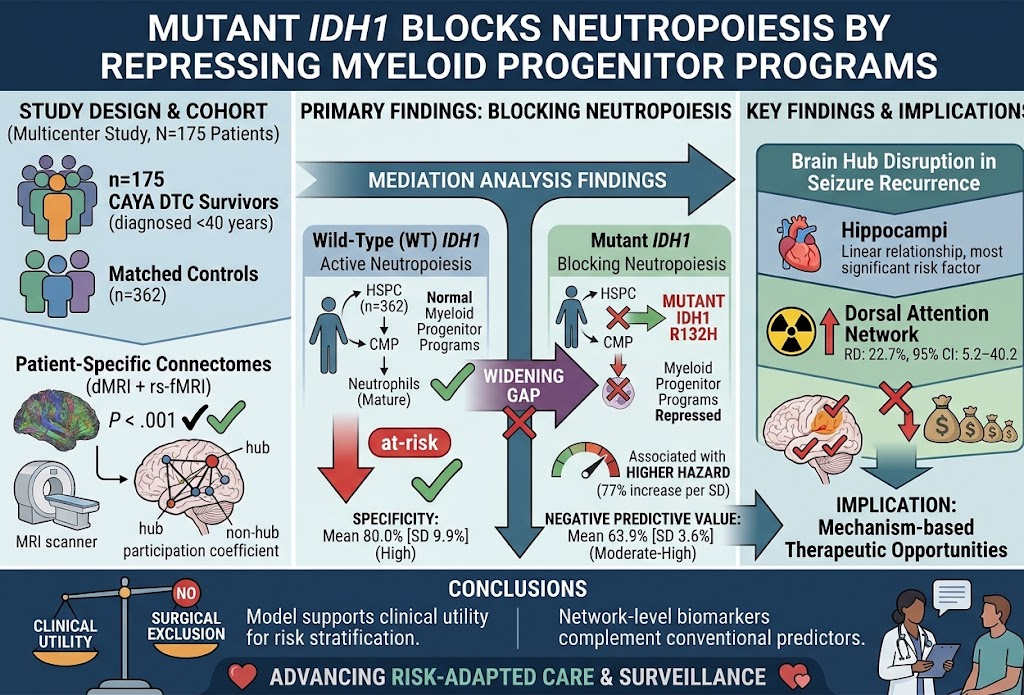
- Mutant IDH1 causes lineage-specific epigenetic alterations selectively impairing neutrophil differentiation in acute myeloid leukemia (AML).
- IDH1 is physiologically upregulated in myeloid progenitors, linking its mutation to targeted repression of neutrophil transcriptional programs.
- A heterozygous inducible Idh1 mutant mouse model demonstrated a cell-intrinsic block in neutrophil differentiation by suppressing key transcription factors, including Cebpe.
- Reactivation of differentiation by Cebpe induction or hypomethylating agents reveals the differentiation block is reversible, offering therapeutic avenues for IDH1-mutant myeloid neoplasms.

Study Background
Mutations in isocitrate dehydrogenase genes IDH1 and IDH2 are common in various cancers, notably in acute myeloid leukemia (AML). These mutations are associated with aberrant metabolic activity and epigenetic dysregulation, contributing to leukemogenesis. However, the distinct mechanisms by which mutant IDH1 versus mutant IDH2 influence hematopoietic differentiation and leukemia development remain incompletely understood. Neutrophils are a critical component of innate immunity, and their impaired differentiation can contribute to immunodeficiency and disease progression in AML. Understanding how mutant IDH1 specifically disrupts neutrophil lineage commitment could reveal novel insights into AML pathophysiology and treatment strategies.
Study Design
This study employed a multi-modal approach integrating DNA methylation profiling in human AML patients harboring IDH1 or IDH2 mutations with transcriptional analyses of normal hematopoiesis in humans and mice. Crucially, a genetically engineered inducible mouse model expressing a heterozygous Idh1 mutation under the endogenous promoter allowed investigation of the mutation’s functional impact on hematopoiesis in a preleukemic context. The study probed epigenetic alterations, transcription factor expression, and differentiation capacity of neutrophil progenitors, alongside therapeutic modulation via Cebpa overexpression and hypomethylating agents.
Key Findings
The investigation uncovered striking neutrophil lineage-specific DNA methylation changes unique to IDH1-mutant AML patients, correlating with a profound block in neutrophil differentiation. Transcriptional profiling showed that IDH1 (human) and Idh1 (murine) expression physiologically increases in myeloid progenitors, suggesting that mutant IDH1 disrupts differentiation programs active in these cells.
In the inducible Idh1 mutant mouse model, a cell-intrinsic blockade of neutrophil maturation was demonstrated at the progenitor level. This block was characterized by repression of critical myeloid transcription programs, notably diminished expression of Cebpe, a transcription factor pivotal for neutrophil lineage progression. Importantly, reactivation of Cebpe expression, achieved either through forced expression of its upstream regulator Cebpa or treatment with hypomethylating drugs, restored neutrophil differentiation. This indicates that the differentiation arrest induced by mutant IDH1 is not permanent but reversible with appropriate epigenetic modulation.
These findings elucidate a mechanistic link between mutant IDH1-induced epigenetic repression and myeloid differentiation arrest. The specificity of these effects to neutrophil progenitors highlights a previously unappreciated lineage vulnerability in IDH1-driven myeloid neoplasms.
Expert Commentary
This study advances our understanding of the molecular underpinnings of IDH1-mutant AML by identifying a reversible blockade in neutropoiesis attributable to disrupted transcriptional programs in progenitors. It complements existing knowledge that IDH mutations produce oncometabolites like 2-hydroxyglutarate, which alter DNA and histone methylation.
The use of an inducible murine model strengthens causal inference, highlighting cell-intrinsic effects of mutant Idh1 distinct from broader microenvironmental influences. Notably, the demonstrated reversibility with hypomethylating agents aligns with clinical observations that such therapies can induce remission in AML, supporting epigenetic modulation as a therapeutic strategy.
Limitations include the focus on preleukemic hematopoiesis; full leukemic transformation involves additional genetic and epigenetic hits that may modulate these pathways. The translation of murine findings to human AML biology and patient response requires careful validation. Nonetheless, these insights provide a valuable framework for developing targeted treatments for IDH1-mutant myeloid malignancies.
Conclusion
Mutant IDH1 exerts a targeted epigenetic repression of neutrophil differentiation programs in myeloid progenitors, causing a reversible block in neutropoiesis. Elevated physiological IDH1 expression in these progenitors likely predisposes this lineage to mutant effects, explaining the strong clinical association of IDH1 mutations with myeloid neoplasms. Therapeutic strategies aimed at reactivating differentiation, such as hypomethylating agents or modulating key transcription factors, hold promise for overcoming this differentiation blockade in IDH1-mutant AML. Future research should explore integration of these approaches into clinical practice and their efficacy in established leukemia contexts.
Reference
Hakobyan M, Langstein J, Ramos Medina MJ, Kleinert E, Schönung M, Hartmann M, Rohdjess H, Wojtarowicz J, Staeble S, Türe M, Pobiedonoscew Y, Claus R, Bullinger L, Oakes CC, Zoldan K, Cross M, Platzbecker U, Kneisel N, Raffel S, Germing U, Hoermann G, Haas S, Rippe K, Fröhling S, Pusch S, Plass C, Milsom MD, Lipka DB. Mutant IDH1 blocks neutropoiesis by repressing myeloid progenitor programs. Blood. 2026 Aug 13;148(7):867-881. doi: 10.1182/blood.2025031268. PMID: 42200677.