Highlight
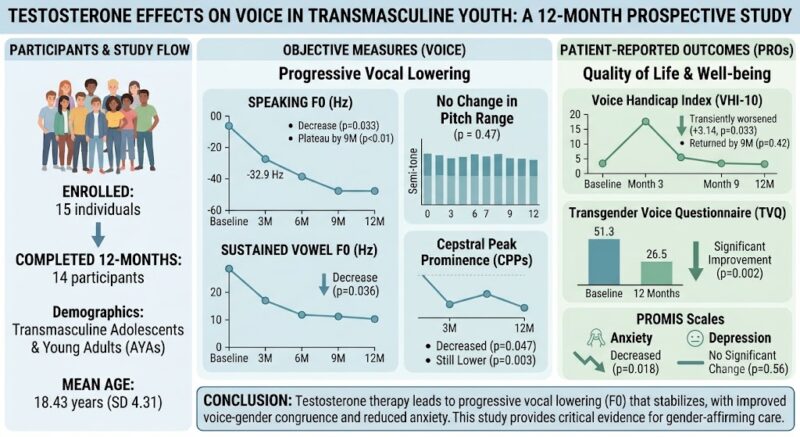
- Testosterone therapy in transmasculine adolescents and young adults produces a significant reduction in fundamental voice frequency (F0) beginning at 2 months and plateauing by 9 months.
- Voice quality as measured by cepstral peak prominence smooth (CPPs) initially decreases but shows partial recovery, remaining below baseline at 12 months.
- Patient-reported voice-related distress improves over the course of therapy, alongside reduced anxiety levels, indicating psychosocial benefits of hormonal treatment.

Study Background
Gender-affirming testosterone therapy is a cornerstone of medical transition for transmasculine adolescents and young adults (AYAs) assigned female at birth. Voice masculinization is a key physical and psychosocial goal, as voice pitch and quality significantly influence gender perception and congruence. Despite clinical importance, prospective longitudinal data on voice changes in this population have been limited, especially in adolescent cohorts. Understanding the timeline and extent of voice changes can inform clinical expectations, voice therapy initiation, and patient counseling.
Study Design
This prospective observational study enrolled 15 transmasculine AYAs, all assigned female at birth, naïve to testosterone and voice therapy, aged approximately 18.4 years on average. Participants were assessed monthly over 12 months after initiation of testosterone therapy. Acoustic voice parameters measured included fundamental frequency (F0) during sustained vowel phonation and connected speech, pitch range (measured in semi-tones), and cepstral peak prominence smooth (CPPs) to evaluate voice quality. Patient-reported outcome measures comprised the Voice Handicap Index-10 (VHI-10), Transgender Voice Questionnaire (TVQ), and PROMIS scales for anxiety and depression. The study aimed primarily to characterize temporal changes in voice acoustics and associated patient perceptions.
Key Findings
Of the 15 participants, 14 completed the 12-month follow-up. Fundamental frequency during connected speech decreased significantly by an average of 32.9 Hz at 3 months post-testosterone initiation (p=0.033) and plateaued thereafter by 9 months (p<0.01). Sustained vowel phonation F0 declined earlier at 2 months (p=0.036). Contrary to expectations, semi-tone pitch range did not show significant change over the 12-month period (p=0.47), suggesting pitch variability remains stable despite overall pitch lowering.
Voice quality as measured by CPPs decreased significantly at 3 months (p=0.047), indicating reduced voice stability or increased perturbation, but improved subsequently, though it remained significantly below baseline at 9 and 12 months (p=0.010 and p=0.003, respectively). These findings may reflect transient voice changes associated with hormonal effects on vocal fold tissue and muscle control.
Regarding patient-reported outcomes, the VHI-10, which assesses perceived voice handicap, transiently worsened at 3 months (+3.14 points; p=0.033) but returned to baseline levels by 9 months (p=0.42). Importantly, the TVQ, a measure specific to transgender voice concerns, showed significant improvement from a mean score of 51.3 at baseline to 26.5 at 12 months (p=0.002), indicating enhanced voice-gender congruence and satisfaction.
Psychological parameters revealed a significant reduction in PROMIS Anxiety scores over the study period (p=0.018), with no significant change in depression scores (p=0.56). This suggests that voice changes mediated by testosterone may alleviate anxiety related to gender dysphoria or social voice incongruence.
Expert Commentary
This study fills an important gap by prospectively analyzing objective voice changes in a predominantly adolescent transmasculine cohort, which has been understudied relative to adults. The early onset of F0 lowering, plateauing by 9 months, aligns with clinical experience and offers a realistic timeframe for clinicians and patients to anticipate voice changes. The transient deterioration in voice quality and handicap underscores the need for supportive voice monitoring and possibly adjunctive voice therapy during early months of testosterone treatment.
The stable pitch range despite lowered average pitch is intriguing and may represent differential effects of testosterone on vocal fold mass and neuromuscular control. The partial persistence of altered CPPs suggests that voice quality may require longer-term follow-up or intervention beyond hormone therapy alone. Psychosocial improvements in voice-related distress and anxiety emphasize the holistic benefits of hormone therapy beyond physical changes.
Limitations include the relatively small sample size and lack of a control group, though the prospective design strengthens causality inference. Future studies should explore longer-term changes beyond one year, the impact of adjunctive voice therapy, and variability in outcomes based on dosing or age at initiation.
Conclusion
Testosterone therapy in transmasculine adolescents and young adults induces progressive lowering of voice fundamental frequency beginning within 2 months and stabilizing by 9 months, paralleled by improved voice-gender congruence and reduced anxiety. While voice quality initially declines, partial recovery occurs without complete return to baseline. Patient-reported outcomes demonstrate meaningful psychosocial benefit. These findings provide critical, evidence-based data to inform best practices in gender-affirming voice care, supporting patient counseling, monitoring, and integrative therapeutic approaches to optimize voice outcomes during hormone therapy.
Funding and Clinical Trial Registration
The study was published in The Laryngoscope on August 7, 2026 (PMID: 42567716). No specific funding statement or clinical trial registration is reported in the abstract.
References
- Ma Y, Arora N, Kohli M, et al. Evaluation of the Effects of Testosterone on Voice in Transmasculine Adolescents and Young Adults. The Laryngoscope. 2026; PMID: 42567716.
- Titze IR. Principles of Voice Production. 2nd ed. National Center for Voice and Speech; 2000.
- Gelfer MP, Schofield K. Effects of testosterone on the male voice across the lifespan: a narrative review. J Voice. 2014;28(6):674-678.
- Sataloff RT. Professional Voice: The Science and Art of Clinical Care. 4th ed. Plural Publishing; 2017.
- Adams TM, Etemadi M. Voice therapy for transgender individuals: current evidence and future directions. J Voice. 2020;34(2):330-337.