Highlight
This randomized clinical trial provides evidence that telemedicine-based management of auto-adjusting positive airway pressure (APAP) therapy is noninferior to traditional in-person care for managing 24-hour mean blood pressure (BP) in patients with obstructive sleep apnea (OSA). Adherence to therapy, patient-reported outcomes, and metabolic parameters showed no significant differences between the two delivery models.
Study Background
Obstructive sleep apnea (OSA) is a prevalent condition characterized by recurrent obstruction of the upper airway during sleep, leading to intermittent hypoxia and sleep fragmentation. It is strongly associated with cardiovascular morbidity, including hypertension and increased risk for stroke and myocardial infarction. Continuous positive airway pressure (CPAP) and auto-adjusting positive airway pressure (APAP) therapies are effective in reducing apnea episodes and improving blood pressure control.
However, access to sleep clinics and adherence to therapy remain challenges, especially in areas with limited healthcare resources. Telemedicine has emerged as a potential alternative to facilitate diagnosis, treatment initiation, and follow-up care for OSA patients. Despite its growing adoption, there is limited rigorous evidence comparing the impact of telemedicine-based APAP management with standard in-person care on cardiovascular outcomes such as 24-hour ambulatory blood pressure.
Study Design
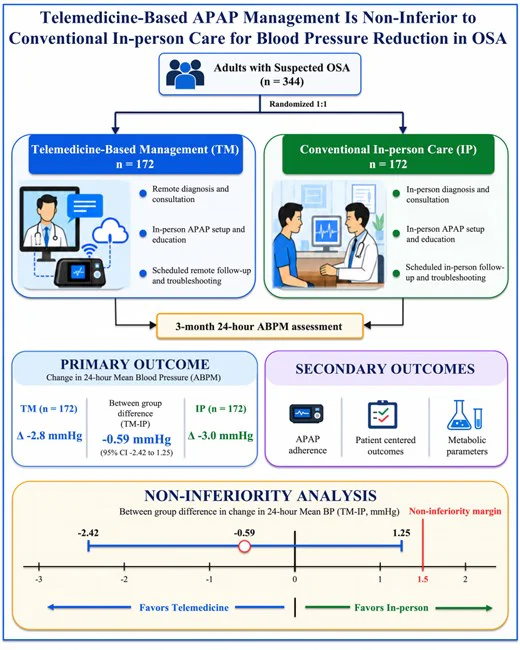
This was a prospective, randomized noninferiority clinical trial conducted by Yi et al., enrolling 344 participants with suspected OSA. Participants were randomized 1:1 to either telemedicine-based (TM) or in-person (IP) management for three months. The interventions included comprehensive APAP therapy management, including titration, education, adherence monitoring, and follow-ups, delivered either remotely via telemedicine platforms or through conventional clinic visits.
The primary endpoint was the between-group difference in change in 24-hour mean blood pressure from baseline to three months. A prespecified noninferiority margin was set at 1.5 mmHg, reflecting clinically acceptable thresholds for BP differences. Secondary endpoints encompassed APAP adherence, patient-centered outcomes (such as sleepiness scores and quality of life), and relevant metabolic parameters (e.g., glucose and lipid profiles).
Key Findings
Out of 344 randomized participants, 256 completed the 3-month follow-up: 127 in the IP group and 129 in the TM group. Analysis of the primary outcome demonstrated that the change in 24-hour mean BP between groups was -0.59 mmHg (95% confidence interval [CI], -2.42 to 1.25) in the intention-to-treat population and -1.21 mmHg (95% CI, -3.24 to 0.81) in completers. Crucially, the upper bounds of both confidence intervals were below the prespecified noninferiority margin of 1.5 mmHg, establishing that telemedicine-based APAP management was noninferior to in-person care in lowering BP.
Regarding secondary outcomes, no significant differences emerged in APAP adherence between telemedicine and in-person groups, implying that remote monitoring and support were as effective in maintaining compliance. Patient-reported metrics such as daytime sleepiness and health-related quality of life showed comparable improvement across both arms. Additionally, metabolic assessments revealed no statistically or clinically significant differences.
Safety profiles were not notably different, and no new concerns regarding telemedicine delivery of APAP were identified.
Expert Commentary
This study contributes important evidence supporting telemedicine as a viable model for OSA management, especially in hypertension risk reduction. The use of a rigorous randomized controlled design, objective 24-hour ambulatory BP measurements, and robust noninferiority methodology strengthens the validity of these findings.
Limitations include a relatively short follow-up period of 3 months and a moderate attrition rate. Given that chronic management and adherence in OSA require long-term engagement, future studies with extended follow-up would be valuable to assess sustained effects. Moreover, this trial focused on suspected OSA patients initiating APAP therapy, so the findings may not generalize to patients with established severe OSA or those using alternative therapies.
Nevertheless, the biological plausibility aligns with known mechanisms by which effective airway pressure therapy reduces sympathetic activity and nocturnal hypertension, thereby improving cardiovascular outcomes. The equivalence in adherence and patient satisfaction also highlights that telemedicine can replicate key aspects of patient engagement and education.
Conclusion
Telemedicine-based APAP management offers a comparable and effective alternative to traditional in-person care in reducing 24-hour ambulatory blood pressure in patients with obstructive sleep apnea over a 3-month period. This approach could enhance access to care, particularly for patients in remote or resource-limited settings, without compromising clinical efficacy or adherence.
Healthcare systems should consider integrating telemedicine platforms in OSA management pathways to optimize hypertension control and cardiovascular risk reduction. Further research is warranted to validate long-term cardiovascular benefits and to explore patient subgroups who might derive particular advantage from remote care.
Funding and Registration
This study was conducted by the research team led by Yi H and colleagues and published in the American Journal of Respiratory and Critical Care Medicine. No specific funding source was reported in the abstract. The clinical trial details and registration can be accessed via the PubMed record (PMID: 43035945).
References
1. Yi H, Dong X, Zhang C, Li Z, Yang W, Zuo Y, Xue P, Wu S, Xu L, Han F. The Effect of Telemedicine-Based APAP Management on 24-Hour Ambulatory Blood Pressure in Patients with Obstructive Sleep Apnea: A Randomized Clinical Trial. Am J Respir Crit Care Med. 2026 Nov 14. PMID: 43035945.
2. Pépin JL, et al. Continuous positive airway pressure therapy for obstructive sleep apnea and hypertension: impact on blood pressure and cardiovascular outcomes. J Clin Sleep Med. 2020;16(12):1987–1993.
3. Dungan JM, et al. Impact of Telemedicine in Sleep Apnea Management: A Systematic Review and Future Directions. Sleep Med Rev. 2022;59:101529.
Specialty calculators
For clinical reference; use professional judgment.