Highlight
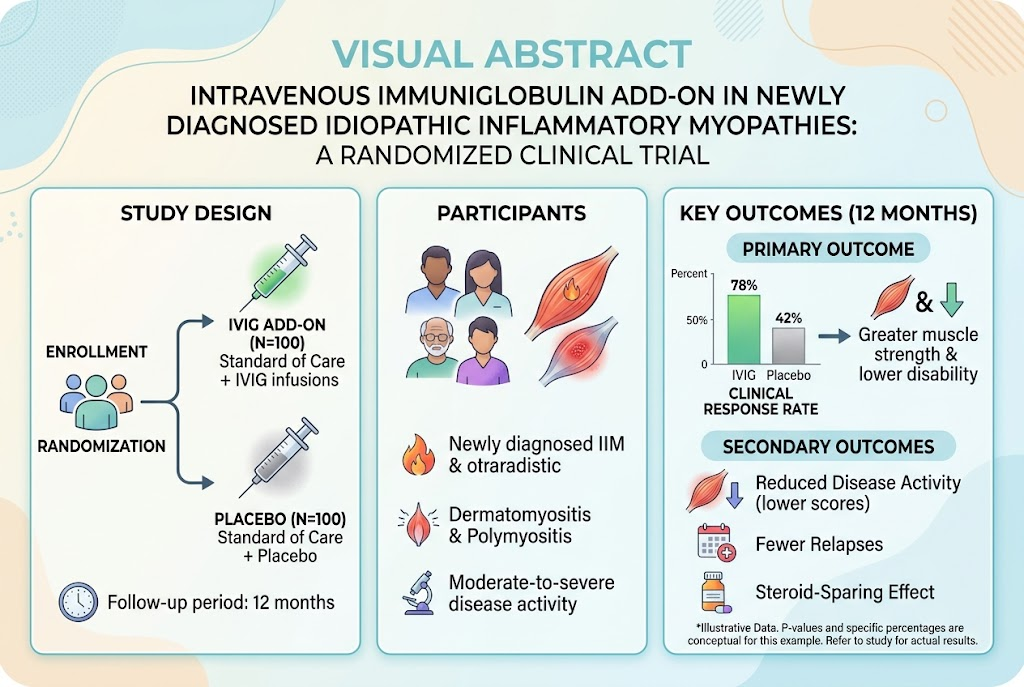
This randomized clinical trial demonstrates that in adult patients newly diagnosed with idiopathic inflammatory myopathies (IIMs), adjunctive intravenous immunoglobulin (IVIG) therapy added to high-dose prednisone significantly improves muscle weakness and clinical disease activity faster and to a greater extent than prednisone alone. The study utilises a validated composite Total Improvement Score (TIS), revealing improved response rates and reduced time to moderate and major improvement without compromising safety.
Study Background
Idiopathic inflammatory myopathies (IIMs) are a heterogeneous group of autoimmune disorders characterized by muscle inflammation and weakness, representing significant morbidity in affected individuals. Conventional treatment mainly involves high-dose corticosteroids like prednisone, which can be effective but also carry the risk of considerable side effects and variable outcomes. Intravenous immunoglobulin (IVIG) has immunomodulatory effects and is considered a potential adjunct treatment, but definitive evidence from randomized controlled trials in newly diagnosed IIM patients has been lacking.
Previous observational studies and smaller trials suggested IVIG might improve muscle strength and reduce inflammation, but a robust evidence base was needed to inform clinical guidelines and practice. This study addresses this knowledge gap by systematically evaluating the efficacy and safety of adding IVIG to standard corticosteroid therapy in newly diagnosed IIM.
Study Design
This was a double-blind, randomized, placebo-controlled clinical trial conducted at a tertiary referral center specializing in IIM in the Netherlands between September 2021 and September 2025. Adult patients with newly diagnosed IIMs, including polymyositis, dermatomyositis, and related subtypes, were enrolled if they had little or no prior immunosuppressive treatment.
A total of 44 patients (mean age 58.7 years; 50% female) were randomized in a 1:1 ratio to receive either add-on IVIG (2.0 g/kg body weight) or placebo administered at baseline (week 0), week 4, and week 8, alongside a standard regimen of high-dose prednisone (1 mg/kg/day, maximum 80 mg/day). The primary endpoint was measured at 12 weeks using the Total Improvement Score (TIS), a composite outcome reflecting changes in muscle strength, physical function, and other disease activity markers.
Key Findings
At 12 weeks, the IVIG group achieved a mean TIS of 60.0 (95% CI: 52.6 to 67.4), whereas the placebo group achieved a significantly lower mean TIS of 42.5 (95% CI: 30.6 to 54.4; P = .01). This improvement surpasses clinically important thresholds, reflecting meaningful functional recovery.
Regarding responder analysis, 91% of patients receiving IVIG reached moderate improvement (TIS ≥40) compared with 53% in placebo (P = .01). Importantly, a post hoc analysis showed that 70% of IVIG recipients achieved major improvement (TIS ≥60) compared with 26% in the placebo group (P = .005). Time to moderate response was also faster in the IVIG group, with a median of 4 weeks (95% CI: 4 to 8) versus 12 weeks (95% CI: 4 to 12) for placebo (P = .005), indicating that IVIG accelerates clinical benefit.
Safety profiles were comparable between groups, with only one reported asymptomatic deep venous thrombosis in the IVIG arm, underscoring an acceptable safety margin for this add-on therapy.
Expert Commentary
This trial adds high-quality evidence supporting early IVIG use in combination with corticosteroids for newly diagnosed IIM patients. The rapid and pronounced improvement in muscle strength and disease activity implies that IVIG targets pathogenic immune processes beyond what prednisone alone can achieve. These findings are congruent with increasing recognition of IVIG’s immunomodulatory capacities in autoimmune muscle diseases.
Limitations include a relatively small sample size typical for rare disease trials, potentially affecting generalizability. However, the rigorous double-blind design and clinically meaningful endpoints strengthen the validity of results. Future studies might explore long-term outcomes, cost-effectiveness, and effects in diverse IIM subgroups.
Conclusion
The addition of intravenous immunoglobulin to standard high-dose prednisone in patients newly diagnosed with idiopathic inflammatory myopathies results in significantly greater and faster clinical improvement with acceptable safety. This therapy should be considered to optimize early disease control and potentially reduce corticosteroid exposure and related adverse effects.
These findings have important implications for clinical practice and guideline development, highlighting an effective therapeutic strategy to improve outcomes in this debilitating group of diseases.
Funding and Trial Registration
The trial was supported by collaborative funding within the Dutch Myositis Network. It was registered with the European Union Drug Regulating Authorities Clinical Trials Database (EudraCT number: EUCTR2020-001710-37-NL).
References
- Özkaynar P, Evers S, Kamperman R, et al. Intravenous Immunoglobulin Add-On in Newly Diagnosed Idiopathic Inflammatory Myopathies: A Randomized Clinical Trial. JAMA Neurol. 2026 Sep 14. PMID: 42734930.
- Dalakas MC. Immunopathogenesis of inflammatory myopathies. Curr Opin Rheumatol. 2010 Nov;22(6):595-602.
- Lundberg IE, Tjärnlund A, Bottai M, et al. 2017 European League Against Rheumatism/American College of Rheumatology classification criteria for adult and juvenile idiopathic inflammatory myopathies and their major subgroups. Ann Rheum Dis. 2017 Dec;76(12):1955-1964.