Highlight
Korsakoff syndrome, a severe neurocognitive disorder due to thiamine deficiency, predominantly affects individuals with alcohol use disorder and carries a high mortality risk. In a large cohort from Greater Paris University Hospitals, 1320 patients exhibited frequent anterograde amnesia and characteristic MRI brain abnormalities in the Papez circuit and vascular leukoencephalopathy. Under-recognition of Wernicke encephalopathy was common, and mortality was significantly associated with malnutrition, alcoholic liver disease, male sex, and advanced age.
Study Background
Korsakoff syndrome is classically described as a persistent amnestic state resulting from thiamine (vitamin B1) deficiency, most commonly seen following Wernicke encephalopathy, and closely linked to chronic alcohol misuse. Despite its recognized clinical importance, contemporary data on its clinical presentation, neuroimaging features, and long-term prognosis remain scarce. The disorder poses significant challenges in diagnosis and management, with considerable implications for cognitive disability and mortality. There is an unmet need for comprehensive characterization of patients diagnosed with Korsakoff syndrome in real-world clinical settings to inform better diagnostic vigilance, care pathways, and outcome prediction.
Study Design
This cohort study utilized electronic health records from the Clinical Data Warehouse of the Greater Paris University Hospitals (AP-HP), a 39-hospital network, capturing adult patients with a documented diagnosis of Korsakoff syndrome between August 1, 2017, and December 31, 2022. The study population included 1320 patients with a mean age of 62.9 years, predominately male (72.9%). Data collection encompassed clinical features, comorbid conditions, neuroimaging findings from brain MRI scans, and mortality outcomes, with follow-up extending to a median of 3.1 years. The primary endpoint was all-cause mortality, while secondary outcomes addressed the frequency and nature of clinical symptoms, MRI abnormalities, and associated comorbidities. Multivariable survival analyses identified predictive factors linked to mortality risk.
Key Findings
Clinical Characteristics
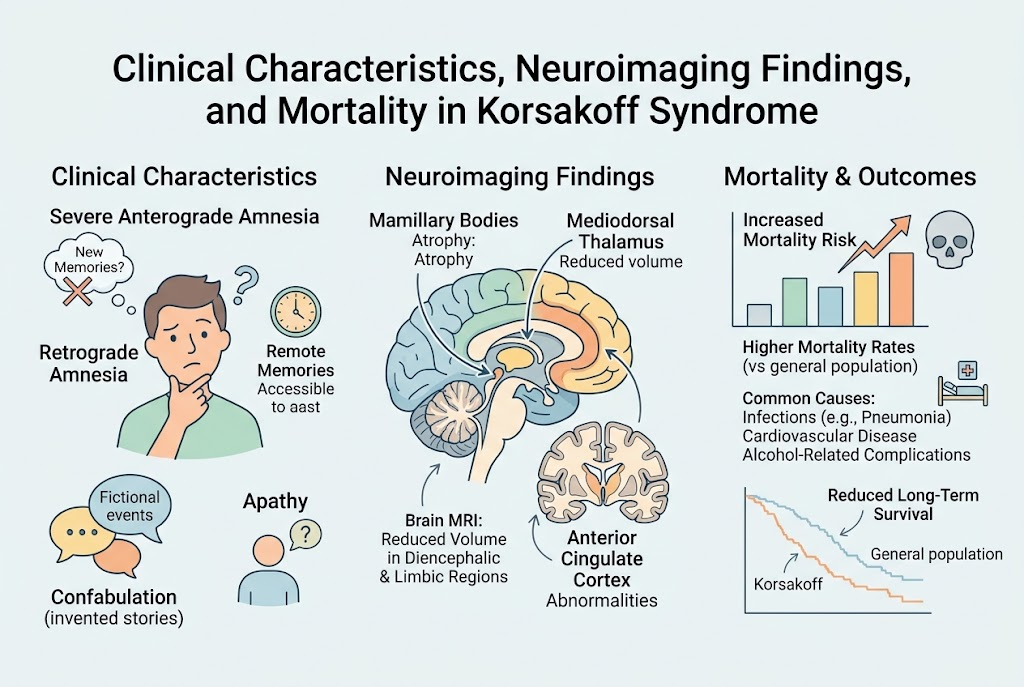
The most frequently reported clinical manifestation was anterograde amnesia, present in 61.4% of a well-documented subgroup of 114 patients, consistent with the hallmark memory impairment in Korsakoff syndrome. Importantly, only 19% of these patients had a documented history of preceding Wernicke encephalopathy, highlighting a substantial under-recognition or documentation gap for the acute thiamine deficiency phase that precedes Korsakoff syndrome. This finding underscores potential opportunities for earlier diagnosis and intervention.
Neuroimaging Findings
Among patients who underwent brain MRI, abnormalities involving the Papez circuit—critical to memory processing—and vascular leukoencephalopathy were each found in 44.4% of cases. The Papez circuit lesions likely reflect the characteristic pathophysiology of thiamine deficiency targeting limbic structures such as the mammillary bodies and thalamus. Concurrent vascular leukoencephalopathy suggests a high burden of cerebrovascular comorbidities, which may compound cognitive impairment and complicate management.
Mortality and Predictors
Over the median follow-up duration, 30.2% of patients died, indicating considerable mortality risk associated with Korsakoff syndrome. Multivariable analyses revealed several independent predictors of mortality:
- Malnutrition (HR 1.54; 95% CI, 1.15-2.05), reflecting the critical role of nutritional status and ongoing metabolic vulnerability.
- Alcoholic liver disease (HR 1.45; 95% CI, 1.10-1.91), indicating end-organ damage from chronic alcohol abuse as a key contributor to mortality.
- Male sex (HR 1.45; 95% CI, 1.13-1.86), consistent with the demographic distribution and higher risk patterns observed in alcoholism-related conditions.
- Advanced age, particularly the 80-89 year bracket (HR 1.89; 95% CI, 1.27-2.81), reflecting the impact of aging on comorbidity and resilience.
These findings delineate a profile of patients at elevated risk, emphasizing the need for targeted clinical monitoring and supportive interventions.
Expert Commentary
Korsakoff syndrome remains a clinical challenge due to its insidious onset and chronic progression. The study’s demonstration of frequent under-recognition of preceding Wernicke encephalopathy suggests a critical gap in early diagnosis and preventive care, as timely thiamine supplementation is crucial to avert irreversible neurological damage. The neuroimaging observations reinforce the syndrome’s basis in limbic system injury and reveal the complexity introduced by vascular pathology, which merits attention in clinical assessment and management.
Furthermore, the identification of malnutrition and alcoholic liver disease as prominent mortality predictors aligns with the broader literature on the systemic effects of chronic alcoholism. Male predominance and advanced age as risk factors reflect demographic trends but stress the importance of comprehensive geriatric assessment and gender-sensitive interventions.
This study provides robust, real-world evidence supporting the call for standardized diagnostic protocols and integrated multidisciplinary care for patients with Korsakoff syndrome. Limitations include reliance on retrospective electronic health record data and potential underdocumentation biases. Prospective studies examining therapeutic strategies and rehabilitation approaches are warranted to improve outcomes.
Conclusion
This large clinical cohort study elucidates the clinical and radiologic landscape of Korsakoff syndrome and confirms its substantial mortality risk. The frequent under-recognition of antecedent Wernicke encephalopathy highlights an urgent need for earlier detection and intervention strategies. Malnutrition and alcoholic liver disease emerge as critical mortality predictors, suggesting that comprehensive nutritional and hepatologic care is essential in this population. These findings advocate for enhanced awareness, diagnostic standardization, and multidisciplinary management to improve prognosis and quality of life for patients afflicted with this challenging neurocognitive disorder.
Funding and Clinical Trials Registration
The study was conducted using publicly available clinical data from the Greater Paris University Hospitals Clinical Data Warehouse. No additional external funding information or clinical trials registration was provided in the source publication.
References
- Coffi I, Lecœur E, Zarca K, et al. Clinical Characteristics, Neuroimaging Findings, and Mortality in Korsakoff Syndrome. JAMA Neurol. 2026 Sep 14; PMID: 42734904.
- Sechi G, Serra A. Wernicke’s encephalopathy: new clinical settings and recent advances in diagnosis and management. Lancet Neurol. 2007 May;6(5):442-55.
- Victor M, Adams RD, Collins GH. The Wernicke-Korsakoff Syndrome and Related Neurologic Disorders due to Alcoholism and Malnutrition. 1989.
- Zhao Z, Marín-Hernández A, et al. Neuroimaging in Korsakoff syndrome: insights and advances. Neuroimage Clin. 2020 Oct 28;28:102431.