Introduction and Context
Leiomyosarcoma (LMS) is an uncommon malignant mesenchymal tumor arising from smooth muscle–lineage cells and occurring in diverse anatomic sites — most commonly the uterus, retroperitoneum, extremities, and visceral organs. Clinical behavior is heterogeneous: some patients have indolent disease, others aggressive metastatic spread. Because LMS is rare and biologically diverse, evidence to guide site-specific management has been fragmented and often extrapolated from broader soft-tissue sarcoma (STS) data. The International Leiomyosarcoma Global Consensus Group (Campos et al.), publishing a consensus statement in JAMA Oncology (2026), convened clinicians, researchers and patient advocates to synthesize current evidence and issue practical, site-aware recommendations for diagnosis, local therapy, systemic treatment and follow-up, and to identify priority research gaps (PMID: 42720945).
Why this consensus matters now
– New systemic agents and expanding local therapies (e.g., stereotactic radiation, liver-directed techniques) have emerged, but LMS-specific, high-quality data are limited.
– Molecular profiling has revealed substantial heterogeneity among LMS tumors but has yet to translate into broad, validated targeted treatments.
– Management varies widely by tumor site, institutional expertise and geography. The consensus aims to harmonize best practices and point the field toward LMS-focused trials.
Key reference driving this summary
– Campos F, Gladdy R, Achee A, et al. Management of Soft Tissue and Visceral Leiomyosarcomas. JAMA Oncol. 2026 Sep 10. PMID: 42720945. https://pubmed.ncbi.nlm.nih.gov/42720945/
Other important guideline context
– ESMO–EURACAN Clinical Practice Guidelines: soft tissue and visceral sarcomas (Casali PG et al., Ann Oncol. 2021).
– NCCN Clinical Practice Guidelines in Oncology: Soft Tissue Sarcoma (NCCN, current version).
New Guideline Highlights
Major themes and headline recommendations from the 2026 International Leiomyosarcoma Consensus:
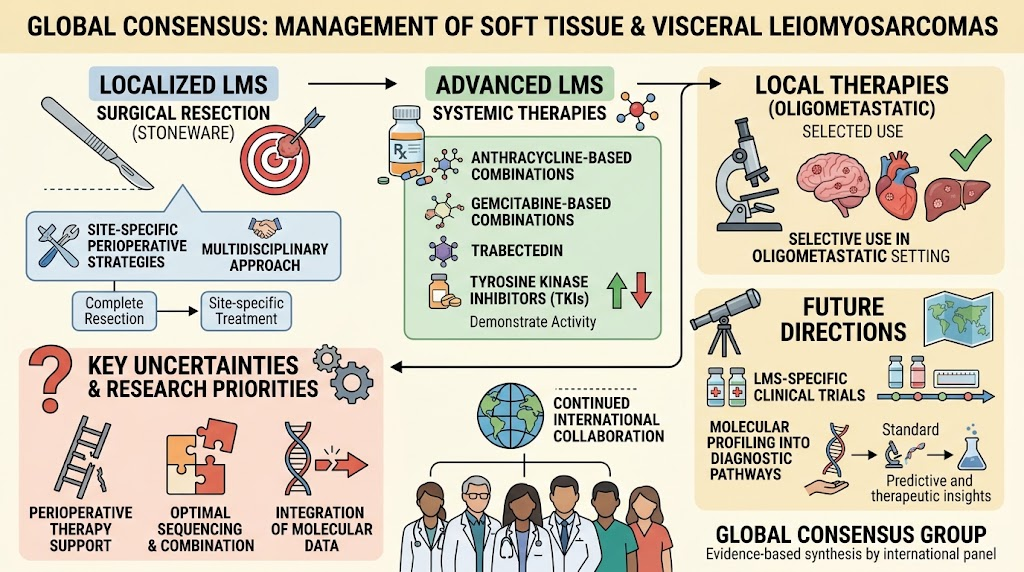
– Multidisciplinary care in specialized sarcoma centers is the foundation of high-quality LMS management and is strongly recommended for all phases: diagnosis, local therapy, systemic treatment and survivorship.
– Site-specific approaches: although principles overlap, perioperative strategies and use of radiotherapy differ by primary site (uterine, retroperitoneal/visceral, extremity/trunk).
– Surgery with negative margins remains the cornerstone for localized disease across sites; the role of neoadjuvant or adjuvant systemic therapy remains uncertain and should be individualized, typically considered for high-risk, large or marginally resectable tumors.
– For advanced/metastatic LMS, doxorubicin-based regimens are the recommended first-line systemic therapy for most patients; other active options include gemcitabine-based combinations (notably for uterine LMS), trabectedin and tyrosine kinase inhibitors (e.g., pazopanib). Optimal sequencing beyond first-line therapy is not established.
– Local therapy (metastasectomy, ablation, stereotactic radiotherapy) has a role in selected patients with oligometastatic disease, particularly for isolated pulmonary, hepatic or soft-tissue metastases.
– Wider implementation of molecular profiling is encouraged in research contexts; actionable alterations remain uncommon but may inform trial enrollment or off-label targeted strategies.
Key takeaways for clinicians
– Refer suspected LMS early to a sarcoma center for coordinated imaging, core biopsy and pathology review.
– Prioritize complete resection with negative margins when feasible; plan the resection in consultation with reconstructive, vascular and other relevant surgeons for complex sites.
– Use systemic therapy judiciously: reserve neoadjuvant/adjuvant chemo for selected high-risk cases; in advanced disease, begin with anthracycline-based therapy, then tailor subsequent lines to prior exposure, comorbidity and LMS subtype.
Updated Recommendations and Key Changes from Previous Guidance
The 2026 consensus updates prior broader sarcoma guidelines by:
– Explicitly separating site-specific recommendations for uterine, retroperitoneal/visceral and extremity LMS rather than generalizing across STS.
– Endorsing stronger multidisciplinary pathways and earlier pathology review to reduce misclassification (LMS can be confused with other spindle-cell tumors).
– Highlighting local therapies (SBRT, ablation, metastasectomy) as legitimate consolidative strategies in oligometastatic LMS when combined with systemic control — a step beyond prior conservative recommendations.
– Emphasizing unmet needs: routine use of broad next-generation sequencing (NGS) is recommended mainly for trial access and to identify rare actionable mutations, not for standard targeted therapy guidance.
Table (bullet format) — What changed vs. prior guidance
– Multidisciplinary care: From recommended to strongly recommended for all patients.
– Perioperative chemotherapy: From sometimes recommended to individualized; consensus emphasizes lack of prospective LMS-specific benefit for most patients.
– Radiotherapy: From broadly recommended in extremity STS to site-specific: strong for extremity/trunk high-grade tumors, limited/individualized for uterine and visceral LMS.
– Molecular profiling: From optional to encouraged for clinical trial enrollment and complex cases; routine therapeutic actionability remains limited.
Topic-by-Topic Recommendations
Diagnosis and staging
– Imaging: CT chest (all patients) plus site-appropriate cross-sectional imaging (contrast-enhanced MRI for extremity/trunk; CT or MRI for pelvic/retroperitoneal/visceral masses). Consider PET-CT selectively.
– Biopsy: Core needle biopsy is the standard for establishing the diagnosis before definitive surgery. Avoid excisional biopsy that may compromise later resection if malignancy is suspected.
– Pathology: Central pathology review at an experienced sarcoma center is strongly recommended. Immunohistochemistry panel should include desmin, smooth muscle actin (SMA), h-caldesmon and others to support smooth muscle differentiation. Molecular testing (NGS panel) is recommended when available, especially for advanced disease and trial enrollment, but routine molecularly matched therapy is not yet standard.
Grading and staging
– Use established sarcoma grading systems (e.g., FNCLCC) and AJCC/UICC staging for prognostication and treatment planning. Tumor size, depth, grade and site remain the dominant prognostic factors.
Local therapy and surgery
– General principle: Aim for complete surgical resection with negative margins (R0) when possible. Preoperative planning should involve appropriate specialties (vascular, urologic, gynecologic, plastic/reconstructive) depending on site.
– Extremity/trunk LMS: Limb-sparing surgery with negative margins is standard. Postoperative radiotherapy is recommended for high-grade or margin-positive tumors to improve local control; preoperative radiotherapy can be considered in select situations.
– Retroperitoneal/visceral LMS: En bloc resection to achieve macroscopic complete resection is the goal. The role of routine radiotherapy is limited; selective preoperative radiation or intraoperative radiation may be considered in centers with expertise.
– Uterine LMS: Total hysterectomy is the standard for localized uterine LMS. Lymphadenectomy is not routinely indicated unless nodes are suspicious. Morcellation should be avoided if malignancy is suspected; incidental LMS discovered after morcellation should prompt specialist referral for re-exploration considerations.
Perioperative systemic therapy
– Consensus: There is no universal recommendation for routine neoadjuvant or adjuvant chemotherapy for resectable LMS. Consider systemic therapy in individually high-risk patients (large, high-grade, close/marginally resectable tumors) after multidisciplinary discussion. Evidence from LMS-specific randomized trials remains limited; decisions should weigh potential benefit in relapse risk reduction against toxicity.
Management of advanced/metastatic LMS
– First-line systemic therapy: Anthracycline-based regimens (doxorubicin alone or in combination when tumor shrinkage is required) remain the recommended first-line option for most patients. Combination with ifosfamide increases response rates but not consistently overall survival and increases toxicity — consider when cytoreduction is needed.
– Second- and later-line options: Gemcitabine plus docetaxel (or gemcitabine alone) is commonly used, particularly in uterine LMS; trabectedin has demonstrated activity in LMS and is preferred in some settings (often after failure of anthracycline-based therapy); pazopanib is an oral tyrosine kinase inhibitor with activity in non-liposarcoma STS, including LMS. Other targeted agents and investigational therapies are accessible via clinical trials.
– Sequencing: There is no consensus ideal sequence beyond first-line therapy; choices should reflect prior exposure, patient performance status, histologic features and patient preference.
– Treatment continuation strategies: Emerging data suggest benefit to continuing some systemic agents until progression and using maintenance strategies in selected patients, but these approaches remain individualized.
Local therapy for metastases
– For patients with isolated or limited metastases (e.g., single lung or liver lesions), metastasectomy, thermal ablation or stereotactic body radiotherapy may be reasonable and potentially curative in selected cases. Decisions should be made by a multidisciplinary team and consider disease-free interval, number and location of metastases, and response to systemic therapy.
Follow-up and survivorship
– Surveillance plans should be risk-adapted. For high-risk resected LMS, follow-up commonly includes clinical evaluation and chest imaging every 3–6 months for the first 2–3 years, then at longer intervals up to 5 years or beyond as clinically indicated. Site-specific imaging (e.g., pelvic MRI for uterine LMS) is used when clinically relevant.
– Survivorship care should include attention to late treatment effects (cardiotoxicity after anthracyclines, renal toxicity from ifosfamide, functional deficits after extensive surgery), psychosocial support and referral to rehabilitation services.
Special populations
– Uterine LMS: Avoid power morcellation when malignancy is suspected; total hysterectomy is standard. The role of fertility-sparing surgery is extremely limited and should be reserved for highly selected cases with thorough counseling and specialist input.
– Pediatric and adolescent patients: Management should be coordinated with pediatric sarcoma teams; histologic and molecular characterization may differ and influence treatment choices.
– Frail patients or those with significant comorbidity: Consider less-intense systemic options, palliative local measures, and focus on quality of life.
Expert Commentary and Insights
Consensus panel perspectives
– Strong agreement that centralization of care improves outcomes: experienced multidisciplinary teams can reduce diagnostic error, optimize surgical planning and increase access to trials.
– There was widespread acknowledgment of the limited LMS-specific randomized evidence to guide perioperative therapy — most recommendations rely on extrapolation from broader STS studies, smaller LMS series and expert opinion.
– On molecular profiling, experts urged routine collection of tumor tissue and consideration of NGS in advanced disease to facilitate trial enrollment, recognizing that actionable alterations in LMS are uncommon.
Key controversies
– Perioperative chemotherapy: Panelists differed on thresholds for offering neoadjuvant/adjuvant chemotherapy (tumor size, grade, site-specific considerations). The consensus emphasizes individualized decision-making and the need for LMS-focused trials.
– Radiotherapy for retroperitoneal LMS: Because randomized data are sparse and surrounding normal structures limit dose, the role of routine RT is controversial; decisions should be made in expert centers.
– Optimal sequencing of systemic agents in advanced disease: No high-level evidence defines an optimal sequence; practice varies internationally based on drug availability, toxicity profiles and clinician experience.
Future directions and research priorities
– LMS-specific randomized trials of perioperative chemotherapy and site-directed strategies (especially for retroperitoneal and uterine disease).
– Biomarker-driven trials to identify predictive molecular features and targeted therapies.
– Prospective studies of local therapies in oligometastatic LMS to define when metastasis-directed treatments improve survival or quality of life.
– Real-world data and registries to capture outcomes across diverse practice settings and support pragmatic trials.
Practical Implications
For clinicians
– Refer patients with suspected LMS to a sarcoma center early. Ensure core biopsy and specialist pathology review before definitive therapy.
– Communicate with patients about the uncertainty around perioperative chemotherapy and the rationale for individualized management.
– Prioritize enrollment in LMS-specific clinical trials when available; where not available, consider referral to regional or national trials.
For health systems
– Strengthen referral pathways to sarcoma centers and support multidisciplinary tumor boards.
– Facilitate access to NGS and biobanking for patients with advanced disease to accelerate biomarker discovery.
Patient perspective
– Shared decision-making is critical: given the limited LMS-specific high-level evidence, patients’ values regarding toxicity, functional outcome and surveillance intensity should guide individualized choices.
Practical Case Vignette
Jane, a 52-year-old woman, presents with a 9-cm deep soft-tissue mass of the thigh on MRI. Core needle biopsy shows high-grade leiomyosarcoma. Multidisciplinary review at a sarcoma center recommends limb-sparing wide resection with goal negative margins and adjuvant radiotherapy given tumor size and high grade. Because the tumor is resectable with anticipated negative margins and data supporting routine benefit of adjuvant chemotherapy in LMS are limited, chemotherapy is not routinely recommended; however, because the tumor is large and high grade, the team discusses the option of perioperative chemotherapy with Jane — including potential benefits and toxicities — and offers clinical trial enrollment if available. Postoperative surveillance focuses on chest CT every 3–6 months for two years and clinical exams with interval MRIs for local surveillance.
References
1. Campos F, Gladdy R, Achee A, et al. Management of Soft Tissue and Visceral Leiomyosarcomas. JAMA Oncol. 2026 Sep 10. PMID: 42720945. https://pubmed.ncbi.nlm.nih.gov/42720945/
2. Casali PG, Abecassis N, Bauer S, et al. Soft tissue and visceral sarcomas: ESMO–EURACAN Clinical Practice Guidelines. Ann Oncol. 2021. (ESMO–EURACAN guidelines for STS — clinical practice resource).
3. NCCN Clinical Practice Guidelines in Oncology (NCCN Guidelines®). Soft Tissue Sarcoma. National Comprehensive Cancer Network. Current version (access via https://www.nccn.org).
4. Judson I, Verweij J, Gelderblom H, et al. (EORTC 62012 and related trials provide data on anthracycline-based chemotherapy regimens in advanced STS; clinicians should consult published randomized trials and guideline summaries for detailed chemotherapy comparative data.)
Note: This article summarizes the 2026 International Leiomyosarcoma Global Consensus and situates it within existing ESMO and NCCN guidance. Because LMS-specific randomized data are limited, many recommendations reflect consensus expert interpretation of current evidence and highlight the need for LMS-specific clinical trials.