Highlight
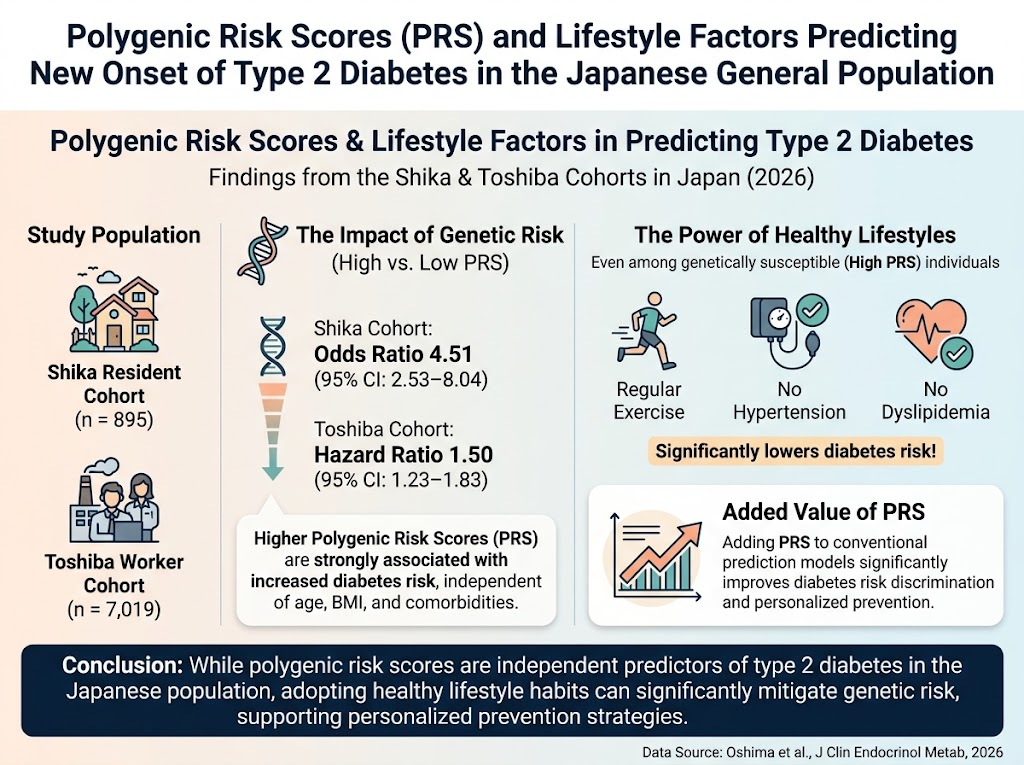
- Polygenic risk scores (PRS) significantly predict type 2 diabetes development in Japanese populations independent of traditional risk factors.
- Healthy lifestyle factors such as regular exercise, and absence of hypertension or dyslipidemia are associated with reduced diabetes risk, even in individuals with high genetic susceptibility.
- Adding PRS to conventional risk prediction models improves diagnostic discrimination for identifying individuals at higher risk of developing diabetes.
Study Background
Type 2 diabetes mellitus (T2DM) represents a major public health burden globally, including in East Asia, where prevalence continues to increase due to aging populations and lifestyle changes. Japanese populations exhibit unique genetic and environmental factors influencing diabetes risk. While conventional risk predictors—such as age, body mass index (BMI), hypertension, and dyslipidemia—are well established, the contribution of polygenic risk scores (PRS), which aggregate genetic susceptibility across multiple variants, remains underexplored in this ethnic group. Integrating PRS with lifestyle factors could provide a more precise risk stratification to guide personalized prevention.
Study Design
This investigation combined two cohorts to examine associations between PRS, lifestyle, and T2DM onset in Japanese adults. The Shika resident cohort (n=895) enabled a cross-sectional evaluation, whereas the Toshiba worker cohort (n=7019) permitted longitudinal risk assessment. PRS were derived from genome-wide association studies (GWAS) targeting East Asian populations and stratified participants into low, intermediate, and high genetic risk groups. Diabetes diagnosis was established by hemoglobin A1c (HbA1c) levels, fasting blood glucose, self-reported diagnosis, or use of antidiabetic medication. Multivariate logistic regression and Cox proportional hazards models assessed the independent and combined effects of PRS and lifestyle factors—including exercise habits, hypertension, and dyslipidemia status—on diabetes risk.
Key Findings
The study revealed a robust association between higher PRS and increased risk of T2DM in both cohorts. In the cross-sectional resident cohort, individuals with high PRS had an odds ratio (OR) of 4.51 (95% confidence interval [CI], 2.53–8.04) for diabetes compared to those with low PRS. Similarly, in the longitudinal worker cohort, high PRS predicted diabetes onset with a hazard ratio (HR) of 1.50 (95% CI, 1.23–1.83). These associations persisted after adjusting for confounders such as age, BMI, and presence of comorbidities.
Importantly, lifestyle factors modified diabetes risk particularly among genetically susceptible individuals. Regular exercise, along with the absence of hypertension or dyslipidemia, correlated with a significant reduction in incident diabetes risk within the high PRS group. This finding underscores the potential of lifestyle modification to mitigate genetic predisposition effects.
Integration of PRS into traditional prediction models enhanced discrimination accuracy for diabetes risk, supporting its potential clinical utility. This improvement suggests that combining genetic and lifestyle data may refine targeting for early intervention and resource allocation.
Expert Commentary
The findings align with growing evidence that polygenic risk contributes meaningfully to diabetes susceptibility across diverse ethnic backgrounds. From a clinical perspective, PRS may serve as an adjunct tool in risk stratification, especially in populations with distinct genetic architectures such as East Asians. However, the moderate effect size and overlap with lifestyle factors indicate PRS should complement, not replace, established risk assessments.
Limitations include the study’s restriction to Japanese cohorts, which may limit generalizability to other ethnicities. Furthermore, lifestyle data were self-reported, potentially introducing bias. Longitudinal studies are desirable to confirm causality and assess how integrating PRS influences clinical decision-making and patient outcomes.
Mechanistically, the multifactorial etiology of T2DM involves gene-environment interactions influencing insulin resistance and β-cell function. PRS capture cumulative genetic susceptibility to these pathophysiological processes. The observed lifestyle effects highlight the plasticity of disease risk, even when genetic susceptibility is elevated.
Conclusion
This study clearly demonstrates that polygenic risk scores are independently associated with type 2 diabetes risk in Japanese populations and enhance prediction beyond traditional clinical risk factors. Nevertheless, healthy lifestyle behaviors remain critically important in reducing diabetes risk, even among individuals with high genetic predisposition. These results advocate for integrating genetic data with lifestyle and clinical metrics to enable personalized risk assessment and targeted prevention interventions in type 2 diabetes.
Implications for Practice and Research
Incorporating PRS into routine diabetes risk screening may help identify high-risk individuals earlier, facilitating timely lifestyle counseling and potential pharmacologic prevention. Future research should explore how best to translate PRS information into actionable clinical strategies, evaluate cost-effectiveness, and examine patient acceptability. Multiethnic studies will also help confirm translatability across populations.
Funding and ClinicalTrials.gov
Funding details were not specified in the abstract. No clinical trial registration was mentioned.
References
Oshima M, Hara A, Toyama T, et al. Polygenic risk scores and lifestyle factors predicting new onset of type 2 diabetes in the Japanese general population. J Clin Endocrinol Metab. 2026 Sep 16;111(10):2890-2899. PMID: 41992540.