Introduction
Functional independence is crucial for maintaining quality of life in older adults and individuals living with chronic health conditions. Assessing a person’s ability to perform extended activities of daily living (EADL) beyond basic self-care tasks helps clinicians and caregivers tailor interventions and monitor progress accurately. Traditional measures, like the original Nottingham Extended Activities of Daily Living scale, have been widely used; however, they may not fully capture contemporary lifestyles and daily activities influenced by modern technology and social changes.
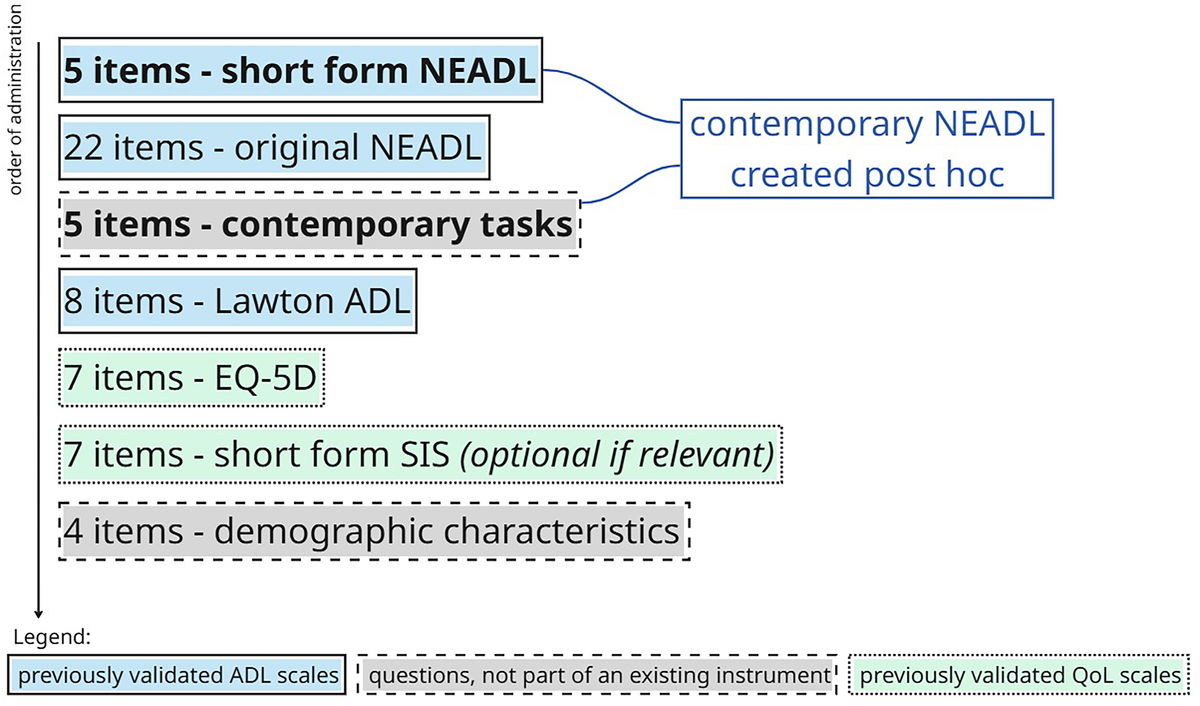
This study aimed to validate a previously described 5-item short-form Nottingham EADL scale and to assess a newly developed Contemporary Extended Activities of Daily Living scale incorporating up-to-date tasks. The goal was to evaluate whether the inclusion of modern, relevant activities would maintain or improve measurement reliability and validity in a mixed population of adults over 60 years with chronic health conditions and their caregivers and healthcare providers.
Methods
An online questionnaire was administered to 712 participants, including adults aged 60 and over who either live with chronic conditions or receive care, as well as caregivers and healthcare professionals. This mixed sample ensured diverse perspectives on functional activities. Participants completed the original 22-item Nottingham scale, the 5-item short-form Nottingham EADL, and the novel Contemporary EADL scale, which incorporated tasks reflecting current societal and technological norms.
Statistical analysis focused on evaluating internal consistency using Cronbach’s alpha, and criterion and convergent validity through Spearman’s correlations. These analyses compared the short-form and contemporary scales against the original Nottingham EADL and quality of life scores measured by the European Quality of Life 5-dimension (EQ-5D) scale.
Results
Both the 5-item short-form Nottingham EADL scale and the novel Contemporary EADL scale demonstrated good internal consistency with Cronbach’s alpha values of 0.84 (95% CI: 0.82-0.86) and 0.88 (95% CI: 0.87-0.89), respectively, indicating reliable measurement within each scale. The short-form Nottingham scale displayed excellent concurrent validity with the original Nottingham scale (rs = 0.82, p < .001). The contemporary activities included in the new scale were all individually correlated with the original Nottingham scale items, reinforcing their relevance.
The full Contemporary EADL scale showed strong concurrent validity (rs = 0.78, p < .001) compared to the original scale. Both scales also correlated moderately with quality of life measures: short-form Nottingham scale (rs = 0.68, p < .001) and Contemporary EADL scale (rs = 0.56, p ≤ .001), supporting construct validity that relates functional independence to overall wellbeing.
Discussion
The findings support that updating functional independence measures to include contemporary activities does not diminish the reliability or validity of the assessment tool. Including modern tasks—such as the use of technology, managing finances digitally, or social communication through current platforms—better reflects everyday challenges faced by older adults today. This may enhance the perceived relevance and acceptance of such scales among patients and clinicians.
Current tools like the Nottingham EADL have served well but may underrepresent activities impacted by technological and cultural shifts. This study’s Contemporary EADL scale bridges this gap, supporting holistic assessment that accounts for diverse activity patterns across populations with chronic diseases and aging adults.
However, future research should explore larger samples with wider demographic diversity and longitudinal monitoring to confirm the scale’s responsiveness to changes over time and its utility across different care settings.
Clinical Implications
Clinicians and healthcare providers assessing functional independence in older adults should consider integrating contemporary activities into evaluations to capture a comprehensive picture of patients’ abilities. This approach can guide more personalized care plans focusing on enabling independence in both traditional and modern daily tasks. Furthermore, caregivers and rehabilitation specialists can tailor interventions to address specific deficits identified by this broader assessment.
Conclusions
Our initial validation study demonstrates that a Contemporary Extended Activities of Daily Living scale incorporating modern tasks maintains strong psychometric properties and meaningful relationships with established quality of life measures. Incorporating up-to-date activities into functional assessments is an important step toward modernizing tools that reflect contemporary lifestyles in aging populations and chronic disease management.
Ongoing research should further refine these scales, ensuring cultural adaptability and sensitivity to the evolving nature of daily life, thereby enhancing the relevance and impact of functional independence measurement in clinical practice and research.