Highlight
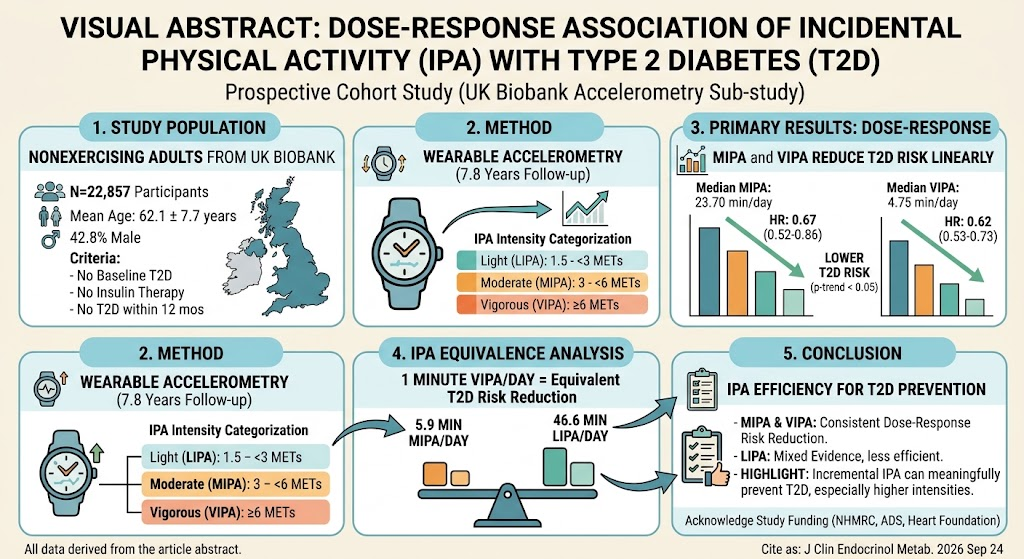
1. Moderate- and vigorous-intensity incidental physical activities (IPA), measured objectively by wearable accelerometers, are inversely associated with type 2 diabetes (T2D) risk in a dose-dependent manner among UK adults who self-report as nonexercisers.
2. One minute of vigorous-intensity IPA provides equivalent T2D risk reduction to approximately 6 minutes of moderate-intensity or 47 minutes of light-intensity IPA, highlighting the greater efficiency of higher-intensity incidental activities.
3. Light-intensity IPA alone, despite being linked to some risk reduction at median levels, does not exhibit a consistent dose-response relationship with T2D incidence.
Study Background
Type 2 diabetes mellitus (T2D) presents a significant and growing global public health challenge, contributing to increased morbidity and mortality through its complications. Physical activity (PA) is a well-established modifiable risk factor for T2D. While structured exercise is known to confer protection, much less is understood about incidental physical activity (IPA)—unplanned, everyday movements performed throughout the day—and how its intensity levels relate to diabetes risk.
Prior studies predominantly relied on self-reports and often conflated structured exercise with incidental activity. Given the widespread adoption of wearable accelerometers, opportunities have expanded to quantify intensity-specific incidental physical activity objectively and examine its direct association with T2D risk over time.
Study Design
This prospective cohort study utilized data from the UK Biobank accelerometry sub-study, which involved a large sample of middle-aged to older adults. Participants included were those who self-identified as nonexercisers at baseline to specifically focus on incidental rather than planned physical activity. Individuals with prevalent T2D, insulin use, or T2D diagnoses within 12 months of baseline were excluded to minimize reverse causation.
Incidental physical activity was measured by wrist-worn accelerometers and categorized based on metabolic equivalent task (MET) values into light-intensity (1.5 to <3 METs, LIPA), moderate-intensity (3 to <6 METs, MIPA), and vigorous-intensity (≥6 METs, VIPA) activity. The primary endpoint was incident T2D obtained mainly from linked primary care records over a median follow-up of 7.8 years.
The reference group consisted of participants engaging in neither moderate- nor vigorous-intensity IPA, allowing evaluation of relative risk reductions across activity intensities. Dose-response relationships and equivalence between activity intensities regarding T2D risk reduction were calculated.
Key Findings
The final analytic cohort included 22,857 nonexercisers with a mean age of 62.1 years, of whom 42.8% were male. During follow-up, 721 participants (3.2%) developed T2D.
Statistical analyses demonstrated a near-linear inverse relationship between T2D incidence and the amount of moderate (MIPA) and vigorous (VIPA) IPA accumulated. Specifically, the median daily duration of vigorous IPA (approximately 4.75 minutes) was associated with a 38% lower risk of developing T2D (hazard ratio [HR] 0.62, 95% confidence interval [CI] 0.53–0.73). Similarly, median moderate IPA (23.7 minutes/day) corresponded to a 33% risk reduction (HR 0.67, 95% CI 0.52–0.86).
In contrast, light-intensity IPA, despite linkage with reduced risk at median levels, did not show a consistent dose-dependent effect across the range of activity.
Quantitatively, one minute of vigorous IPA per day equated, in terms of T2D risk reduction, to roughly 5.9 minutes of moderate IPA or 46.6 minutes of light IPA, emphasizing the disproportionately greater metabolic impact of higher-intensity movement even when incidental.
Expert Commentary
This study robustly highlights the protective dose-dependent effects of intensity-specific incidental physical activity against T2D incidence in a population typically categorized as physically inactive. The use of objective accelerometer data helps overcome biases inherent in self-reported PA assessments, offering more precise quantification of actual daily movement.
The findings reinforce current public health recommendations that emphasize not only increasing total physical activity but also incorporating higher-intensity activities to maximize metabolic health benefits. Given that these activities were incidental rather than structured exercise, the results suggest achievable lifestyle changes such as brisk walking or climbing stairs could significantly reduce T2D risk.
Limitations include a focus on older adults within the UK Biobank, which may limit generalizability to younger or more diverse populations. Also, while residual confounding cannot be excluded, the strength and dose-dependence of associations support a likely causal relationship.
Conclusion
This prospective wearable-based cohort study provides compelling evidence that moderate and vigorous incidental physical activities substantially lower type 2 diabetes risk in a dose-dependent manner, even among self-reported nonexercisers. Vigorous IPA confers greater per-minute benefits relative to lower intensities, highlighting the potential value of promoting incidental, intensity-varied movements in daily living for diabetes prevention.
Future research should explore these associations in broader, more diverse cohorts and investigate mechanistic pathways linking incidental intensity-specific activity with glucose homeostasis. Clinicians should consider counseling patients on incorporating incidental higher-intensity activities as viable interventions to mitigate T2D risk.
Funding and ClinicalTrials.gov
The study did not specify funding sources or clinical trial registration within the published abstract. Further details may be accessed via the full publication or UK Biobank database.
References
Sabag A, Biswas RK, Koemel NA, et al. The dose-response association between wearables-quantified incidental physical activity and type 2 diabetes: a prospective cohort study. J Clin Endocrinol Metab. 2026 Sep 24; PMID: 42784530. https://pubmed.ncbi.nlm.nih.gov/42784530/
Colberg SR, et al. Physical activity/exercise and diabetes: a position statement of the American Diabetes Association. Diabetes Care. 2016 Nov;39(11):2065-2079.
Byrne NM, Hills AP, Hunter GR, et al. Metabolic equivalents: one size does not fit all. J Sports Sci Med. 2011 Sep;10(3):471-8.