Highlights
- In utero exposure to maternal preexisting or gestational diabetes significantly elevates offspring diabetes risk, with higher hazard ratios observed in First Nations populations compared to non-First Nations.
- Periconception glycemic control, as indicated by lower maternal HbA1c, is associated with a reduction in offspring diabetes incidence among women with preexisting diabetes.
- Evidence from large population-based cohorts spanning over two decades reinforces the importance of early preventive interventions and tailored maternal diabetes management strategies to mitigate intergenerational diabetes transmission.
- These findings emphasize the need for culturally engaged healthcare approaches and policy frameworks targeting high-risk populations such as First Nations communities.
Background
Diabetes mellitus poses a global public health challenge, with increasing prevalence across all age groups, including children and young adults. The intergenerational transmission of diabetes risk related to maternal hyperglycemia during pregnancy has emerged as a critical area of investigation, particularly within populations exhibiting disproportionate diabetes burdens such as First Nations peoples in Canada. Gestational diabetes mellitus (GDM) and preexisting maternal diabetes confer exposure to a hyperglycemic intrauterine environment, fostering metabolic programming that predisposes offspring to early onset of diabetes, predominantly type 2 diabetes (T2D). Understanding the magnitude of risk and modifiable factors such as periconception glycemic control is essential to develop effective interventions and reduce health disparities.
Key Content
Longitudinal Population-Based Evidence: The 2026 Retrospective Cohort Study by Shah et al.
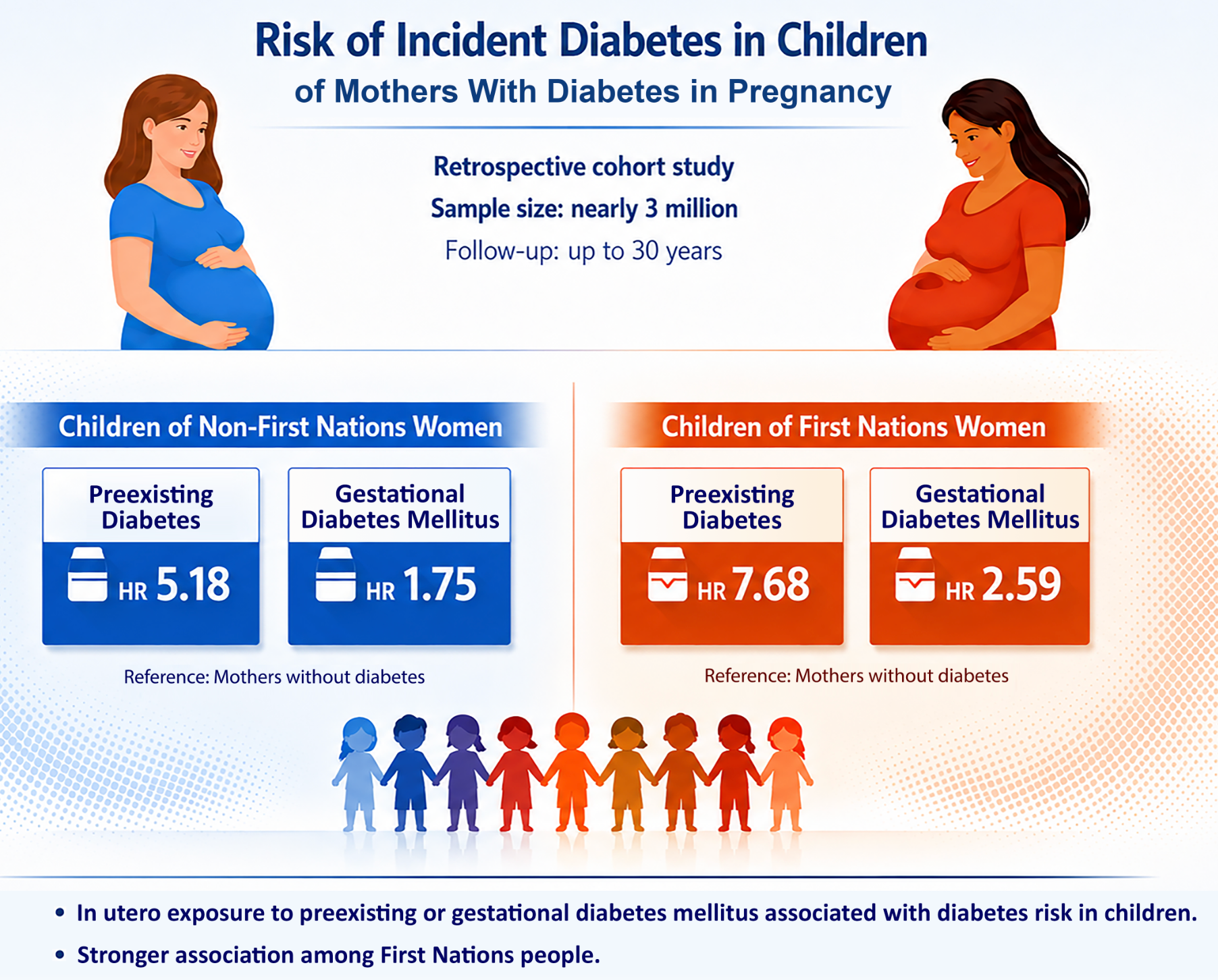
A landmark First Nations-engaged and -co-led retrospective cohort study analyzed administrative healthcare data encompassing 2,851,583 children born between April 1994 and March 2016 to mothers aged 12-49 years. Median follow-up age was 16 years. This study uniquely stratified risk by maternal diabetes status and ethnicity (First Nations versus non-First Nations).
– Children born to non-First Nations mothers with preexisting diabetes exhibited an adjusted hazard ratio (HR) of 5.18 (95% CI 4.82-5.57) for incident diabetes, compared to children of non-diabetic mothers; for those with maternal GDM exposure, the HR was 1.75 (1.65-1.84).
– Among First Nations offspring, these HRs were notably higher: 7.68 (5.91-9.98) for preexisting diabetes and 2.59 (2.07-3.24) for GDM, reflecting a stronger association.
– Importantly, within mothers with preexisting diabetes, each 1% (11 mmol/mol) decrement in periconception HbA1c correlated with an 11% reduction in offspring diabetes risk (HR 0.89, 95% CI 0.80-0.995, P=0.04), highlighting the benefit of glycemic control before conception.
This robust evidence underscores the significant independent effects of preexisting diabetes and GDM on offspring diabetes risk and confirms a dose-response relationship with maternal glycemic control.
Supporting Cohort Studies from Manitoba, Canada
Earlier studies from the Manitoba population-based repositories provide complementary insights:
1. **Dabelea et al. (2018, JAMA Pediatrics)**
– Analyzed 467,850 mother-infant dyads with follow-up to approximately 18 years.
– Demonstrated type 2 diabetes exposure conferred higher offspring risk compared with GDM.
– No significant interaction was seen between First Nations status and diabetes type, but First Nations offspring had a markedly higher incidence rate and earlier onset of T2D.
2. **Schmidt et al. (2016, Diabetes Care)**
– Examined 321,008 births with 15 years median follow-up.
– Both GDM exposure and First Nations status were independently associated with a 3- to 5-fold increased hazard of early-onset T2D in offspring.
– No synergistic interaction identified, though First Nations status exerted a stronger influence.
These studies reinforce the notion that in utero hyperglycemic exposure is a modifiable risk factor influencing diabetes risk trajectories, especially important where indigenous populations exhibit higher baseline prevalence.
Mechanistic Insights and Biological Rationale
The pathogenesis underlying increased offspring diabetes risk involves fetal programming in a hyperglycemic milieu, leading to altered insulin secretion and action, epigenetic modifications, and disrupted β-cell development. Chronic exposure to maternal hyperglycemia also affects adipose tissue distribution and mitochondrial function in offspring, fostering insulin resistance. The stronger associations seen in First Nations populations plausibly reflect genetic predispositions compounded by socioeconomic and environmental determinants.
Clinical and Public Health Implications
– **Periconception Glycemic Control:** The association of lower periconception HbA1c with reduced offspring diabetes risk advocates for preconception screening and optimization of glucose levels in women with preexisting diabetes.
– **Early Pregnancy Screening:** Recognizing that GDM diagnosis often occurs in mid to late pregnancy, strategies to identify and manage hyperglycemia earlier could mitigate fetal exposure.
– **Culturally Adapted Interventions:** Engaging First Nations communities in co-designed healthcare programs is crucial to address systemic disparities and facilitate effective diabetes prevention.
– **Longitudinal Follow-Up:** Offspring with in utero exposure require targeted monitoring for early signs of dysglycemia.
Expert Commentary
The accumulating evidence firmly establishes maternal diabetes status during pregnancy as a potent determinant of offspring diabetes risk with critical implications for intergenerational health. The marked differences in hazard ratios among First Nations versus non-First Nations populations underscore the intersection of biological vulnerability and social determinants. While the retrospective cohort designs limit causal inference, the size, longitudinal nature, and comprehensive ethnic stratification provide compelling data for clinical action. Challenges remain in standardizing and implementing preconception care broadly, especially in marginalized populations.
From a translational perspective, the findings align with developmental origins of health and disease (DOHaD) models, reinforcing interventions aimed at maternal metabolic health before and during pregnancy. Integration of genetic, epigenetic, and environmental data may further elucidate susceptibility pathways. To optimize outcomes, clinical guidelines should emphasize preconception care in diabetes management protocols and prioritize resource allocation for high-risk Indigenous groups.
Conclusion
Cumulative evidence establishes that in utero exposure to preexisting diabetes or GDM significantly elevates the risk of diabetes in offspring, with disproportionately higher risks among First Nations children. Importantly, improved periconception glycemic control attenuates this risk, offering a viable intervention point. These insights necessitate enhanced screening programs, culturally tailored preventive strategies, and longitudinal follow-up of exposed offspring to reduce the intergenerational diabetes burden.
Future research should focus on prospective interventions to improve maternal glycemic control preconceptionally, mechanistic studies elucidating population-specific susceptibilities, and policy-driven efforts to address sociocultural barriers in Indigenous healthcare settings.
References
- Shah BR, Odugbemi T, Li Z, Stewart C, Green ME, Jones CR, Walker JD, Wicklow B. In Utero Exposure to Preexisting or Gestational Diabetes Mellitus Increases Incidence of Diabetes in the Children of First Nations and Non-First Nations Mothers: A Retrospective Cohort Study. Diabetes Care. 2026 Oct 1;49(10):1821-1827. PMID: 42536661.
- Dabelea D, McIntyre HD, et al. Association of Gestational Diabetes and Type 2 Diabetes Exposure In Utero With the Development of Type 2 Diabetes in First Nations and Non-First Nations Offspring. JAMA Pediatr. 2018 Aug 1;172(8):724-731. PMID: 29889938.
- Schmidt M, et al. Exposure to Gestational Diabetes Mellitus: Impact on the Development of Early-Onset Type 2 Diabetes in Canadian First Nations and Non-First Nations Offspring. Diabetes Care. 2016 Dec;39(12):2240-2246. PMID: 27703026.