Highlight
- Brepocitinib, a selective TYK2 and JAK1 inhibitor, significantly improves cutaneous sarcoidosis (CS) activity scores within 16 weeks compared with placebo.
- The 45 mg dose showed a dose-dependent clinical benefit, with marked improvements across stringent response criteria including skin clearance.
- The treatment was effective even in difficult-to-treat CS subtypes such as lupus pernio despite discontinuation of glucocorticoids.
- Brepocitinib was well tolerated with no serious adverse events reported in the study duration.
Study Background
Cutaneous sarcoidosis (CS) is a chronic, granulomatous inflammatory skin disease characterized by a wide spectrum of lesions. It often causes substantial morbidity and adversely impacts patients’ quality of life. Currently, there are no therapies approved specifically for CS, and treatment options often rely on systemic glucocorticoids or immunosuppressants that carry significant side effects and variable efficacy. Consequently, there remains an unmet medical need for safe and effective targeted therapies that can provide clinically meaningful improvements in skin lesions and patient-reported outcomes.
Study Design
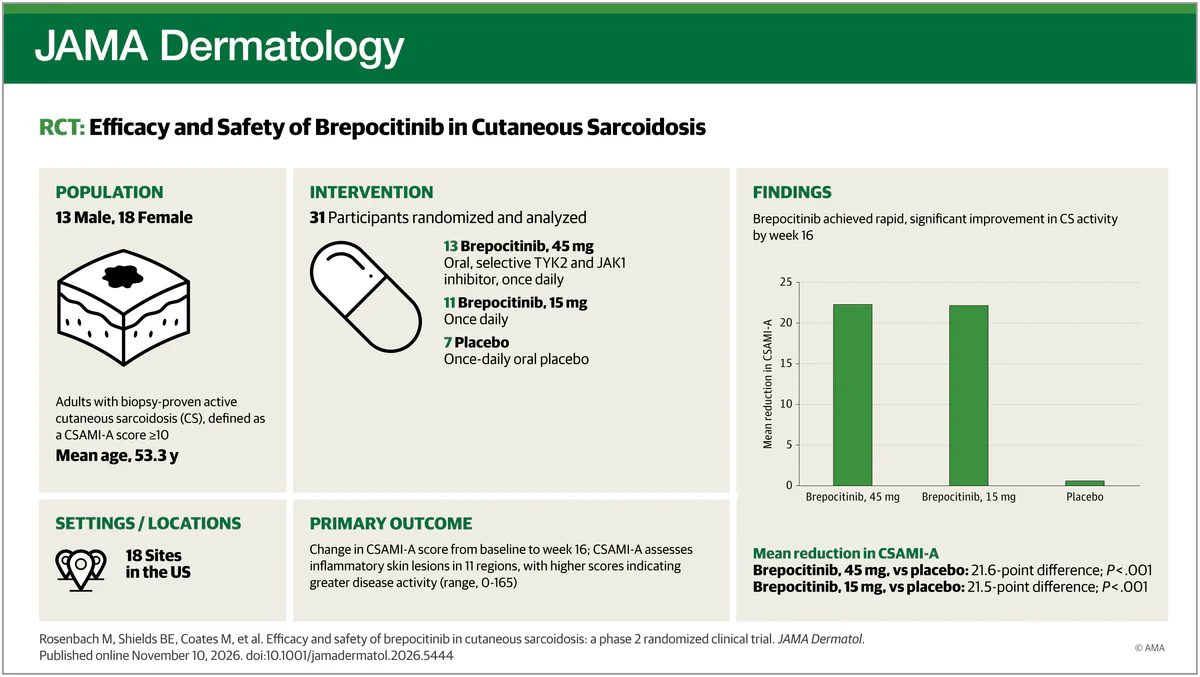
The BEACON trial is a global, multicenter, randomized, double-blind, placebo-controlled phase 2/3 study evaluating brepocitinib, an oral, selective tyrosine kinase 2 (TYK2) and Janus kinase 1 (JAK1) inhibitor, in adults with biopsy-proven active cutaneous sarcoidosis. This prespecified interim analysis focuses on the 16-week, dose-ranging phase 2 portion conducted between April and July 2025.
A total of 31 participants (mean age 53.3 years, 58% female) were randomized 3:2:2 to receive brepocitinib 45 mg, brepocitinib 15 mg, or placebo once daily. The primary endpoint was the change from baseline in the Cutaneous Sarcoidosis Activity and Morphology Instrument-Activity (CSAMI-A) score at week 16. Secondary endpoints included rates of achieving clear or almost clear skin on Cutaneous Sarcoidosis Activity-Investigator Global Assessment (CSA-IGA), various CSAMI-A response thresholds, patient-reported outcomes, and safety assessments.
Key Findings
Both doses of brepocitinib led to rapid and statistically significant improvement in CS activity compared with placebo. At week 16, the mean improvement in CSAMI-A was 22.3 points in the 45 mg group and 22.2 points in the 15 mg group versus only 0.7 points with placebo (P < .001). This robust improvement indicates a substantial reduction in skin lesion activity and severity.
More stringent clinical response endpoints further demonstrated superiority of brepocitinib, particularly the 45 mg dose, consistent with a dose-dependent effect:
- CSA-IGA clear or almost clear: 69.2% (45 mg) vs 0% (placebo), P = .01
- CSAMI-A response (≥50% improvement): 76.9% vs 0%, P = .003
- ≥10-point reduction in CSAMI-A score: 100% vs 14.3%, P < .001
- Achievement of CSAMI-A score < 5: 61.5% vs 0%, P = .005
Importantly, treatment benefits extended to challenging disease phenotypes such as lupus pernio, even after mandatory discontinuation of systemic glucocorticoids, underscoring brepocitinib’s potential as a steroid-sparing agent. Participants also reported significant improvements in skin-related quality of life.
Regarding safety, no deaths or serious adverse events were reported during the study. Brepocitinib was generally well tolerated at both doses.
Expert Commentary
The BEACON phase 2 results mark a significant milestone as the first randomized, placebo-controlled trial demonstrating the efficacy of a targeted kinase inhibitor in cutaneous sarcoidosis. The dual TYK2/JAK1 inhibition mechanism is biologically plausible given the central role of cytokine signaling pathways mediated through these kinases in granulomatous inflammation and sarcoidosis pathogenesis.
While the sample size is modest and the interim nature of the analysis warrants cautious interpretation, the magnitude and consistency of dose-dependent clinical responses across multiple endpoints are encouraging. These data support brepocitinib as a potential steroid-sparing therapeutic option that addresses a key unmet need in dermatologic and systemic sarcoidosis.
Future phase 3 data with larger cohorts and longer follow-up will be pivotal to confirm long-term efficacy, safety, and impact on systemic manifestations. Additionally, mechanistic studies may further elucidate how JAK/STAT pathway modulation can modulate granulomatous skin inflammation.
Conclusion
Brepocitinib demonstrated rapid, dose-dependent, and clinically meaningful improvements in cutaneous sarcoidosis activity with a favorable safety profile in this phase 2 trial. As the first targeted therapy to show efficacy in this indication, brepocitinib offers hope for a new precision medicine approach in treating cutaneous sarcoidosis, addressing a significant unmet clinical need.
Pending confirmatory phase 3 results, selective TYK2/JAK1 inhibition may become an important addition to therapeutic strategies for patients suffering from this persistent and often debilitating skin disease.
Funding and Clinical Trial Registration
The BEACON study was funded and sponsored by the brepocitinib manufacturer and conducted globally across multiple centers. Trial registration number is ClinicalTrials.gov Identifier: NCT06978725.
References
- Rosenbach M, et al. Efficacy and Safety of Brepocitinib in Cutaneous Sarcoidosis: A Phase 2 Randomized Clinical Trial. JAMA Dermatol. 2026 Nov 10; PMID: 43008126.
- Baughman RP, et al. Sarcoidosis. Lancet. 2003;362(9387):1113–22.
- Chen ES, Moller DR. Sarcoidosis—scientific progress and clinical challenges. Nat Rev Rheumatol. 2011 Aug 16;7(8):457-67.
Specialty calculators
For clinical reference; use professional judgment.