Highlight
1. Minimal ultrasound (US) findings, particularly tendon sheath involvement, precede Doppler-active synovitis in ACPA-positive individuals with musculoskeletal symptoms without clinical arthritis.
2. Presence of US findings at baseline is associated with a threefold increased risk of developing clinical arthritis within three years.
3. Tendon involvement combined with IgM rheumatoid factor positivity further amplifies arthritis risk.
4. Longitudinal monitoring reveals a progressive accumulation of presynovitis findings prior to overt clinical arthritis.
Study Background
Rheumatoid arthritis (RA) is a chronic systemic autoimmune disease characterized by synovial inflammation leading to joint destruction and disability. Early diagnosis and intervention are critical to improving long-term outcomes. ACPA (anticitrullinated protein antibody) positivity in asymptomatic individuals or those with musculoskeletal symptoms signifies increased risk for RA development. Identifying early preclinical stages is a major unmet need to enable timely preventive therapies.
Conventional clinical examination often detects RA only after overt synovitis with active inflammation. Ultrasound is increasingly used to detect subclinical synovial changes including synovial thickening and power Doppler signals reflecting active synovitis. However, features preceding Doppler-active synovitis, corresponding to a stage termed “presynovitis,” remain poorly defined and their prognostic significance unclear.
Study Design
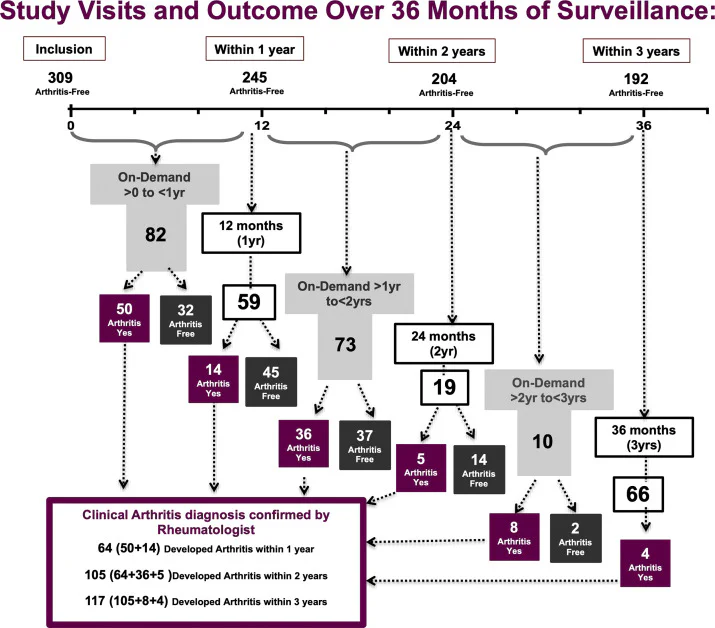
This prospective cohort study enrolled 309 ACPA-positive individuals with musculoskeletal symptoms but no clinical arthritis or power Doppler synovitis at baseline. Participants underwent systematic ultrasound evaluation at inclusion and longitudinally. Ultrasound features assessed included minimal synovial thickening, tendon sheath involvement, bursal effusions, and cortical bone irregularities. Serological markers measured were anti-cyclic citrullinated peptide 2 IgG and IgM rheumatoid factor.
The primary endpoint was the development of clinical arthritis fulfilling the 2010 ACR/EULAR criteria within 3 years. Statistical analyses included Cox proportional hazards and logistic regression to assess associations between baseline US findings and arthritis progression.
Key Findings
Over a median follow-up of 13 months, 38% (117/309) of participants developed clinical arthritis; 83% of these met formal RA classification criteria. Baseline presence of any minimal ultrasound abnormality was found in 24% (75/309) of individuals.
Individuals with any US finding at baseline had a significantly increased risk of developing clinical arthritis, with a hazard ratio (HR) of 3.3 (95% confidence interval [CI] 2.3-4.8). Among US parameters, tendon sheath involvement showed the strongest predictive association (HR 3.6, 95% CI 2.4-5.4). Notably, combining tendon involvement with IgM RF positivity increased risk further (HR 4.2, 95% CI 2.7-6.4).
Longitudinal analysis demonstrated a gradual accumulation of US-defined presynovitis features over time preceding arthritis onset, whereas nonprogressors rarely showed these changes. Tendon involvement frequently appeared before synovial thickening and Doppler activity, suggesting a temporal sequence in inflammatory initiation.
Expert Commentary
This study provides compelling evidence that subtle US changes precede clinically evident inflammatory arthritis in ACPA-positive individuals and represent a distinct presynovitis phase. These findings build upon previous research suggesting a preclinical RA phase identifiable by imaging modalities.
The strong predictive value of tendon sheath involvement, particularly in the context of seropositivity for IgM RF, underscores tendon inflammation as an early pathogenic event in RA development. This may reflect the importance of entheses and peritendinous tissue as initial targets in autoimmunity.
From a clinical perspective, targeting individuals based on these US markers could refine risk stratification and support early intervention trials aiming to prevent RA onset. However, generalizability remains to be validated in larger multiethnic cohorts, and integration with other biomarkers and clinical features is warranted.
Conclusion
The Karolinska Risk-RA cohort study identifies ultrasound-defined minimal synovial and tendon sheath abnormalities, constituting presynovitis, as strong predictors for progression to clinical arthritis in ACPA-positive high-risk individuals. Incorporation of ultrasound into early risk assessment may enhance timely diagnosis and facilitate preventive strategies for rheumatoid arthritis.
Funding and Clinical Trials Registration
Details on funding sources and clinical trial registration were not provided in the abstract. Full text should be consulted for this information.
References
- Kisten Y, Cîrciumaru A, Dehara M, et al. Ultrasound-defined presynovitis is associated with progression to clinical arthritis in ACPA-positive individuals at risk of rheumatoid arthritis: longitudinal insights from the Karolinska Risk-RA cohort. Ann Rheum Dis. 2026;85(11):2107-2118. PMID: 42471275.
- Naredo E, Möller I, Cruz A, et al. Power Doppler ultrasound positivity predicts arthritis development in patients with clinically suspect arthralgia. Semin Arthritis Rheum. 2015;44(6):732-739.
- van Boheemen L, van den Broek M, Bos WH. Imaging and biomarker combinations increase prediction of arthritis in seropositive arthralgia patients. Rheumatology (Oxford). 2020;59(10):2828-2836.
Specialty calculators
For clinical reference; use professional judgment.