Highlight
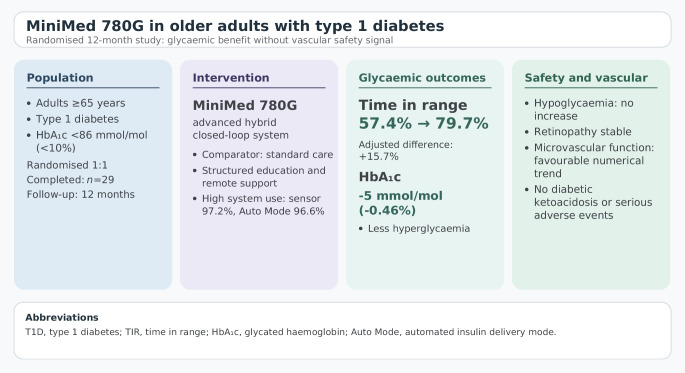
- The MiniMed 780G system significantly increased time in range and reduced HbA1c in adults aged ≥65 years with type 1 diabetes over 12 months.
- Improvements in glycaemic control were achieved without increasing hypoglycaemia risk or serious adverse events.
- There was a numerical, although statistically non-significant, trend toward improved microvascular function after MiniMed 780G implementation.
- Retinal vascular status remained stable, indicating no short-term vascular deterioration with this advanced therapy in an older population.
Study Background
Type 1 diabetes mellitus (T1DM) in older adults presents distinct clinical challenges due to the combination of long disease duration, increased comorbidity burden, and heightened vulnerability to hypoglycaemia and vascular complications. Optimal glycaemic management remains critical but difficult, particularly as hypoglycaemia risk increases and glucose variability often worsens with age. Hybrid closed-loop insulin delivery systems represent a transformative advancement, automating insulin delivery and improving glycaemic metrics in many populations; however, evidence in adults aged 65 years or older is limited. This study addresses a crucial knowledge gap by evaluating metabolic and vascular outcomes after transitioning to the MiniMed 780G system in this understudied demographic.
Study Design
This open-label, single-centre, randomised controlled trial enrolled 34 adults aged ≥65 years with T1DM and baseline HbA1c below 86 mmol/mol (10%), all naïve to hybrid closed-loop technology. Participants were randomized 1:1 to either advanced hybrid closed-loop (AHCL) therapy using the MiniMed 780G system or standard therapy (either multiple daily injections or continuous subcutaneous insulin infusion). Glycaemic outcomes and vascular status were assessed over a 12-month follow-up period. The primary endpoint was glycaemic management quantified by time in range (TIR, 70–180 mg/dL). Secondary outcomes included detailed glycaemic metrics, safety endpoints, and assessments of vascular function using post-occlusive reactive hyperaemia (microvascular function) and retinal vascular imaging analyzed via artificial intelligence.
Key Findings
Of 34 randomized participants, 29 completed the study. Baseline characteristics, including glycaemic control parameters, were similar between groups. The AHCL group demonstrated a marked and sustained improvement in glucose regulation, with TIR increasing significantly from 57.4% at baseline to 79.7% at 12 months (p<0.001). Between-group adjusted differences favored AHCL for TIR by 15.7% (95% CI 8.6–22.6) and for HbA1c by -5 mmol/mol (-0.46%, 95% CI -0.89% to -0.04%). Notably, the improvements did not come at the expense of safety, with no increase in hypoglycaemia, diabetic ketoacidosis, or severe hypoglycaemia events reported.
Glycaemic excursions above the target range, measured both as time above range (TAR) and higher-level hyperglycaemia, also decreased significantly (nominal p0.05), it hints at beneficial vascular effects following improved glycaemic management. Retinal vascular status, evaluated with sophisticated AI analysis, remained stable over 12 months in both eyes, confirming no adverse vascular remodeling.
Expert Commentary
This study fills a critical evidence gap by demonstrating the efficacy and safety of the MiniMed 780G system in a population traditionally underrepresented in clinical trials — older adults with longstanding T1DM and multiple comorbidities. The robust improvement in TIR and HbA1c without increased hypoglycaemia risk confirms the therapeutic potential of hybrid closed-loop systems even in more vulnerable elderly populations.
The lack of statistically significant vascular improvements may reflect the small sample size, relatively short duration for detecting microvascular changes, or stable baseline vascular function in this cohort. Nonetheless, the observed trend toward improved microvascular function aligns with the biological plausibility that optimized glycaemic control can positively impact endothelial health. This is clinically relevant as microvascular complications substantially contribute to morbidity in T1DM.
Limitations include single-centre design, modest sample size, and open-label nature, which may limit generalizability and introduce bias. Despite this, the consistency of glycaemic improvements and safety profile strongly supports the clinical value of MiniMed 780G. Future larger, multicenter studies with longer follow-up are warranted to conclusively establish vascular benefits and assess impacts on macrovascular outcomes and quality of life.
Conclusion
The MiniMed 780G system is an effective and safe option to improve glycaemic management in adults aged 65 years and older with type 1 diabetes, achieving meaningful increases in time in range and reductions in HbA1c without increasing hypoglycaemia risk. Early indications of favorable microvascular function changes, though not statistically significant, are encouraging and warrant further investigation. These findings support expanding access to advanced closed-loop technologies for older adults to enhance metabolic control and potentially mitigate vascular complications.
Funding and Trial Registration
This research was registered under ClinicalTrials.gov (NCT06207838). Funding sources were not specified in the provided data.
References
1. Matejko B, Cyranka K, Suduł P, et al. Metabolic and vascular outcomes after transition to the MiniMed 780G system in adults ≥65 years with type 1 diabetes: a randomised, single-centre study. Diabetologia. 2026 Jun 25;69(9):2421-2431. PMID: 42347980.
2. Beck RW, Riddlesworth T, Ruedy K, et al. Effect of continuous glucose monitoring on glycemic control in adults with type 1 diabetes using insulin injections: the DIAMOND randomized clinical trial. JAMA. 2017;317(4):371-378.
3. Heinemann L, Freckmann G. CGM versus FGM; or, continuous glucose monitoring is not flash glucose monitoring. J Diabetes Sci Technol. 2015;9(5):947-950.
4. Battelino T, Danne T, Bergenstal RM, et al. Clinical targets for continuous glucose monitoring data interpretation: recommendations from the international consensus on time in range. Diabetes Care. 2019 Aug;42(8):1593-1603.
5. Moser EG. Epidemiology and challenges in older adults with type 1 diabetes. Diabetes Spectr. 2020;33(1):31-36.