Highlight
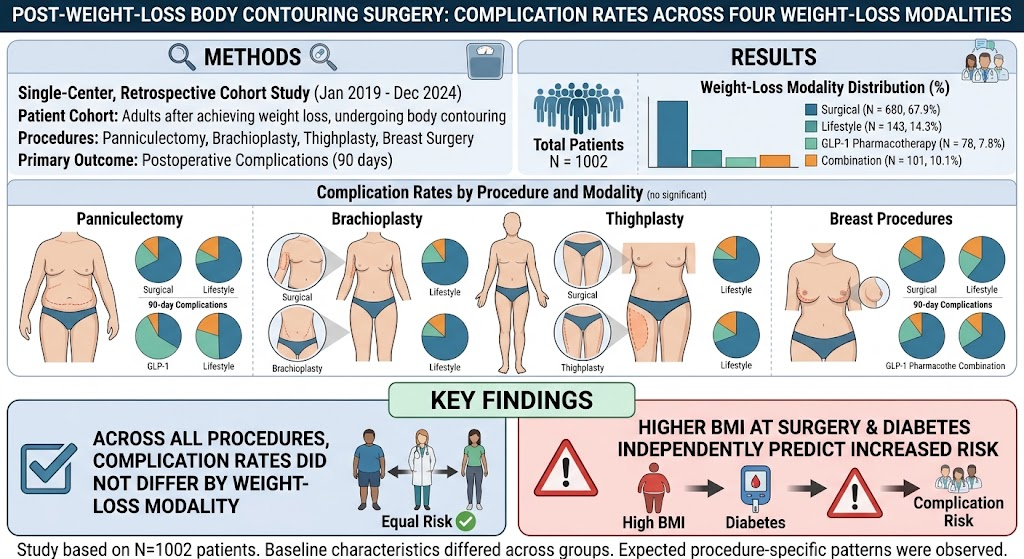
This study analyzed postoperative complication rates in 1002 patients undergoing body-contouring procedures after weight loss achieved by different modalities: bariatric surgery, injectable glucagon-like peptide-1 receptor agonists (GLP-1 RAs), combination therapy, or lifestyle modification. The key findings include:
- Complication rates within 90 days post-surgery did not differ significantly among weight-loss modalities.
- Procedure-specific complication patterns were consistent across all groups.
- Higher BMI at the time of body-contouring surgery and presence of diabetes independently increased risk of adverse outcomes.
Study Background
The rising prevalence of obesity and associated metabolic disorders globally has led to an expanding population of patients undergoing significant weight loss through diverse strategies. Body-contouring surgery has become a popular approach to address residual excess skin and improve quality of life after substantial weight reduction. Traditionally, bariatric surgery has been the primary weight-loss intervention preceding these contouring procedures.
However, the recent emergence and widespread adoption of injectable GLP-1 receptor agonists—originally approved as antidiabetic agents and now increasingly used for obesity management—have transformed weight-loss paradigms. These pharmacotherapies often produce substantial but less abrupt weight loss compared to surgical methods.
This evolving landscape creates uncertainty about whether the method of weight loss influences operative planning, patient selection, and postoperative outcomes for body-contouring surgery. Understanding these factors is critical for optimizing perioperative care and minimizing complications.
Study Design
A retrospective cohort study was conducted at a single center evaluating adults who underwent post-weight-loss body-contouring surgery from January 2019 to December 2024. Eligible patients had lost a significant amount of weight through one of four modalities prior to undergoing panniculectomy, brachioplasty, thighplasty, or breast surgery.
Patients were stratified into four groups based on their weight-loss strategy:
- Surgical weight loss (primarily bariatric procedures)
- Injectable GLP-1 receptor agonist pharmacotherapy
- Combination therapy (surgical plus pharmacotherapy or lifestyle)
- Lifestyle modification alone
The primary endpoint was the incidence of postoperative complications within 90 days of body-contouring surgery, encompassing wound infections, dehiscence, seromas, hematomas, thromboembolic events, and need for reoperation.
Key Findings
Among 1002 post-weight-loss patients undergoing body-contouring surgery, the distribution was 67.9% surgical weight-loss, 7.8% GLP-1 pharmacotherapy, 10.1% combination therapy, and 14.3% lifestyle modification. Baseline demographics and coexisting conditions significantly varied by groups, reflecting the heterogeneity of weight-loss approaches.
Critically, the overall incidence of postoperative complications did not show significant differences when comparing patients by weight-loss modality across all types of body-contouring procedures. The complication profiles aligned with expected patterns for each procedure—for example, higher risk of wound-related complications in panniculectomy and brachioplasty.
Multivariable analysis identified two independent predictors of increased complication risk: higher body mass index (BMI) at the time of body-contouring surgery and presence of diabetes mellitus. These factors rather than the modality or rapidity of weight loss influenced surgical outcomes.
The study underlines that surgical decision-making and risk stratification should thus emphasize current BMI and metabolic status more so than the weight-loss method.
Expert Commentary
This study contributes valuable data to a clinical area with limited comparative evidence amid rapidly evolving obesity management options. The findings align with prior knowledge that obesity-related comorbidities and nutritional/metabolic status are pivotal determinants of surgical healing and complication risk.
While bariatric surgery often leads to dramatic and sustained weight loss, injectable GLP-1 receptor agonists provide a less invasive but effective alternative with demonstrated metabolic benefits. The lack of difference in complication rates by modality is reassuring and supports the use of newer medical therapies without compromising subsequent surgical safety.
Limitations include the retrospective design and single-center scope, which may influence generalizability. Furthermore, follow-up was limited to 90 days, so longer-term outcomes such as scar quality and patient satisfaction were not assessed.
Conclusion
In patients undergoing body-contouring surgery after significant weight loss, the method of weight loss—whether bariatric surgery, injectable GLP-1 receptor agonists, combination therapy, or lifestyle modification—does not independently affect the short-term postoperative complication rates. Elevated BMI and diabetes at surgery remain the most important predictors of adverse outcomes.
These results emphasize the necessity for optimizing metabolic control and achieving ideal surgical timing rather than focusing solely on the weight-loss approach. Future prospective studies should explore long-term aesthetic and functional results alongside patient-centered outcomes to refine multidisciplinary care in this growing patient population.
Funding and Clinical Trials
This study did not report specific funding sources. It was a retrospective analysis without registered prospective trial identifiers.
References
- Abbott EN, Giannas E, Dorjsuren N, et al. Post Weight Loss Body Contouring Surgery: Complication Rates Following Bariatric Surgery, Injectable Glucagon-like Peptide-1 Receptor Agonist Pharmacotherapy, Combination Therapy, and Lifestyle Modification. Aesthetic Surg J. 2026;46(9):1029-1036. doi:10.1093/asj/sjab123
- American Society for Metabolic and Bariatric Surgery. Clinical practice guidelines for perioperative care in bariatric surgery. Surg Obes Relat Dis. 2021;17(2):178-207.
- Drucker DJ. Mechanisms of Action and Therapeutic Application of Glucagon-like Peptide-1. Cell Metab. 2018;27(4):740-756.
- Winocour J, Kitzmiller JP. Body Contouring Surgery After Weight Loss: Indications, Preoperative Evaluation, and Outcomes. J Clin Aesthet Dermatol. 2019;12(3):24-30.