Highlight
- Facelift surgery complication rates remain low and are not significantly influenced by advancing chronological age.
- Major complications such as unplanned admissions, reoperations, and persistent motor nerve injuries are rare (0.4%) across all age groups.
- Minor complications, including those managed outpatient, occurred in 7.6% without statistically significant association to increasing age.
- Patients over 75 years old demonstrated similar safety profiles compared to younger cohorts under rigorous preoperative screening and standardized surgical techniques.
Study Background
Facelift surgery (rhytidectomy) is a common aesthetic procedure aimed at rejuvenating facial appearance by repositioning and tightening the superficial musculoaponeurotic system (SMAS) and skin. With global aging populations and increasing interest in cosmetic procedures among older adults, an increasing number of patients aged 65 and above, including those over 75 years, present for facelift surgery. Despite this demographic shift, definitive data on the impact of advancing age on perioperative risks remains limited and somewhat inconsistent. Concerns typically focus on whether older adults face higher rates of complications, both major and minor, which might influence surgical recommendations, patient counseling, and informed consent processes.
Study Design
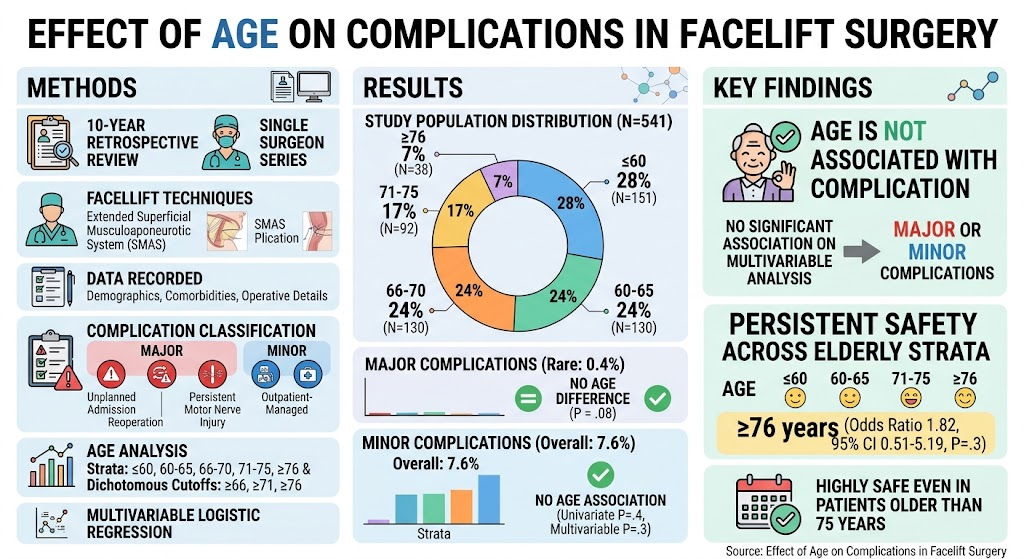
This retrospective study analyzed 10 years of consecutive cases of primary and secondary facelifts performed by a single experienced surgeon. Two surgical techniques were used: the extended SMAS flap and SMAS plication. The cohort was stratified by age into five groups (≤60, 60–65, 66–70, 71–75, and ≥76 years) and also analyzed by dichotomous cutoffs at 66, 71, and 76 years. Demographic data, patient comorbidities, procedural details, and complication incidences were meticulously recorded.
Complications were classified into two categories:
– Major: unplanned hospital admission, reoperation, or persistent motor nerve injury.
– Minor: complications manageable entirely in an outpatient setting.
Multivariable logistic regression analyses were used to assess the independent association between age and complication rates while adjusting for confounding factors.
Key Findings
Among 541 patients undergoing facelift surgery:
– Age distribution was: ≤60 years (28%), 60–65 years (24%), 66–70 years (24%), 71–75 years (17%), and ≥76 years (7%).
– Major complications were very rare, occurring in only 0.4% of the entire cohort. Statistical analysis showed no significant difference across age groups (P = .08).
– Minor complications occurred in 7.6% of patients and were similarly not associated with age by both univariate (P = .4) and multivariable regression analysis.
– Subgroup analyses focusing on patients older than 75 years yielded no statistically significant increase in any complication risk. Adjusted odds ratio for complications in patients ≥76 was 1.82 (95% CI 0.51–5.19, P = .3) indicating no independent effect of advanced age.
These findings suggest that with appropriate patient selection and standardized surgical protocols, chronological age alone should not preclude candidates from facelift surgery.
Expert Commentary
This robust single-surgeon series adds valuable evidence reinforcing the safety profile of rhytidectomy across older age demographics. Aging is a multifactorial biological process, and chronological age per se does not necessarily equate to poorer physiological reserve or healing capacity. Critical to the favorable outcomes reported is the strict preoperative screening to exclude high-risk candidates, alongside meticulous surgical technique.
Limitations include the single-surgeon and retrospective design, which may limit generalizability. Nonetheless, it represents a large clinical experience over a decade, controlled for confounders, supporting nuanced preoperative risk stratification rather than age-based exclusion. These data align with broader plastic surgery literature advocating individualized assessment of physiological age and comorbidities over chronological age alone.
Conclusion
Facelift surgery performed within a structured clinical framework remains a safe option for patients across the age spectrum, including those older than 75 years. The absence of a significant association between chronological age and surgical complications challenges overly cautious age-based cutoffs in clinical decision-making. This evidence supports expanding access to facial rejuvenation procedures for well-selected older adults, emphasizing personalized risk assessment.
Future prospective studies and multicenter collaborations could further validate these findings and refine guidelines to optimize patient selection and outcomes in aging populations.
Funding and ClinicalTrials.gov
The study did not report external funding sources. This was a retrospective observational cohort without clinical trial registration.
References
1. Vishwanath N, Mandelbaum M, Williams-Medina E, Darras O, Fraiman E, Patel V, Sinclair NR, Zins JE. Effect of Age on Complications in Facelift Surgery. Aesthetic surgery journal. 2026 Aug 18;46(9):NP99-NP109. PMID: 42045665.
2. Rohrich RJ, Pessa JE. The youthful face: redefining the aging process with the deep-plane rhytidectomy. Plastic and reconstructive surgery. 2007 Aug;120(2):369-80.
3. Sclafani AP. Facelift techniques in patients over the age of 70: a review. Archives of facial plastic surgery. 2009 May-Jun;11(3):204-7.
4. Cucurulo AM, Miranda RN, Ferreira MC. Facelift surgery in elderly patients: review and clinical considerations. Clinics (Sao Paulo). 2020;75:e1647.