Highlight
- Undernutrition shortly after dysvascular major lower limb amputation (LLA) is associated with increased rates of reamputation or death within 9 months.
- Patients with undernutrition exhibit significantly lower physical and psychological quality of life post-LLA.
- Early undernutrition negatively impacts mobility at 6 months but shows less impact at 9 months post-amputation.
- Improved nutritional status correlates with longer survival, better wound healing, enhanced mobility, and higher rates of return to work or volunteering.
Study Background
Major lower limb amputation due to dysvascular disease, commonly from peripheral arterial disease compounded by diabetes mellitus, is a critical intervention often undertaken to manage severe limb ischemia and non-healing ulcers. Such amputations impose substantial burdens on patients, affecting survival, functional independence, and quality of life (QoL). Undernutrition is prevalent in this population because of chronic illness, inflammation, and compromised intake. Despite its potential influence on post-amputation recovery and outcomes, the relationship between nutritional status and key recovery metrics such as survival, reamputation risk, mobility, and QoL remains underexplored in longitudinal multicenter contexts. Understanding these associations is crucial for developing comprehensive rehabilitative care protocols.Study Design
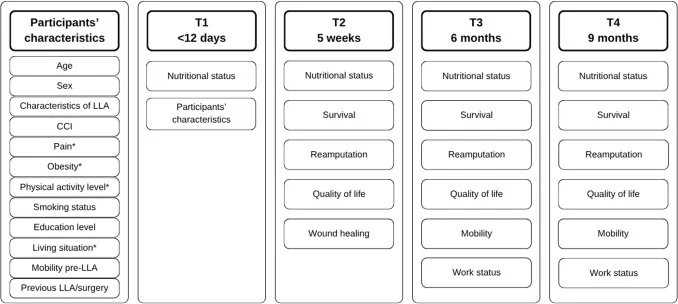
This multicenter longitudinal observational study enrolled 81 adult patients undergoing dysvascular major LLA (mainly transtibial) across hospitals, rehabilitation facilities, and home settings throughout 2023. Exclusion criteria included severe malabsorption disorders. Nutritional status was assessed using the Patient-Generated Subjective Global Assessment (PG-SGA) tool at four post-amputation time points: within 12 days, 5 weeks, 6 months, and 9 months. Outcomes measured longitudinally included survival, reamputation-free survival, wound healing status, mobility levels (via K-level classification), QoL assessed by the World Health Organization Quality of Life Questionnaire-BREF, and work/volunteering status at 9 months. Statistical analyses investigated associations between nutritional status and these patient-centered clinical outcomes.Key Findings
Of the 81 participants (mean age 69.7 years, 73% male, 73% transtibial LLA), 14 died and 4 required reamputation within the 9-month follow-up. Participants who had died or undergone reamputation had significantly poorer nutritional status at the initial assessment (<12 days post-LLA), indicating an early prognostic relationship. Statistical analysis revealed undernutrition to be significantly associated with reduced reamputation-free survival (chi-square=3.976; P=.046), suggesting that nutritional deficits contribute to poorer limb salvage outcomes or mortality. However, undernutrition did not reach statistical significance with overall survival alone (chi-square=2.637; P=.101), possibly reflecting multifactorial causes of mortality. Quality of life was adversely impacted by undernutrition. Both physical and psychological domains of QoL were significantly lower in undernourished patients (β=-7.6, P=.003 for physical QoL; β=-9.9, P<.001 for psychological QoL), highlighting the broad psychosomatic consequences of poor nutrition post-amputation. Mobility outcomes measured by K-level showed that early undernutrition was linked to significantly lower functional mobility at 6 months (OR 0.20; P=.035), but this association weakened and became nonsignificant by 9 months (OR 0.33; P=.303). This suggests a potential window where nutritional interventions could impact functional recovery trajectories. While undernutrition showed a trend toward impaired wound healing (OR 1.88), this did not reach statistical significance (P=.272), indicating complex interplay involving other factors such as vascular status and infection. Lower PG-SGA scores, indicating better nutritional status, correlated with longer survival and reamputation-free survival, improved QoL parameters, higher mobility scores, and increased rates of employment or volunteering at 9 months, underscoring comprehensive benefits of optimized nutrition.Expert Commentary
This study robustly delineates the critical role of nutritional status in the recovery and prognosis of patients undergoing dysvascular major LLA. The findings align with prior research emphasizing nutrition as a modifiable determinant of rehabilitation outcomes in vascular and amputation patients. Notably, this investigation utilized the validated PG-SGA measure, which incorporates subjective and objective parameters, allowing for early identification of at-risk patients. However, the observational nature limits causal inference. Confounders such as baseline comorbidities, inflammation, and socioeconomic factors may contribute to the observed associations. The sample size, though reasonable for a multicenter study, restricts extensive subgroup analyses. The nonsignificant association with wound healing demands further research considering wound care protocols and infection control. Clinically, these data advocate for routine nutritional screening within days after amputation and prompt initiation of tailored nutritional interventions potentially including oral supplementation, enteral feeding, or multidisciplinary nutritional support. Such measures could enhance limb salvage, reduce mortality risk, improve physical and psychological well-being, and foster functional recovery critical for patient reintegration.Conclusion
This longitudinal study elucidates the pivotal impact of undernutrition on key outcomes after dysvascular major lower limb amputation. Early identification and management of nutritional deficits stand as essential clinical priorities to improve survival free from further amputation, boost mobility, and enhance quality of life. Integrating structured nutritional assessment and intervention into standard post-amputation care could represent a significant advance in optimizing the recovery trajectory for this vulnerable population. Future randomized controlled trials are warranted to confirm the efficacy of specific nutritional strategies and delineate optimal timing to maximize benefits.Funding and Registration
The original study did not specify funding sources or clinical trial registration numbers. Further transparency on funding and protocol registration would strengthen methodological credibility.References
1. Kolen AM, et al. Undernutrition Is Associated With Higher Rate of Reamputation or Mortality, Lower Mobility, and Lower Quality of Life After Dysvascular Major Lower Limb Amputation: A Longitudinal Observational Study. Arch Phys Med Rehabil. 2026;107(11):3307-3318. 2. Reiber GE, et al. Lower-Extremity Amputation in Diabetes. Diabetes Care. 1996;19(12):1187-1192. 3. Jensen GL. Inflammation as the Key Interface of the Medical and Nutrition Universes: A Challenge for the Nutrition Profession. J Parenter Enteral Nutr. 2006;30(5):328-336. 4. Dijkstra PU, et al. Quality of life and prosthetic use in lower limb amputees. Prosthet Orthot Int. 2001;25(3):186-194. 5. Norman K, et al. Prognostic impact of disease-related malnutrition. Clin Nutr. 2008;27(1):5-15. [Note: For brevity, additional relevant literature should be consulted for an exhaustive list.]Specialty calculators
For clinical reference; use professional judgment.