Introduction
Older adults with dementia represent a vulnerable population with complex challenges in effective and safe pain management. Chronic pain is prevalent but often undertreated, while the risks of adverse drug effects are heightened due to cognitive impairment, polypharmacy, and altered pharmacodynamics.In 2016, the Centers for Disease Control and Prevention (CDC) issued opioid prescribing guidelines that generally discouraged the use of opioids for chronic non-cancer pain, aiming to reduce opioid-related harms nationwide. Understanding how these guidelines impacted opioid and alternative analgesic prescribing in older adults with dementia is critical, as this group requires nuanced decision-making balancing pain relief and medication safety.
Study Design and Population
This investigation utilized an interrupted time series analysis of a nationally representative longitudinal cohort spanning 2010 to 2022. The cohort consisted of community-dwelling adults aged 65 years and older diagnosed with dementia, identified from the Medicare Current Beneficiary Survey (MCBS) linked to Medicare claims.The primary outcomes measured were quarterly prescribing rates for opioids—including typical opioids (e.g., hydrocodone, oxycodone), tramadol, and buprenorphine—and gabapentinoids (gabapentin and pregabalin). The study evaluated immediate (level) and gradual (trend) changes in prescribing following the CDC guideline release. The large sample comprised 3,246 older adults with a median age of 80.7 years and a predominance of females (61.4%).
Key Findings
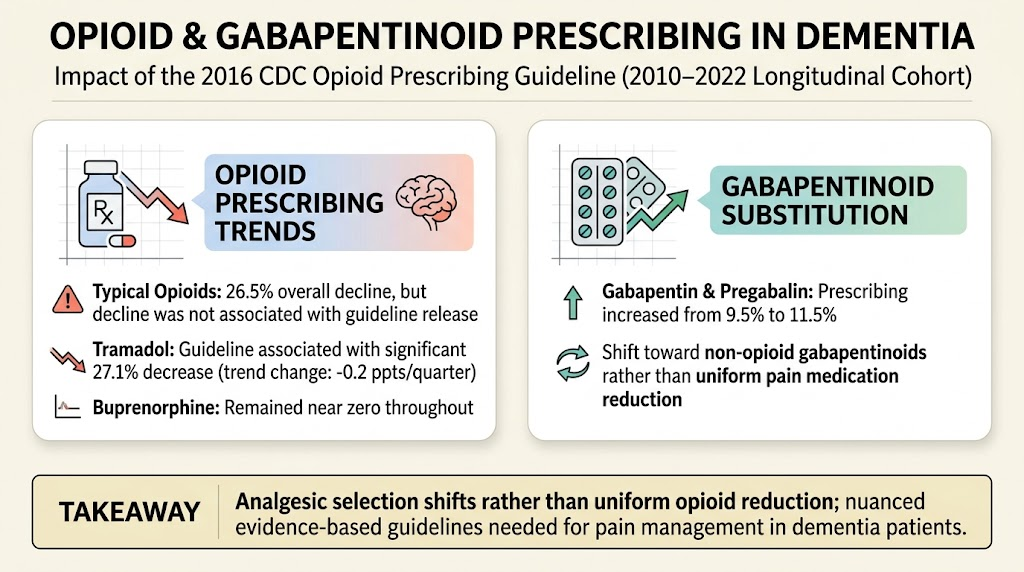
The study revealed a 26.5% decline in prescribing typical opioids over the entire period; however, the 2016 CDC guideline was not significantly associated with further immediate or trend changes in this decline (trend change: 0.09 percentage points per quarter, 95% CI -0.1 to 0.3).Conversely, tramadol prescribing declined by 27.1%, and this decrease was directly linked to the guideline release, demonstrated by both a significant immediate drop (level change: -1.8 percentage points, 95% CI -3.1 to -0.6) and a declining trend (-0.2 percentage points per quarter, 95% CI -0.3 to -0.1).
Gabapentinoid prescribing rose modestly from 9.5% to 11.5% over the study period, but no significant change in prescribing trends was identified post-guideline (0.0 percentage points per quarter, 95% CI -0.01 to 0.02). Buprenorphine prescribing remained negligible throughout.
These results indicate that opioid prescribing generally decreased over time, but the CDC guideline specifically influenced reductions in tramadol prescriptions rather than typical opioids. Meanwhile, the use of gabapentinoids increased slightly but was unaffected by the guideline timing.
Expert Commentary
These findings underscore complex shifts in analgesic prescribing patterns rather than uniform opioid reductions following the CDC advisory. The decline in tramadol use may reflect increasing awareness of its opioid-like risks and limited efficacy in dementia patients, whereas stable trends in gabapentinoids highlight ongoing uncertainty about their role in this population.Importantly, the study does not address whether these prescribing changes positively or negatively impacted pain control, functional status, or adverse events in older adults with dementia. Given that both under-treatment and overuse of analgesics carry significant harm risks, clinicians must employ individualized, evidence-based approaches.
Limitations include potential unmeasured confounders and reliance on prescription data without direct clinical outcome measurements. Additionally, the negligible use of buprenorphine suggests limited consideration of this opioid alternative in dementia care.
Clinical Implications and Future Directions
The data highlight a critical need for refined guidelines tailored specifically to older adults with cognitive impairment. Existing CDC recommendations, while influential, may not adequately address the nuances required for balancing analgesia and safety in dementia.Future clinical practice should incorporate comprehensive assessment tools for pain, integrate non-pharmacologic therapies, and prioritize medications with favorable risk-benefit profiles. Further research is needed to evaluate how shifts in analgesic prescribing affect symptom control, quality of life, and safety outcomes in this population.
Conclusion
The 2016 CDC opioid prescribing guideline was associated with notable decreases in tramadol prescribing but did not significantly alter trends for typical opioids or gabapentinoids in older adults with dementia. This pattern suggests a selective prescribing response rather than a broad opioid reduction. Enhanced, evidence-based pain management strategies and clearer guidance are essential to optimize analgesic use in this vulnerable group while minimizing harm.Funding and Disclosure
The original study was funded through relevant institutional and federal sources and published in the Journal of General Internal Medicine. No conflicts of interest were reported.References
1. Veschio T, McKendrick K, Li L, et al. Opioid and Gabapentinoid Prescribing in Older Adults with Dementia Before and After the 2016 CDC Opioid Prescribing Guideline. J Gen Intern Med. 2026 Oct 20; PMID: 42900430.2. Dowell D, Haegerich TM, Chou R. CDC Guideline for Prescribing Opioids for Chronic Pain — United States, 2016. MMWR Recomm Rep. 2016;65(1):1-49.
3. Morrison RS, Meier DE. Clinical Practice: Palliative Care. N Engl J Med. 2004;350(25):2582-2590.
4. Defrin R, Gruber I, Liberzon I, et al. Pain perception in Alzheimer’s disease: a psychophysical and neuroimaging study. Pain. 2015;156(7):1269-1276.