Highlights
- Rapid peak expansion of ciltacabtagene autoleucel (cilta-cel) CAR T-cells is strongly associated with delayed neurotoxicities (DNTs), including parkinsonism, in patients with relapsed/refractory multiple myeloma (RRMM).
- Absolute lymphocyte count (ALC) serves as a clinically accessible surrogate biomarker for CAR T-cell expansion, facilitating early identification of patients at elevated DNT risk.
- Distinct expansion-toxicity relationships exist between two BCMA-targeted CAR T-cell therapies—cilta-cel and idecabtagene vicleucel (ide-cel)—highlighting the importance of product-specific monitoring strategies.
- Preemptive strategies guided by quantitative ALC thresholds may mitigate morbidity from DNTs, addressing a major clinical challenge in cilta-cel therapy.
Background
Multiple myeloma (MM) is a heterogeneous plasma cell malignancy with traditionally poor prognosis in relapsed/refractory (R/R) settings. Recent advances in chimeric antigen receptor (CAR) T-cell therapies targeting B-cell maturation antigen (BCMA) have revolutionized treatment paradigms, offering deep and durable responses in heavily pretreated RRMM patients. Idecabtagene vicleucel (ide-cel) and ciltacabtagene autoleucel (cilta-cel) are clinically approved BCMA-directed CAR T-cell products with demonstrated efficacy. However, management of treatment-related toxicities, particularly neurotoxicities such as immune effector cell-associated neurotoxicity syndrome (ICANS) and delayed neurotoxicity syndromes, represents a significant unmet need. Delineation of the relationship between CAR T-cell expansion kinetics and these toxicities is crucial for optimizing therapeutic outcomes and patient safety.Key Content
CAR T-Cell Expansion Kinetics and Clinical Correlates
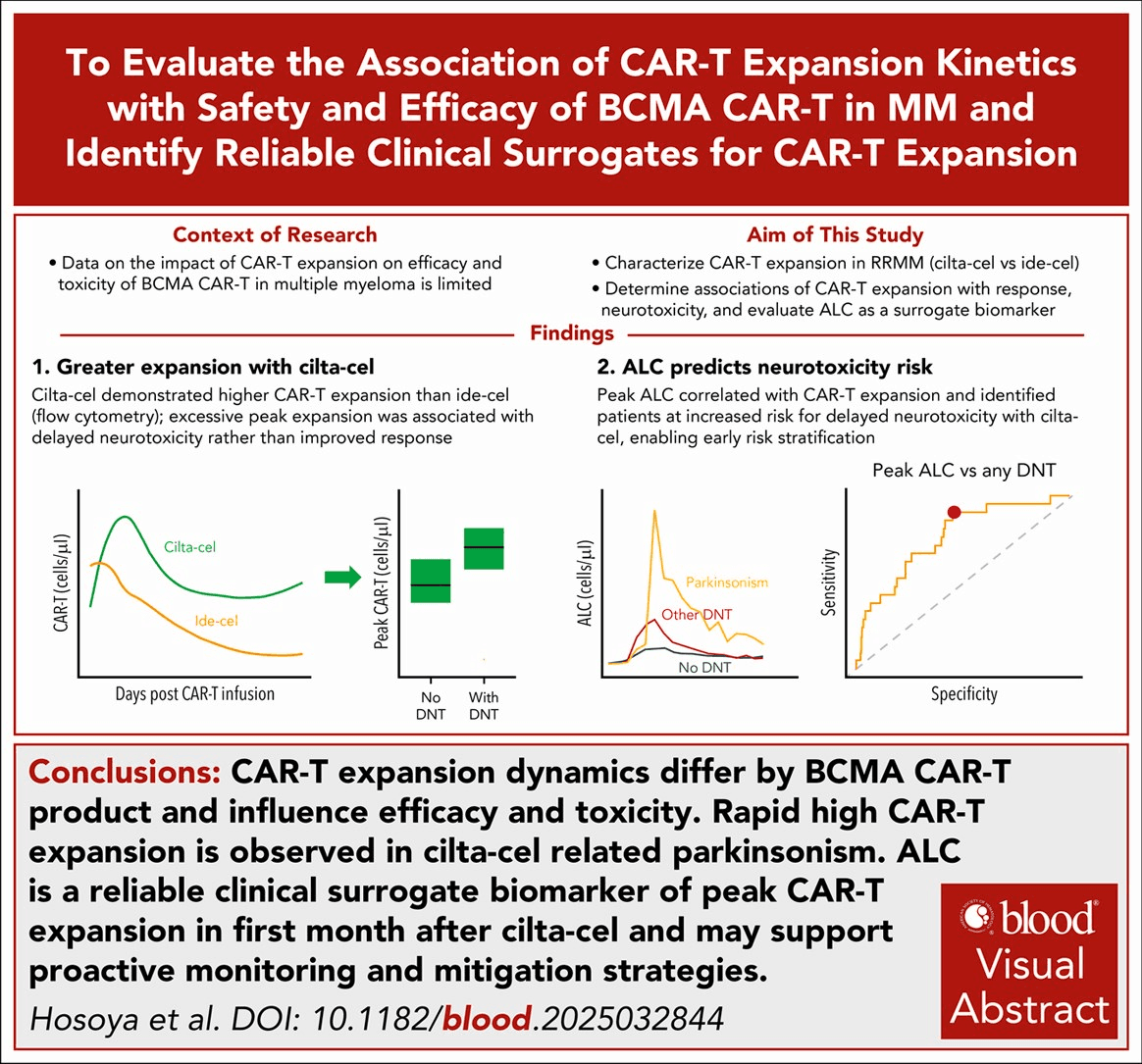
Hosoya et al. (2026) conducted a pivotal study evaluating CAR T-cell kinetics in RRMM patients receiving ide-cel (n=36) or cilta-cel (n=54), utilizing a uniform flow cytometry-based assay for quantification. The median peak CAR T-cell expansion was significantly higher with cilta-cel (106 cells/μL) compared to ide-cel (49 cells/μL). In the ide-cel cohort, peak expansion correlated positively with clinical response, underscoring expansion as a marker of efficacy. Contrastingly, in the cilta-cel cohort, peak expansion did not predict response but was strongly associated with an increased risk of delayed neurotoxicities (median peak 1009 cells/μL in DNT cases versus 96 cells/μL in non-DNT cases), a complication manifesting weeks after infusion and linked with lasting functional impairment.Identification of Absolute Lymphocyte Count as a Surrogate Biomarker
Recognizing the limited availability of standardized CAR T quantification assays, the investigators assessed absolute lymphocyte count (ALC) in a large multicenter cohort (N=532; cilta-cel, n=256; ide-cel, n=276) as a surrogate biomarker of CAR T-cell expansion. Elevated peak ALC was significantly associated with development of DNT, particularly parkinsonism after cilta-cel therapy. Threshold analysis demonstrated that a peak ALC ≥3 × 10^3/μL, or ≥2.5 × 10^3/μL following a twofold increase from baseline, predicted higher DNT risk with sensitivity of 81% and specificity of 59%. This metric offers a practical and uniformly available tool for early recognition of at-risk patients.Distinct Toxicity Profiles and Immune Dynamics
Complementary studies (e.g., Alhomoud et al., 2026; Hosoya et al., 2026 Sci Transl Med) suggest cilta-cel-associated neurotoxicity involves atypical non-ICANS neurological presentations including parkinsonism and cranial nerve palsies, distinct from classic ICANS observed frequently with ide-cel. Robust expansion of CD4+ CAR T-cell subsets with inflammatory gene signatures has been implicated in non-ICANS neurotoxicities. PET imaging studies also revealed altered cerebral metabolism and connectivity changes in neurotoxic patients after BCMA-directed CAR-T, implicating frontal-subcortical circuits in pathogenesis.Clinical Outcomes and Real-World Validation
Real-world data (Chari et al., 2026) confirm the efficacy and safety profiles of cilta-cel in outpatient and inpatient settings, echoing trial outcomes while highlighting resource use advantages of outpatient administration. Frailty analyses highlight that although cilta-cel remains effective in frail RRMM patients, frailty is associated with increased neurotoxicity risk, emphasizing the need for tailored risk stratification integrating biomarkers, clinical status, and CAR T-cell kinetics.Therapeutic Implications and Risk Mitigation Strategies
Emerging evidence indicates the limited efficacy of corticosteroid prophylaxis timed at ALC expansion to reduce delayed neurotoxicity incidence or severity, prompting the exploration of additional targeted interventions. Current recommendations advocate close monitoring of ALC alongside neurological assessment post-cilta-cel infusion. The defined ALC thresholds provide actionable criteria for implementing intensified surveillance and early interventions, potentially reducing long-term disability from DNTs.Expert Commentary
This comprehensive characterization of cilta-cel expansion dynamics relative to neurotoxicity represents a critical advance in optimizing BCMA CAR T-cell therapy for RRMM. The dissociation of expansion-efficacy correlation in cilta-cel versus ide-cel underscores biologic differences between CAR constructs and highlights the nuanced risk-benefit profiles requiring product-specific management. Adoption of ALC as a surrogate marker democratizes monitoring capabilities, enabling broader clinical application beyond specialized centers with advanced assay infrastructure. Despite these advances, challenges remain. The moderate specificity of ALC thresholds indicates that additional biomarkers, including immunophenotypic and cytokine profiles, are needed to refine risk prediction. The mechanistic underpinnings of DNT, including CAR T-cell trafficking to neural sites and resultant neuroinflammation, require deeper investigation to inform targeted prophylactic or therapeutic approaches. Furthermore, clinical trials incorporating response-adapted bridging therapies, as suggested by Morris et al. (2026), may mitigate toxicity incidence by controlling tumor burden pre-infusion. Guidelines currently lack consensus on management of delayed neurotoxicity, impeding standardized care pathways. Prospective validation of ALC-guided monitoring in real-world cohorts and integration into clinical workflows will be essential. Meanwhile, balancing maximal CAR T-cell expansion for efficacy against neurotoxicity risk remains a central clinical conundrum.Conclusion
Rapid and excessive CAR T-cell expansion following ciltacabtagene autoleucel therapy is closely linked to delayed neurotoxicities with potential long-term sequelae in patients with RRMM. Relative to idecabtagene vicleucel, cilta-cel exhibits unique expansion-toxicity dynamics, necessitating tailored monitoring strategies. Absolute lymphocyte count emerges as a practical, widely accessible surrogate for CAR T-cell expansion, with defined thresholds enabling early risk stratification for delayed neurotoxicity. These insights support refinement of preemptive strategies that could reduce morbidity and improve the therapeutic index of BCMA-directed CAR T-cell therapies. Ongoing research should focus on mechanistic elucidation, biomarker development, and prospective interventional trials to mitigate these neurotoxic adverse events and optimize patient outcomes.References
- Hosoya H, Velayati A, Dima D, et al. Rapid peak cilta-cel expansion is associated with delayed neurotoxicity in multiple myeloma. Blood. 2026 Oct 15;148(16):1961-1972. PMID: 42418682. https://pubmed.ncbi.nlm.nih.gov/42418682/
- Chari A, Berdeja JG, Oriol A, et al. Real-world healthcare resource utilization and clinical outcomes among patients with relapsed/refractory multiple myeloma receiving ciltacabtagene autoleucel. J Med Econ. 2026 Dec;29(1):871-884. PMID: 41848013.
- Morris C, et al. Adaptive bridging and holding therapy frequently reduces tumor burden and is associated with reduced toxicity after CAR-T cell therapy in multiple myeloma. Transplant Cell Ther. 2026 Aug 27. PMID: 42660229.
- Alhomoud M, et al. Robust CD4CAR T cell expansion is associated with non-ICANS neurotoxicities after ciltacabtagene autoleucel in patients with multiple myeloma. Sci Transl Med. 2026 Jul 29;18(860):eaed0039. PMID: 42525783.
- Prophylactic dexamethasone at the time of absolute lymphocyte expansion does not mitigate risk or event-free survival for immune effector cell associated delayed neurotoxicity. Blood Cancer J. 2026 Aug 10;16(1):153. PMID: 42728267.
- Jain T, et al. Neurotoxicity-Associated Brain FDG-PET Alterations Following BCMA CAR T-Cell Therapy in Multiple Myeloma. Clin Nucl Med. 2026 Aug;51(8):e545-e553. PMID: 42080607.
- Smith EL, et al. Efficacy and safety of frail patients treated with ciltacabtagene autoleucel in the real world: a CIBMTR analysis. Cancer. 2026;132(19):e70614. PMID: 42779338.