Highlight
This secondary analysis of data from two large multicenter randomized controlled trials evaluated the relationship between rocuronium dosing and success on first-attempt emergency tracheal intubation in critically ill adults. Key findings include: (1) High-dose rocuronium (>1.2 mg/kg) was associated with an increased likelihood of first-attempt intubation success overall. (2) The benefit was pronounced in ICU patients, with no significant association observed in emergency department (ED) intubations. (3) These observational data suggest a dose-dependent effect warranting further prospective randomized evaluation.
Background
Emergency tracheal intubation is a common, high-risk procedure performed in critically ill patients in both the intensive care unit and emergency department settings. Neuromuscular blockers, such as rocuronium, facilitate intubation by optimizing conditions including muscle relaxation and airway visualization. The dose of neuromuscular blockade may influence intubation success and procedural safety. However, the optimal rocuronium dosing strategy for emergency intubation remains uncertain, with potential trade-offs between efficacy and adverse effects such as prolonged paralysis or hemodynamic instability.
Understanding the impact of rocuronium dose on first-attempt intubation success is clinically relevant because increased first-pass success is associated with reduced complications, including hypoxemia, aspiration, and airway trauma. Evidence guiding dose selection in critically ill patients undergoing emergency intubation is limited, prompting this secondary analysis of two well-characterized multicenter trial datasets.
Study Design
This study performed a secondary analysis using data from two previously conducted multicenter randomized controlled trials encompassing 9 United States emergency departments and 24 intensive care units. Adult patients undergoing emergency tracheal intubation who received rocuronium during the procedure were included (n=1822 of 2440 patients in the composite dataset). Patients were categorized into two groups based on their rocuronium dosing regimen: high-dose (>1.2 mg/kg) versus standard-dose (≤1.2 mg/kg).
Propensity score matching was used to adjust for potential confounders and to balance baseline patient characteristics between groups within each clinical setting (ED and ICU). The primary outcome was the success rate of tracheal intubation on the first attempt, an important quality and safety metric in airway management.
Key Findings
A total of 1822 patients who received rocuronium were analyzed, with 720 (39.5%) receiving high-dose and 1102 (60.5%) receiving standard-dose rocuronium. Across combined settings, patients receiving high-dose rocuronium demonstrated a statistically significant higher probability of successful intubation on the first attempt (adjusted relative risk [RR] 1.07; 95% confidence interval [CI], 1.02-1.12).
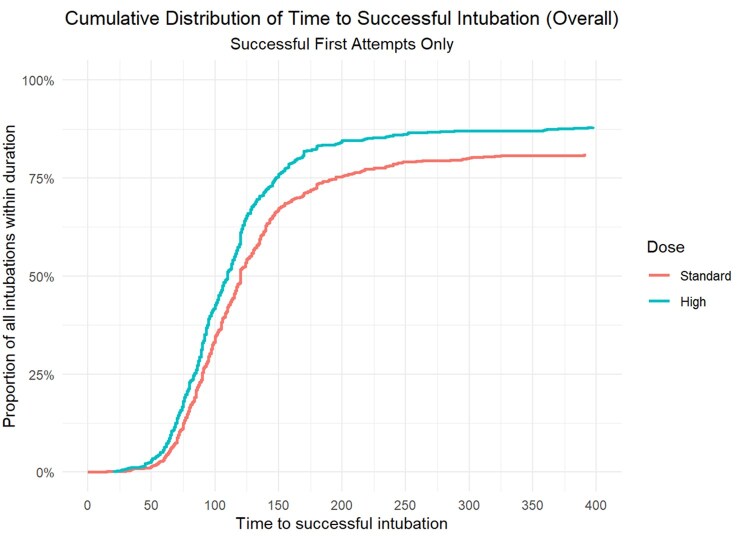
Time-to-event curves for successful intubation on the first attempt. The horizontal axes represent the duration of intubation in seconds. The vertical axes represent the proportion of all intubations successfully completed within a given time horizon. The green curve represents participants receiving high-dose (>1.2 mg/kg) rocuronium. The red curve represents participants receiving standard-dose (≤1.2 mg/kg) rocuronium.
When stratified by setting, the association differed notably:
- ICU setting: High-dose rocuronium was associated with a more pronounced increase in first-attempt success (adjusted RR 1.13; 95% CI, 1.06-1.20), suggesting a clinically meaningful benefit in this population.
- ED setting: No significant difference in first-attempt success was observed between high-dose and standard-dose groups (adjusted RR 0.97; 95% CI, 0.89-1.04).
The findings highlight potential differences in patient characteristics, procedural complexities, or clinical practices between ICU and ED environments that may modulate the effect of rocuronium dose on procedural outcomes.
Expert Commentary
The findings of this secondary analysis provide important hypothesis-generating evidence supporting higher rocuronium dosing to improve intubation success in the ICU. The enhanced muscle relaxation and intubation conditions conferred by a dose above 1.2 mg/kg may facilitate faster and more effective airway management in critically ill patients, thereby potentially reducing procedural risks.
However, this analysis is inherently limited by its observational design and potential for residual confounding despite propensity matching. Differences in underlying patient severity, airway difficulty, or operator experience may influence results. The lack of benefit seen in the ED raises questions regarding setting-specific factors such as urgency, operator skill sets, or adjunct medication use.
Current practice guidelines, including those from anesthesiology and critical care societies, do not definitively recommend high versus standard doses of rocuronium for emergency intubation, underscoring the need for randomized controlled trials to establish causal relationships and optimize dosing protocols.
Conclusion
This secondary analysis of two multicenter trials suggests that administering high-dose rocuronium (>1.2 mg/kg) for emergency tracheal intubation in critically ill adults is associated with improved first-attempt intubation success, particularly in ICU patients. Although promising, these findings require confirmation in dedicated randomized controlled trials to overcome the limitations of observational data and to inform evidence-based airway management strategies that balance efficacy and safety.
The study reinforces that neuromuscular blockade dosing is a potentially modifiable factor that can affect airway management outcomes and highlights the need for tailored approaches based on clinical setting and patient characteristics.
Funding and ClinicalTrials.gov
The original trials and subsequent analysis were supported by institutional grants and research bodies as per the primary publications. Specific funding details were not stated in the secondary analysis abstract. The primary trials were registered and funded through recognized clinical investigation platforms. For further details, see trial identifiers in the original citations.
References
- April MD, Butler H, Demasi SC, Aggarwal NR, Andrea LJ, Barker AB, et al. Rocuronium dose and first-attempt intubation success in the critically ill: secondary analysis of two multicenter trials. American Journal of Respiratory and Critical Care Medicine. 2026;212(8):1740-1749. PMID: 42149702.
- Janz DR, Semler MW, Lentz RJ, et al. Randomized Trial of Video Laryngoscopy versus Direct Laryngoscopy for Endotracheal Intubation of Critically Ill Adults. American Journal of Respiratory and Critical Care Medicine. 2016;193(9):1142-1149.
- Hawser EM, Marchand C, Wickersham N, et al. Neuromuscular blockade: implications for ICU patients and procedural sedation. Critical Care Clinics. 2020;36(1):123-135.