Highlights
- Adalimumab remains the dominant cost-efficient biologic for moderate-to-severe hidradenitis suppurativa (HS) across multiple international health systems.
- Bimekizumab demonstrates superior or comparable clinical efficacy versus other biologics, notably IL-17 inhibitors, with durable long-term benefits and favorable safety profiles.
- Secukinumab shows sustained efficacy up to two years with robust safety, though cost-effectiveness varies by region due to pricing variability.
- Mechanistic studies highlight dual IL-17A/IL-17F blockade as a promising therapeutic strategy, reflecting HS pathogenesis complexity involving neutrophilic inflammation.
Background
Hidradenitis suppurativa (HS) is a chronic, heterogeneous, and inflammatory dermatosis characterized by painful nodules, abscesses, and draining tunnels that impose a substantial physical and psychosocial burden. Moderate-to-severe HS often requires systemic interventions, of which monoclonal antibody biologics targeting key inflammatory cytokines are the mainstay. While adalimumab (a TNF-α inhibitor) was the first biologic approved for HS, newer agents targeting the IL-17 pathway, including secukinumab and bimekizumab, have expanded the therapeutic landscape. However, the high acquisition costs of biologics pose challenges for payers and health systems globally, necessitating economic evaluations alongside clinical efficacy and safety data to guide value-based care and prescribing policies.
Key Content
Evidence from Randomized Controlled Trials and Meta-Analyses
Phase 3 trials such as PIONEER I/II (adalimumab), SUNSHINE/SUNRISE (secukinumab), and BE HEARD I & II (bimekizumab) have demonstrated efficacy of these agents in achieving the Hidradenitis Suppurativa Clinical Response (HiSCR) at thresholds of ≥50% (HiSCR-50) and ≥75% (HiSCR-75) reduction in abscess and inflammatory nodule counts.
Network meta-analyses (NMA) reconcile indirect evidence due to the paucity of head-to-head trials. A 2026 Australasian Journal of Dermatology NMA incorporating baseline disease severity adjustments (PMID: 41804101) indicated that adalimumab had the highest odds ratio (OR 2.81) of achieving HiSCR-50 compared to placebo, followed closely by bimekizumab (OR 2.24). Intriguingly, baseline draining tunnel count significantly modulated response odds, enhancing the interpretation of efficacy in real-world heterogeneous populations.
Separate network meta-analyses focusing on short-term efficacy (12–16 weeks) reveal bimekizumab as the most efficacious agent across all HiSCR outcomes and International HS Severity Score System (IHS4) improvements, outperforming secukinumab and adalimumab, particularly in biologic-naïve populations (PMID: 41457056). Nonetheless, adalimumab consistently demonstrated high efficacy and was associated with the lowest incidence of adverse events (PMID: 40062409).
Real-world evidence (RWE) meta-analysis combining observational data confirmed that secukinumab produces a moderate HiSCR response rate (~50%) and has a manageable safety profile. Bimekizumab, while lacking HiSCR quantitative data in RWE, notably improved disease severity scores and skin pain measures with low adverse events, supporting clinical trial findings (PMID: 41349691).
Long-Term Efficacy and Safety
Open-label extensions and pooled analyses indicate that bimekizumab maintains durable clinical benefit up to two years, with sustained improvements in HiSCR-50/75/90/100 and stable safety profiles without emergent adverse safety signals (PMID: 41248770). Similarly, secukinumab sustains HiSCR response with evidence of delayed loss of response over two years, demonstrating a consistent safety profile congruent with other approved indications (PMID: 39611771, 40839197).
Mechanistic Insights
HS pathogenesis involves dysregulated innate and adaptive immunity with neutrophilic inflammation prominently mediated by cytokines such as IL-17A and IL-17F. Recent translational studies provide evidence that dual blockade of IL-17A and IL-17F by bimekizumab more effectively attenuates inflammatory gene expression in lesional skin and reduces neutrophil chemotaxis compared to inhibition of IL-17A or IL-17F alone (PMID: 39531733). These findings underscore the rationale for IL-17 targeted therapies and encourage biomarker-driven stratification for personalized treatment.
Emerging Therapeutics
In addition to the approved agents, experimental therapies such as vilobelimab targeting complement C5a have shown preliminary promise in adjunctive tunnel reduction, although phase IIb trials did not meet primary endpoints (PMID: 41081529). Phase 2 data on eltrekibart, targeting CXCR1/2 ligands, suggests potential benefits warranting further exploration (PMID: 41061970).
Economic Evaluation and Efficiency Frontier
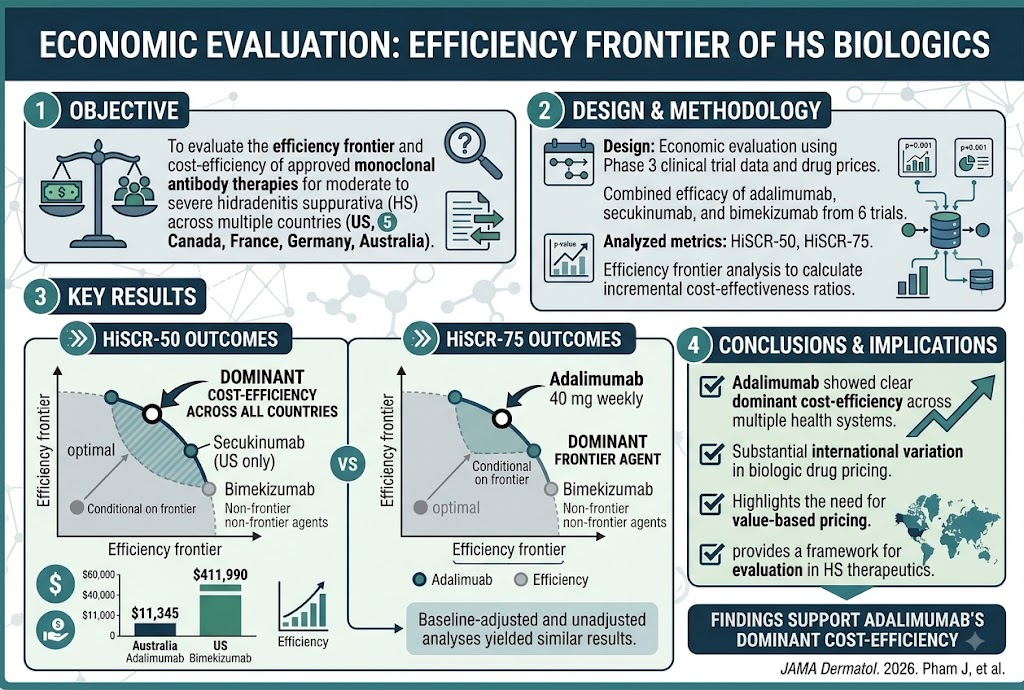
The 2026 economic evaluation integrating efficacy data from phase 3 trials and drug pricing across five countries (US, Canada, France, Germany, Australia) elucidated substantial variability in annual therapy costs, from approximately $11,345 (adalimumab in Australia) to $411,990 (bimekizumab in the US). Efficiency frontier analysis established adalimumab 40 mg weekly consistently on the frontier for both HiSCR-50 and HiSCR-75 across countries, indicating dominant cost-effectiveness. Secukinumab 300 mg every 4 weeks appeared on the frontier only under US pricing scenarios (PMID: 42555037).
This evaluation emphasizes that while bimekizumab may offer superior or comparable efficacy, its high cost limits cost-effectiveness in most health systems. Adjusting for baseline disease severity did not significantly alter the efficiency frontier, reinforcing the robustness of these findings.
Expert Commentary
Despite the expanding armamentarium for HS, comparative effectiveness and economic data remain limited due to the scarcity of direct head-to-head randomized trials. The dominance of adalimumab in cost-effectiveness derives from a combination of established efficacy, extended clinical experience, and relatively lower cost in multiple markets. Newer IL-17A/IL-17F inhibitors like bimekizumab offer improved clinical response rates and potentially deeper remissions but at markedly elevated cost, posing challenges for payer reimbursement and accessibility.
Mechanistically, the dual IL-17A/IL-17F inhibition aligns with emerging understanding of HS as a neutrophilic dermatosis with complex cytokine interplay. This may explain the superior efficacy signals in clinical trials and the sustained quality-of-life improvements documented in patient-reported outcome measures such as the HiSQOL questionnaire.
Challenges remain in treating diverse patient subtypes—detailed phenotyping suggests distinct clusters with variable biologic responsiveness and treatment kinetics, especially in patients with extensive draining tunnels or prior biologic exposure (PMID: 39101698). Furthermore, individual patient factors such as BMI, smoking status, and comorbidities modulate drug pharmacokinetics and response, especially for secukinumab.
Further pragmatic trials and real-world registries are needed to evaluate long-term comparative safety, durability of remission, and define optimum dosing strategies, including dose intensification for refractory subgroups.
Conclusion
Monoclonal antibody therapies represent a critical advancement for moderate-to-severe hidradenitis suppurativa. Adalimumab currently maintains a dominant position in international health systems given its cost-effectiveness and established clinical profile. Bimekizumab and secukinumab provide effective alternatives with potentially superior efficacy profiles, especially through targeted IL-17 blockade mechanisms, yet economic considerations temper their widespread adoption.
Continued integration of clinical efficacy, safety, mechanistic insights, patient-reported outcomes, and rigorous economic evaluations will be vital to guide personalized therapy and value-based care in HS. Future research priorities include head-to-head trials, biomarker-driven patient stratification, and exploration of combination or sequential biologic strategies.
References
- Pham J, Sholji T, Aghajani M, Kok C, Frew JW. Approved Monoclonal Antibody Therapies for Hidradenitis Suppurativa. JAMA Dermatol. 2026 Aug 5; PMID:42555037.
- Khan AA et al. Efficacy of Biologics for Hidradenitis Suppurativa: A Network Meta Analysis. Australas J Dermatol. 2026 May;67(3):e154-e161. PMID:41804101.
- Patel F et al. Short-term efficacy of biologics in moderate-to-severe hidradenitis suppurativa: A systematic review and NMA. J Eur Acad Dermatol Venereol. 2026 Apr;40(4):646-657. PMID:41457056.
- Smith C et al. Efficacy and safety of biologics for hidradenitis suppurativa: A network meta-analysis of phase III trials. J Eur Acad Dermatol Venereol. 2026 Apr;40(4):637-645. PMID:40062409.
- Jones M et al. Bimekizumab demonstrated a favorable safety profile and high levels of efficacy with up to 2 years of treatment in HS. J Am Acad Dermatol. 2026 Mar;94(3):867-878. PMID:41248770.
- Davies J, et al. Real World Evidence of Secukinumab and Bimekizumab in Hidradenitis Suppurativa: A Systematic Review and Meta-Analysis. Actas Dermosifiliogr. 2026 Jan;117(1):104491. PMID:41349691.
- Lee A et al. Long-term efficacy and safety of secukinumab in patients with moderate-to-severe hidradenitis suppurativa: week 104 results. Br J Dermatol. 2025 Mar;192(4):629-640. PMID:39611771.
- Tanaka S et al. The roles of IL-17A and IL-17F in hidradenitis suppurativa pathogenesis. Br J Dermatol. 2025 Mar;192(4):660-671. PMID:39531733.
- Wright S et al. Treatment of hidradenitis suppurativa with adalimumab reduces systemic inflammation and cardiovascular risk markers. Clin Exp Dermatol. 2025 Jan;50(2):339-347. PMID:39141589.