Impact of Palate Repair Timing within First 15 Months on Early Speech Development in Children with Cleft Palate

Highlight

  • Early primary palatoplasty before 15 months is standard to optimize speech outcomes in children with cleft palate.
  • Small delays in palatoplasty timing within this age range may increase the risk of passive cleft speech characteristics by 36 months.
  • Passive cleft speech characteristics (CSCs) persist in about 16-18% of children despite early repair, impacting early speech development.

Study Background

Cleft palate, with or without cleft lip, presents a significant congenital anomaly affecting speech development primarily due to impaired velopharyngeal function. Primary palatoplasty aims to close the palate to enable normal speech development and reduce speech disorders. Earlier intervention has been broadly advocated to mitigate speech deficits, but the optimal timing for surgery remains under investigation. While repairs before 15 months of age are routinely performed, the impact of variation within this window on early speech outcomes is not fully elucidated. Passive cleft speech characteristics (CSCs), including hypernasality and nasal emissions due to velopharyngeal insufficiency, are often persistent and lead to early speech difficulties in children.

Study Design

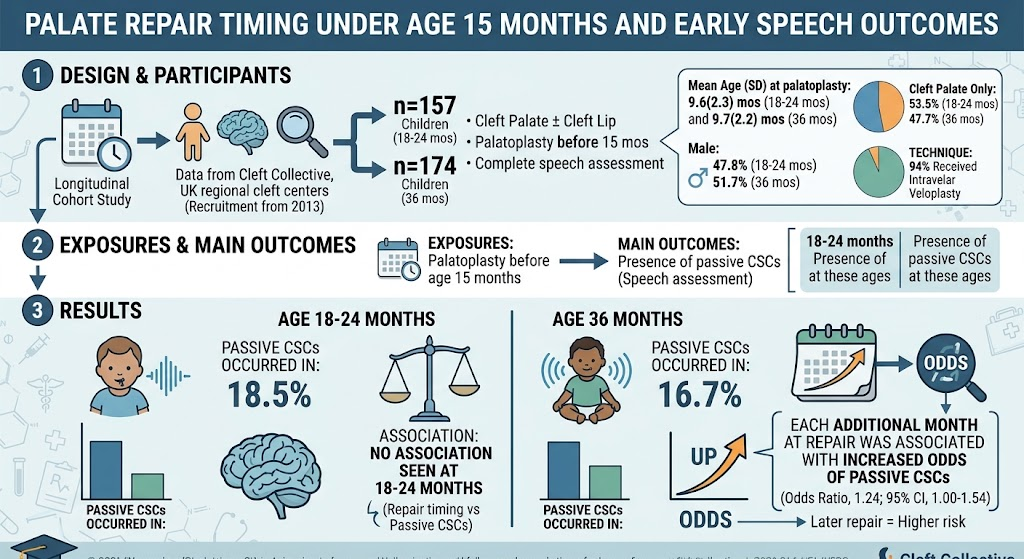
This longitudinal cohort study utilizes data from the UK-based Cleft Collective, encompassing children with cleft palate with or without lip involvement who underwent primary palatoplasty before 15 months of age. Recruitment began in 2013 across all UK regional cleft centers, with ongoing data collection. The study included children who completed formal speech assessments between 18 to 24 months and/or at 36 months. The primary exposure was timing of repair within the first 15 months, and the main outcomes were the presence of passive CSCs at the two assessment ages.

Key Findings

Data from 157 children at 18 to 24 months (mean age at repair 9.6 months) and 174 children at 36 months (mean age 9.7 months) were analyzed. Approximately half the cohort had cleft palate only, and nearly all (94%) underwent an intravelar veloplasty technique. Passive CSCs were observed in 18.5% of children at 18 to 24 months and 16.7% at 36 months.

Crucially, the study found no significant association between timing of palate repair and passive CSC presence at 18 to 24 months. However, at the 36-month assessment, each additional month delay in repair was associated with a 24% increase in odds of passive CSCs (odds ratio 1.24; 95% CI, 1.00-1.54). This finding suggests that although early speech outcomes at 18 to 24 months are not impacted by subtle variations in timing, longer-term speech characteristics at 36 months are negatively influenced even by small delays within the accepted early repair window.

Expert Commentary

This study contributes important evidence to the longstanding debate regarding precise timing of primary palatoplasty. The large, multi-center UK cohort and longitudinal design lend robust data supporting the concept that “earlier is better,” even within the 15-month window. The modest increase in risk of passive CSCs per month delay highlights the importance for cleft teams to minimize scheduling delays for surgery.

Intravelar veloplasty being the predominant technique standardizes surgical approach in this study, reducing confounding by method. Nonetheless, passive CSCs in nearly one-fifth of children underscore the need for additional interventions such as targeted speech therapy or secondary surgical procedures.

Limitations include potential confounding from unmeasured factors influencing both timing and speech development, such as socio-environmental variables and inherent biological differences. Additionally, assessment of passive CSCs at 36 months may not fully represent long-term speech outcomes, which require extended follow-up.

Conclusion

This study affirms the critical influence of timing of primary palatoplasty on early speech development in children with cleft palate. While primary repair before 15 months remains the standard of care to optimize speech outcomes, even within this early window, delays of each additional month modestly increase the likelihood of passive cleft speech characteristics by 36 months. These findings support efforts to prioritize timely surgical intervention and indicate the need for vigilant speech monitoring and rehabilitative strategies post-repair.

Funding and Registration

The study was conducted under the UK Cleft Collective framework with recruitment supported by the National Health Service. Specific funding and clinical trial registration details were not stated in the primary publication.

References

  1. Kotlarek K, Mason K, Davies A, Wren Y. Palate Repair Timing Under Age 15 Months and Early Speech Outcomes. JAMA Otolaryngol Head Neck Surg. 2026 Aug 1;152(8):753-757. PMID: 42275034.
  2. Sell D, Mildinhall S, Albery L, Wills AK, Sandy JR, Ness AR; Cleft Care UK study. The Cleft Care UK study. Part 4: perceptual speech outcomes. Orthod Craniofac Res. 2015 Nov;18 Suppl 2:34-46.
  3. Hardin-Jones MA, Chapman KL. Early speech development in children with cleft palate. Cleft Palate Craniofac J. 2014;51(4):e83-91.
  4. Wilhelm E, Jawad M, Su G, Musgrave MP. Timing of Palatal Repair and Speech Outcomes: Systematic Review. J Plast Reconstr Aesthet Surg. 2023;76(5):1197-1209.

Comments

No comments yet. Why don’t you start the discussion?

Leave a Reply