Highlight
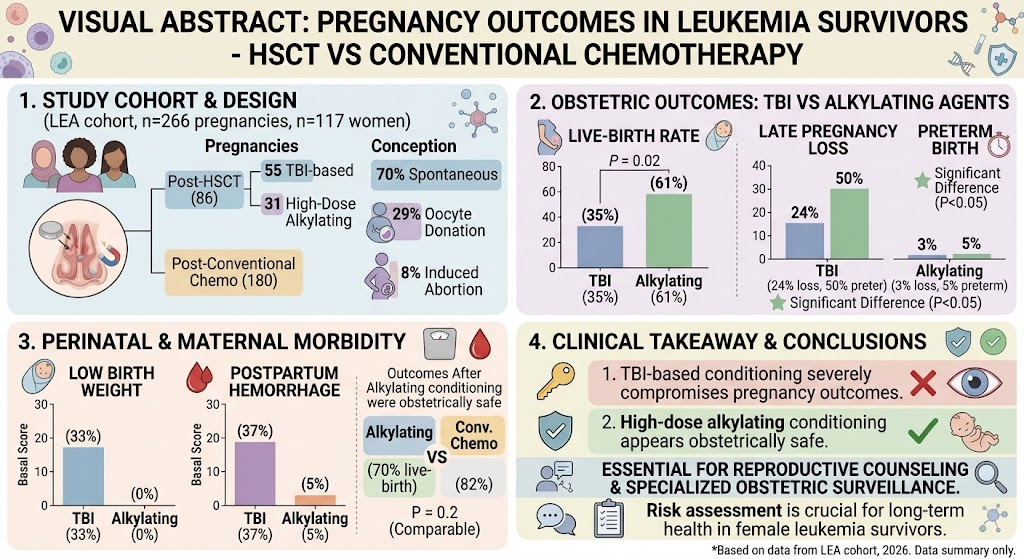
This comprehensive multicenter cohort study compares pregnancy outcomes in female survivors of childhood or adolescent acute leukemia treated with hematopoietic stem cell transplantation (HSCT) using different conditioning regimens versus conventional chemotherapy. It highlights the significant detrimental effects of total-body irradiation (TBI)-based myeloablative conditioning on subsequent pregnancies, including lower live-birth rates and higher complication risks. Conversely, high-dose alkylating agent conditioning appears to preserve fertility and produce pregnancy outcomes comparable to conventional chemotherapy.
Study Background
Childhood and adolescent acute leukemia survivors face risks of long-term toxicities due to intensive therapies, including chemotherapy and hematopoietic stem cell transplantation (HSCT). HSCT often involves myeloablative conditioning with either total-body irradiation (TBI) or high-dose alkylating agents to eradicate malignant cells before stem cell infusion. While TBI is effective, it has known gonadotoxic effects, which may extend to uterine structural changes and fertility impairment. Understanding the reproductive consequences is critical for counseling and long-term management of female survivors, whose pregnancy outcomes after such treatments remain insufficiently characterized. This study addresses the need for robust comparative data on pregnancy outcomes following HSCT with different conditioning modalities relative to conventional chemotherapy.
Study Design
This retrospective multicenter study was nested within the LEA cohort, focusing on females who survived childhood or adolescent acute leukemia and subsequently conceived. The study included 117 women with a total of 266 pregnancies: 86 after HSCT (divided into 55 with TBI-based myeloablative conditioning and 31 receiving high-dose alkylating agent conditioning) and 180 after conventional chemotherapy without HSCT. Data regarding mode of conception, pregnancy outcomes, and complications were systematically collected and compared among groups matched for demographic and clinical characteristics. Key endpoints included live-birth rates, pregnancy loss, prematurity, neonatal birthweight, and maternal complications such as postpartum hemorrhage.
Key Findings
Of the pregnancies post-HSCT, 29% involved oocyte donation assistance, although 70% occurred spontaneously. Notably, 8% of pregnancies after HSCT were unintended and resulted in induced abortion, highlighting the importance of reproductive counseling.
The study reveals a stark difference based on the conditioning regimen employed prior to HSCT:
- Total-Body Irradiation (TBI)-Based Conditioning: Associated with significantly poorer pregnancy outcomes. The live-birth rate was notably low at 35%. TBI increased the risk of late pregnancy loss to 24% compared to just 3% in the alkylating group. Premature births were frequent, occurring in 50% of cases, and low birthweight infants were noted in 33%. Additionally, postpartum hemorrhage rates were high at 37%, suggesting increased maternal morbidity.
- High-Dose Alkylating Agent Conditioning: Pregnancy outcomes resembled those seen after conventional chemotherapy. The live-birth rate was 61%, comparable with 70% in conventional chemotherapy pregnancies, with no statistically significant difference (p=0.2). Rates of late pregnancy loss, prematurity, low birthweight, and maternal complications were not significantly elevated compared to chemotherapy-alone survivors.
This delineates that while myeloablative conditioning regimens overall carry reproductive risks, preserving reproductive and obstetric safety may be possible with alkylating agent conditioning in contrast to TBI.
Expert Commentary
The findings emphasize the profound gonadotoxic and uterine ramifications of TBI, consistent with previous biological data showing uterine fibrosis, reduced volume, and vascular impairment that likely underpin adverse obstetric outcomes. The relative safety of alkylating conditioning for pregnancy outcomes is an important clinical insight, suggesting differential mechanisms of tissue damage.
Clinicians should integrate these data when discussing fertility preservation strategies prior to HSCT and tailor obstetric surveillance protocols for survivors based on conditioning history. The higher incidence of postpartum hemorrhage and preterm birth in TBI survivors calls for specialized perinatal care.
Limitations include the retrospective design and reliance on registry data; nonetheless, the reasonably large sample across multiple centers bolsters generalizability. Future prospective research should investigate interventions to mitigate uterine toxicity and optimize fertility and pregnancy outcomes following TBI-based conditioning.
Conclusion
This study provides critical evidence that TBI-based myeloablative conditioning before HSCT in girls and adolescents with acute leukemia substantially compromises future pregnancy outcomes, with increased risks of pregnancy loss, prematurity, low birthweight, and maternal complications. Conversely, high-dose alkylating agent conditioning appears to preserve pregnancy potential and safety similarly to conventional chemotherapy alone.
These findings offer essential guidance for reproductive counseling, fertility preservation decisions, and tailored antenatal care in female leukemia survivors treated with HSCT during childhood or adolescence. Awareness and early identification of high-risk pregnancies in this population may improve maternal and neonatal outcomes.
Funding and Clinical Trials
The study was conducted within the LEA cohort framework, supported by collaborative multicenter efforts. Specific funding sources were not detailed in the provided abstract. No clinical trials registration was indicated.
References
- Guillerault L, Saultier P, Domenech C, et al. Pregnancy outcomes in women conceiving after hematopoietic stem cell transplantation versus conventional chemotherapy for childhood or adolescent acute leukemia. Bone Marrow Transplant. 2026 Aug 31. PMID: 42675121.
- Laureys M, et al. Gonadal function and fertility after hematopoietic stem cell transplantation. Biol Blood Marrow Transplant. 2019;25(6):1034-1043.
- Laroche V, et al. Effect of total body irradiation on uterine function and fertility preservation strategies in female survivors of childhood cancer. Fertil Steril. 2020;114(4):845-852.