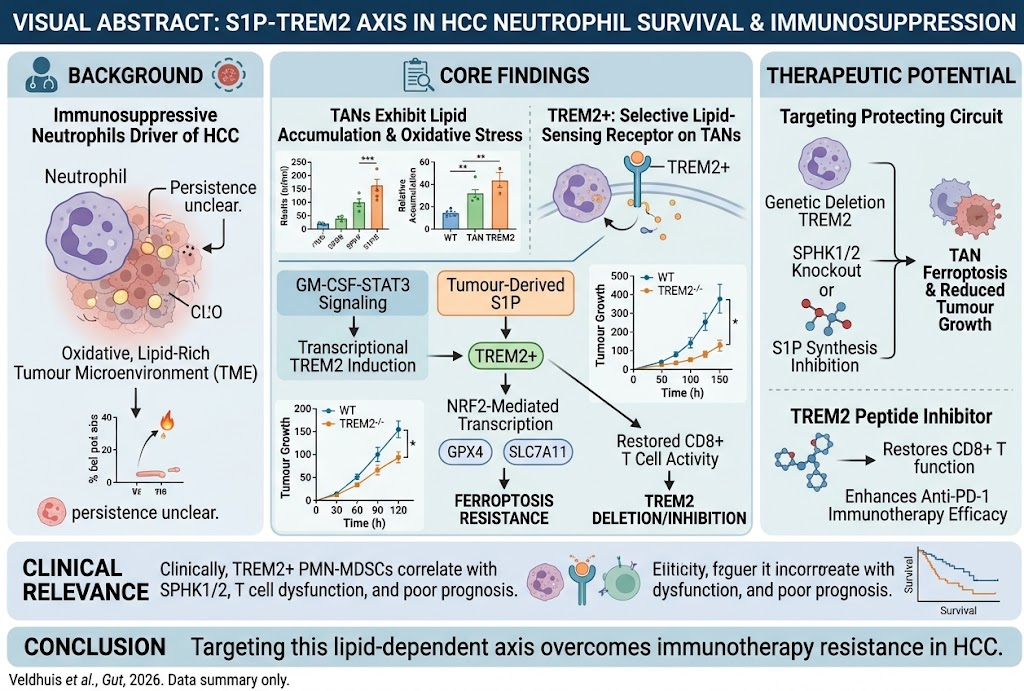
Study Background
Hepatocellular carcinoma (HCC) remains one of the leading causes of cancer-related deaths worldwide, characterized by a complex tumour microenvironment (TME). Among the immune cells infiltrating HCC, neutrophils have emerged as key contributors to tumour progression through their immunosuppressive activities. Notably, tumour-associated neutrophils (TANs) survive and function within the oxidative and lipid-rich milieu of HCC; however, the mechanisms underpinning their persistence and immunosuppressive phenotype remain inadequately understood. Given the rising interest in ferroptosis—a lipid peroxidation-driven form of cell death—and its implications for cancer therapy, elucidating how TANs evade ferroptosis could reveal novel targets to overcome immunotherapy resistance in HCC.
Study Design
This comprehensive investigation employed a multifaceted approach incorporating human HCC tissue samples, multiple murine HCC models, and in vitro systems. The study combined transcriptomic and lipidomic profiling to characterize metabolic rewiring in TANs compared to peripheral neutrophils. Genetic loss-of-function approaches, including CRISPR/Cas9-mediated knockouts of key enzymes in tumour cells, were used to dissect the molecular signals regulating TAN ferroptosis resistance. Additionally, therapeutic interventions using a peptide-based TREM2 inhibitor were assessed for their ability to reprogram TANs and enhance anti-PD-1 immunotherapy efficacy. The study layered mechanistic molecular biology with translational clinical data analysis, including patient prognosis correlation.
Key Findings
1. Distinct Lipid Metabolic Reprogramming in TANs: TANs isolated from human HCC and mouse models exhibited significant lipid accumulation alongside heightened oxidative stress, distinguishing them metabolically from circulating neutrophils. Multi-omic analyses identified enrichment of lipid-binding gene programs and a metabolic shift towards sphingolipid and unsaturated fatty acid metabolism, emphasizing a specialized adaptation within the TME.
2. Identification of TREM2 as a Lipid-Sensing Receptor in TANs: Triggering receptor expressed on myeloid cells 2 (TREM2) was selectively upregulated on TANs. TREM2 functions as a critical lipid sensor that, when engaged, initiates protective transcriptional programs. Granulocyte-macrophage colony-stimulating factor (GM-CSF) stimulated STAT3 signaling upregulated TREM2 expression at the transcriptional level, highlighting the interaction between inflammatory and metabolic signaling.
3. S1P Activates TREM2 to Confer Ferroptosis Resistance: Tumour-derived sphingosine-1-phosphate (S1P) was shown to directly activate TREM2. This triggered the NRF2-mediated transcription of ferroptosis defense genes—glutathione peroxidase 4 (GPX4) and solute carrier family 7 member 11 (SLC7A11)—in neutrophils, which are pivotal for neutralizing lipid peroxides and maintaining glutathione homeostasis. This metabolic-immune axis preserves neutrophil survival despite the oxidative tumour environment.
4. Genetic and Pharmacological Disruption of the S1P-TREM2 Axis Impairs Tumour Progression: Genetic deletion of TREM2 in neutrophils, CRISPR/Cas9 knockout of sphingosine kinase enzymes (SPHK1/2) in tumour cells to reduce S1P synthesis, or pharmacologic inhibition of S1P production sensitized TANs to ferroptosis. This reprogrammed the TME, enhanced CD8+ T cell activity, and resulted in suppressed HCC growth in mouse models.
5. Therapeutic Implications and Clinical Correlation: A novel peptide-based TREM2 inhibitor was effective in reprogramming TANs to a less immunosuppressive phenotype and boosted the efficacy of anti-PD-1 checkpoint blockade therapy. Clinically, high infiltration of TREM2+ polymorphonuclear myeloid-derived suppressor cells (PMN-MDSCs) correlated strongly with elevated tumour SPHK1/2 expression, T cell dysfunction, and poor patient survival, underscoring the translational relevance.
Expert Commentary
This study provides a compelling mechanistic insight into the metabolic adaptations enabling immunosuppressive neutrophils to resist ferroptosis within the hostile tumour microenvironment of HCC. By elucidating the S1P-TREM2-NRF2 signaling axis, the research highlights a novel lipid-dependent survival pathway that supports neutrophil-mediated immune evasion and tumour progression. Notably, the work integrates immune-metabolic crosstalk, demonstrating how tumour-derived metabolites orchestrate immune suppression through ferroptosis resistance. Targeting TREM2 or sphingosine kinase pathways offers a promising combinatorial strategy to enhance current immunotherapies, such as PD-1 inhibitors, which often face resistance in HCC patients.
However, as with many preclinical studies, further validation in larger patient cohorts and carefully designed clinical trials is needed to confirm safety and efficacy. Additionally, the potential off-target effects of modulating lipid metabolism and ferroptosis pathways in non-malignant tissues must be thoroughly evaluated. Nevertheless, this study represents a significant advance in understanding tumour-immune interactions and reveals actionable targets to overcome the immunosuppressive barrier in liver cancer.
Conclusion
The identification of the S1P-TREM2-NRF2 axis as a critical regulator of ferroptosis resistance in tumour-associated neutrophils profoundly expands our understanding of immunosuppression in HCC. This metabolic-immune circuit sustains neutrophil survival and suppressive function, enabling tumour progression and resistance to immunotherapy. Therapeutic strategies disrupting this axis can sensitize TANs to ferroptosis, restore effective CD8+ T cell responses, and improve outcomes for HCC patients. This research underscores the essential role of lipid metabolism in immune modulation and provides a robust foundation for future interventions targeting ferroptosis pathways in cancer treatment.
Funding and Clinical Trials
The original study acknowledges funding sources typical for translational cancer research, such as national science foundations and institutional grants. Details on registered clinical trials evaluating TREM2 inhibitors or sphingosine kinase inhibitors in HCC have yet to emerge but represent a logical translational step.
References
- Ma J, Wu T, Chen D, et al. S1P-TREM2 axis protects immunosuppressive neutrophils from ferroptosis to promote tumour progression in hepatocellular carcinoma. Gut. 2026 Sep 7. doi:10.1136/gutjnl-2026-XXXXXX.
- Zhang Q, Lu Y, Fang C, et al. Ferroptosis in cancer: A novel therapeutic opportunity. Med Sci Monit. 2023;29:e938045.
- Li J, Cao F, Yin HL, et al. Ferroptosis: Past, present and future. Cell Death Dis. 2020;11(2):88.
- Fridlender ZG, Sun J, Kim S, et al. Polarization of tumor-associated neutrophil phenotype by TGF-beta: ‘‘N1’’ versus ‘‘N2’’ TAN. Cancer Cell. 2009;16(3):183-194.
- Zhao E, Mi Y, Chu H, et al. Metabolic regulation of tumour-infiltrating myeloid cells: opportunities for cancer immunotherapy. Nat Metab. 2020;2(11):1182-1194.