Highlights
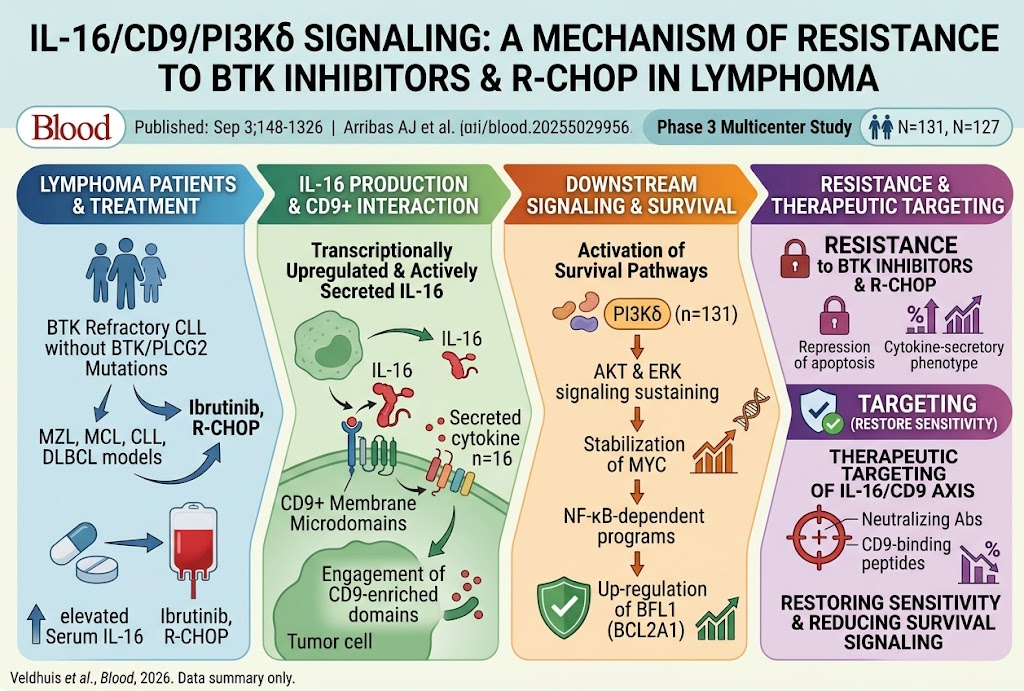
- IL-16 production and secretion is identified as a novel, nongenetic mechanism conferring resistance to BTK inhibitors and R-CHOP in B-cell lymphomas.
- IL-16 interacts with CD9 membrane microdomains to activate PI3Kd, sustaining downstream AKT, ERK, MYC stabilization, and NF-BAd pathways, promoting antiapoptotic survival signaling.
- Disruption of the IL-16/CD9/PI3K axis pharmacologically or via genetic means restores sensitivity to ibrutinib and R-CHOP in preclinical models and primary CLL samples.
- Elevated serum IL-16 correlates with ibrutinib resistance in patients lacking BTK or PLCG2 mutations, underscoring clinical relevance and potential biomarker utility.
Background
B-cell lymphomas, including marginal zone lymphoma (MZL), mantle cell lymphoma (MCL), chronic lymphocytic leukemia (CLL), and activated B-cell-like diffuse large B-cell lymphoma (ABC-DLBCL), represent heterogeneous malignancies with diverse clinical courses and therapeutic challenges. Bruton tyrosine kinase (BTK) inhibitors such as ibrutinib have markedly improved outcomes, particularly in relapsed/refractory settings. However, resistance to BTK inhibition, often unrelated to canonical BTK or PLCG2 genetic mutations, limits long-term efficacy and prompts urgent need to elucidate alternative resistance mechanisms. Moreover, chemoimmunotherapy regimens like R-CHOP remain first-line for many lymphomas, yet resistance remains a major barrier.
Understanding nongenetic adaptations and survival pathways that bypass BTK inhibition could inform strategies to overcome resistance and improve patient outcomes.
Key Content
Development and Characterization of Ibrutinib-Resistant Models
Continuous ibrutinib exposure of MZL cell lines established resistant models demonstrating cross-resistance not only to BTK inhibitors but also to BTK degraders. Whole-exome sequencing and targeted genetic analyses ruled out classical mutations or multidrug resistance phenotypes, indicating nongenetic resistance. Integrated transcriptomic and proteomic profiling revealed broad signaling rewiring, including upregulation of PI3K/AKT, MAPK, and MYC oncogenic pathways, epigenetic changes, suppression of apoptosis, and metabolic shifts characterized by reduced oxidative phosphorylation.
Identification and Role of IL-16
A cytokine-secretory phenotype emerged as a hallmark of resistant cells, with interleukin-16 (IL-16) prominently upregulated at RNA and protein levels. Elevated IL-16 secretion was sufficient to induce ibrutinib resistance in various CD9+ B-cell lymphoma models, including MCL, CLL, and ABC-DLBCL, emphasizing a broad applicability. Patient serum analyses confirmed elevated IL-16 levels in ibrutinib-refractory CLL cases without BTK/PLCG2 mutations, linking preclinical findings to clinical resistance.
Mechanistic Insights: IL-16/CD9/PI3K Axis Activation
Mechanistically, IL-16 signals through CD9-enriched membrane microdomains, concentrating PI3Kd activation. This engagement drives sustained phosphorylation of AKT and extracellular signal-regulated kinase (ERK), stabilizes the MYC oncoprotein, and activates nuclear factor-BAB (NF-BAd)-dependent transcriptional programs. Downstream, heightened expression of antiapoptotic effectors, notably BFL1 (BCL2A1), supports lymphoma cell survival despite BTK inhibitor pressure and R-CHOP chemotherapy.
Therapeutic Targeting and Reversal of Resistance
Pharmacological inhibitors targeting PI3Kd or genetic silencing of IL-16 or CD9 effectively dismantled this survival axis, re-sensitizing resistant cells to both BTK inhibitors and R-CHOP in vitro. Primary CLL samples confirmed that disrupting IL-16 signaling abrogates resistance signatures and enhances drug responsiveness, underscoring translational potential. These findings suggest that combinatorial regimens inhibiting IL-16/CD9/PI3K could overcome current resistance mechanisms.
Expert Commentary
The reported study sheds light on a pivotal, epigenetically regulated mechanism of resistance centered on the IL-16 cytokine and its receptor complex. Unlike genetic resistance via BTK or PLCG2 mutations, this nongenetic pathway involves dynamic cellular reprogramming and paracrine/autocrine cytokine signaling, broadening understanding of lymphoma tumor plasticity.
The role of membrane microdomain CD9 in concentrating IL-16-initiated signaling signifies a novel target for disrupting resistant clones. The downstream activation of PI3Kd and subsequent survival pathways such as NF-BAd and MYC underscore the convergence of canonical oncogenic signaling components facilitating resistance.
Clinically, elevated serum IL-16 could serve as a biomarker to identify patients at risk of BTK inhibitor failure absent classical mutations, guiding early intervention. Integrating IL-16 axis inhibitors or PI3Kd blockade with standard BTK or chemoimmunotherapy regimens might transform outcomes for refractory lymphoma.
Limitations include the need for extensive validation in clinical trials, exploration of safety and efficacy of targeted interventions, and potential heterogeneity across lymphoma subtypes. However, mechanistic clarity offers a strong rationale for translational and clinical development.
Conclusion
IL-16 production and secretion represent a central mechanism of both BTK inhibitor and R-CHOP resistance in B-cell lymphomas through activation of the CD9-mediated PI3K/AKT/MYC/NF-BAd survival axis. Therapeutic disruption of this pathway restores drug sensitivity in preclinical models and primary patient cells, highlighting promising avenues to overcome resistance and improve therapeutic efficacy in refractory B-cell malignancies. Future research should focus on validating IL-16 as a predictive biomarker and developing IL-16/CD9/PI3K-targeted therapies.
References
- Arribas AJ, Cannas E, Sartori G, et al. IL-16 production is a mechanism of resistance to BTK inhibitors and R-CHOP in lymphomas. Blood. 2026;148(10):1312-1327. PMID: 42213644.
- Woyach JA, Furman RR, Liu TM, et al. Resistance mechanisms for the Bruton’s tyrosine kinase inhibitor ibrutinib. N Engl J Med. 2014;370(24):2286-2294. PMID: 24941151.
- Furman RR, Sharman JP, Coutre SE, et al. Idelalisib and rituximab in relapsed chronic lymphocytic leukemia. N Engl J Med. 2014;370(11):997-1007. PMID: 24571756.
- Byrd JC, Furman RR, Coutre SE, et al. Targeting BTK with ibrutinib in relapsed chronic lymphocytic leukemia. N Engl J Med. 2013;369(1):32-42. PMID: 23782158.
- Puente XS, Beà S, Valdés-Mas R, et al. Non-coding recurrent mutations in chronic lymphocytic leukaemia. Nature. 2015;526(7574):519-524. PMID: 26466523.