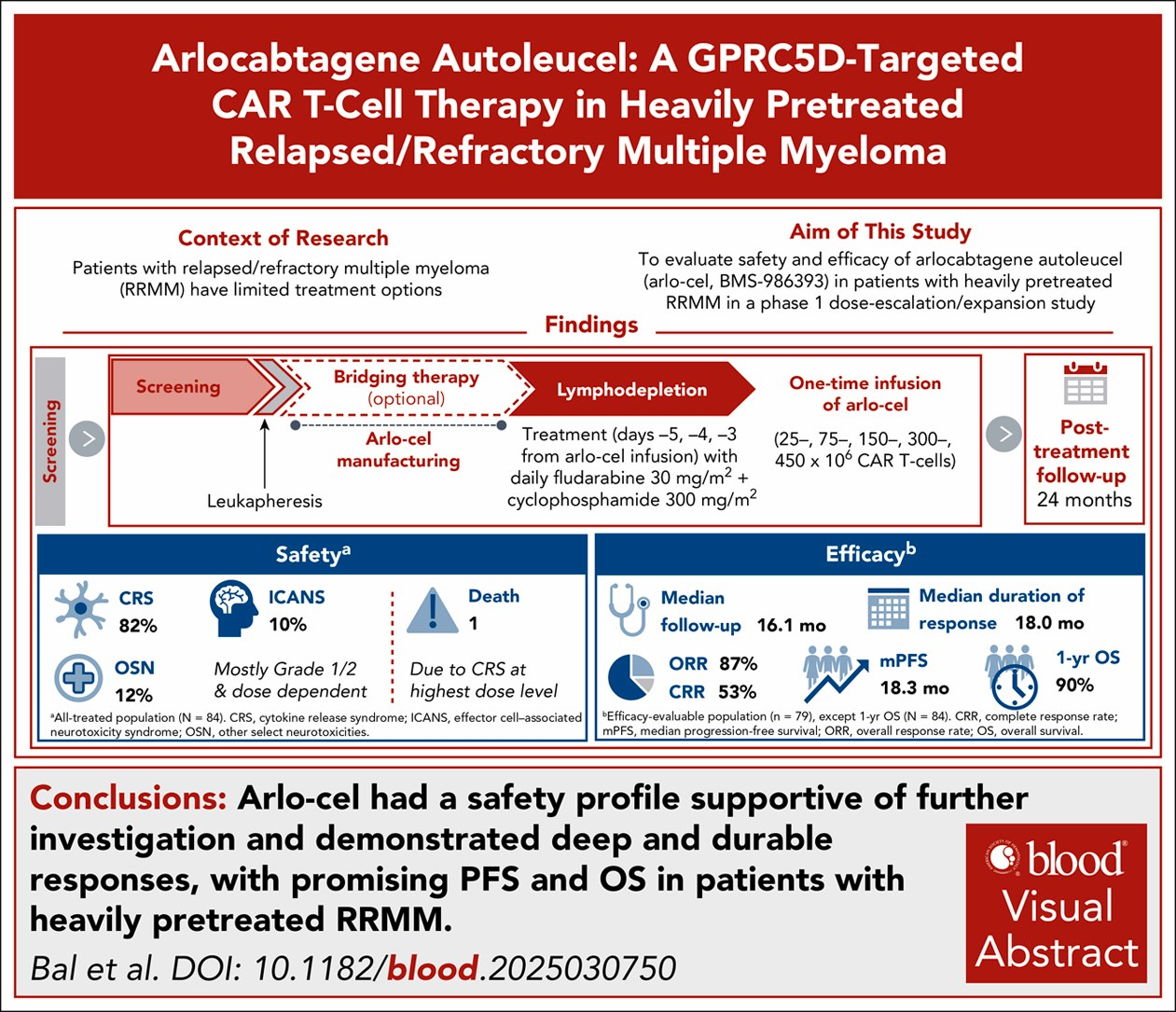
Highlight
- Arlocabtagene autoleucel (arlo-cel) is an autologous CAR T-cell therapy specifically targeting the novel antigen GPRC5D, expressed on multiple myeloma cells.
- The phase 1 study enrolled heavily pretreated patients with relapsed/refractory multiple myeloma (RRMM), including nearly half with prior BCMA-targeted therapy exposure.
- Arlo-cel demonstrated high overall response rates (87%) and durable responses with median progression-free survival (PFS) exceeding 18 months.
- The safety profile included manageable cytokine release syndrome (CRS) primarily of low grade and on-target off-tumor effects such as transient dermatologic and mucosal adverse events.
Study Background: Unmet Needs in Relapsed/Refractory Multiple Myeloma
Multiple myeloma (MM) is a malignancy of plasma cells characterized by complex treatment trajectories. While novel agents such as immunomodulatory drugs (IMiDs), proteasome inhibitors (PIs), and anti-CD38 antibodies have improved outcomes, the disease inevitably relapses and becomes refractory over time. For patients who have undergone multiple lines of therapy, especially those refractory to these standard classes and patients previously treated with B-cell maturation antigen (BCMA)-targeted therapies, therapeutic options remain limited, with poor prognosis and short survival durations. Thus, innovative treatments that can overcome resistance mechanisms and provide sustained disease control are urgently needed.
CAR T-cell therapy targeting BCMA has recently emerged as a promising approach, yet resistance and relapse following BCMA CAR T therapy are reported. Alternative antigen targets for CAR T therapy could expand the armamentarium and improve outcomes in heavily pretreated RRMM.
Study Design
This phase 1, dose-escalation and expansion trial investigated the safety, tolerability, and efficacy of arlocabtagene autoleucel (arlo-cel; BMS-986393), an autologous CAR T-cell therapy directed against G protein-coupled receptor class C group 5 member D (GPRC5D), a novel antigen selectively expressed on multiple myeloma cells but with limited normal tissue expression.
The study enrolled adult RRMM patients who had received ≥3 prior antimyeloma regimens, including an IMiD, PI, and anti-CD38 antibody. Importantly, 49% had prior BCMA-directed therapy exposure, reflecting a heavily pretreated and refractory population.
Arlo-cel was delivered as a single intravenous infusion with doses ranging from 25 million to 450 million CAR T cells. Primary endpoints included the assessment of safety and determination of maximum tolerated dose (MTD). Secondary endpoints comprised overall response rate (ORR), progression-free survival (PFS), overall survival (OS), and duration of response (DoR). The data cutoff for analysis was August 23, 2024.
Key Findings and Results
The trial enrolled 84 RRMM patients with a median of five prior treatment regimens. The efficacy and safety profile of arlo-cel is summarized below.
Efficacy:
- ORR was 87%, with a complete response (CR) rate of 53%, indicating deep remissions in a difficult-to-treat population.
- The median duration of response was 18.0 months, supporting sustained disease control post-infusion.
- Median PFS was 18.3 months (95% CI: 11.8-21.9), a notable improvement compared to historical data in comparable cohorts.
- One-year OS rate reached 90%, underscoring the survival benefit of this approach.
Safety:
- Cytokine release syndrome (CRS), a common CAR T-cell–related toxicity, occurred in 82% of patients, mainly grade 1 or 2, with frequency correlated to dose; a single fatal CRS event occurred at the highest dose level.
- Immune effector cell-associated neurotoxicity syndrome (ICANS) was observed in 10%, predominantly low-grade.
- Other neurotoxicities appeared in 12% of patients, and most neurological events were mild to moderate.
- On-target/off-tumor adverse events affecting skin (30%), nails (19%), and oral mucosa (32%) were generally grade 1 or 2 and transient, resolving without significant intervention. These effects reflect GPRC5D expression in non-malignant tissues but were manageable clinically.
- The MTD was not reached, supporting a favorable tolerability profile across dosing levels.
These results demonstrate arlo-cel’s potent anti-myeloma activity and an acceptable safety profile even in a population with prior BCMA-targeted therapy, which is notable given potential alterations in tumor antigen landscape and immune environment post-BCMA exposure.
Expert Commentary
The targeting of GPRC5D represents an innovative approach in the CAR T-cell therapeutic landscape for multiple myeloma. Unlike BCMA, GPRC5D offers a complementary antigenic target that may overcome resistance mechanisms linked to BCMA antigen loss or modulation.
This first-in-human data is encouraging, especially given the heavy pretreatment burden and prior exposure to BCMA therapies. The durability of responses and manageable safety suggest arlo-cel could fill an important therapeutic gap. Nevertheless, longer follow-up is needed to define long-term toxicity and durability fully. Additionally, mechanisms underlying off-tumor effects should continue to be explored, with supportive care guidelines refined accordingly.
Limitations include the single-arm phase 1 design and relatively small sample size, warranting further investigation in larger, randomized trials to confirm benefit and optimize dosing. Moreover, integration with other treatment modalities and sequencing strategies will be important to contextualize arlo-cel in the broader myeloma treatment algorithm.
Conclusion
Arlocabtagene autoleucel, a GPRC5D-targeted CAR T-cell therapy, has demonstrated deep and durable responses with a manageable safety profile in heavily pretreated RRMM patients, including those with prior BCMA-targeted treatment. This phase 1 study establishes the clinical potential of GPRC5D as a CAR T-cell target and supports further clinical development. Arlo-cel may represent an important advancement in overcoming therapeutic resistance and improving outcomes in a challenging patient population.
Funding and Clinical Trial Registration
This study was supported and funded by Bristol Myers Squibb. The clinical trial was registered on ClinicalTrials.gov under identifier NCT04674813.
References
1. Bal S, et al. Arlocabtagene autoleucel: a GPRC5D-targeted CAR T-cell therapy for heavily pretreated relapsed/refractory multiple myeloma. Blood. 2026;148(10):1240-1250. doi:10.1182/blood.2026000001
2. Kumar SK, et al. Relapsed multiple myeloma: therapeutic challenges and future options. Cancer. 2017;123(20):3902-3910.
3. Cohen AD, et al. B-cell maturation antigen–directed CAR T-cell therapies for multiple myeloma: current challenges and future perspectives. Hematology Oncology Clinics of North America. 2023;37(1):39-55.
4. Raje N, et al. Anti-BCMA CAR T-cell therapy BB2121 in relapsed or refractory multiple myeloma. N Engl J Med. 2019;380(18):1726-1737.