Highlight
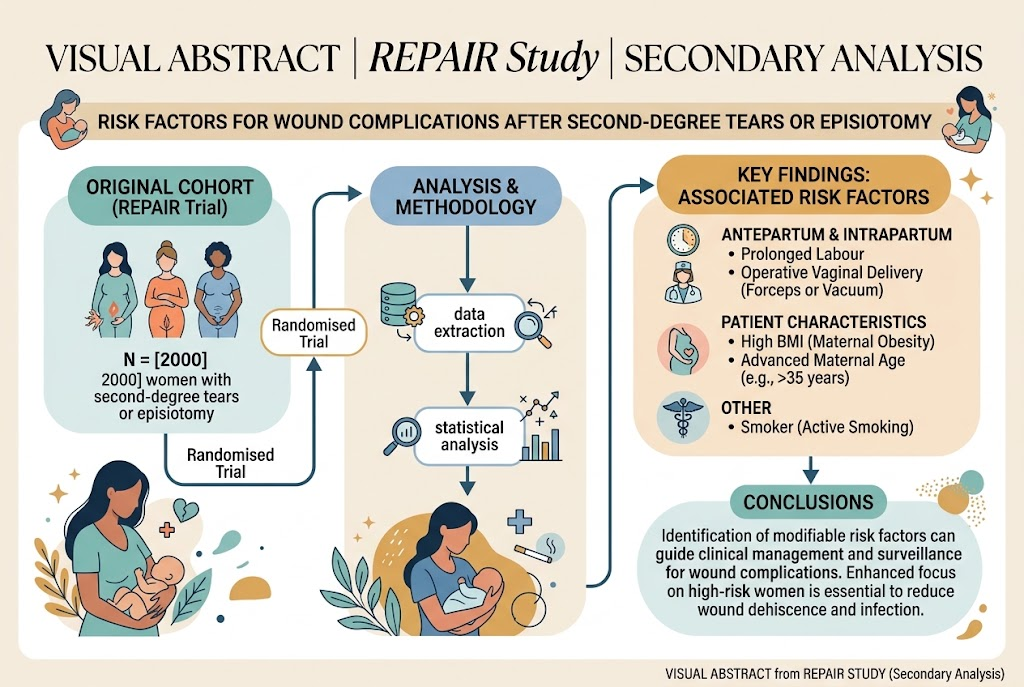
- Prolonged active second stage of labor and deep second-degree perineal tears significantly increase the risk of wound complications post-delivery.
- Doctor involvement in suturing correlates with higher wound complication risk, possibly reflecting greater injury complexity.
- Prophylactic administration of amoxicillin-clavulanic acid markedly reduces the incidence of wound complications.
- Episiotomy was not independently associated with wound complications but remains a borderline factor warranting close monitoring.
Study Background
Perineal trauma during vaginal delivery is common, with second-degree tears and episiotomy frequently occurring. While obstetric anal sphincter injuries have been extensively studied in the context of wound complications, data regarding risk factors for complications following second-degree tears or episiotomy remain scarce. Identifying these risk factors is critical for preventing adverse postpartum outcomes, such as infection, dehiscence, and delayed healing, which can significantly impair maternal wellbeing and quality of life.
Study Design
The analysis is based on data collected from the REPAIR randomized controlled trial conducted between March and December 2023 at a university hospital in the Capital Region of Denmark. The trial enrolled 442 women with confirmed second-degree perineal tears or episiotomy after childbirth. Participants were randomized to receive either prophylactic antibiotics (amoxicillin-clavulanic acid) or placebo. This secondary analysis combined all participants into a single cohort to explore associations between obstetric, clinical, and repair-related factors and the development of clinically relevant wound complications. Candidate variables were selected based on prior literature and clinical judgment. Multivariable logistic regression models were used to adjust for potential confounders with effect sizes reported as adjusted odds ratios (aORs) and 95% confidence intervals (CIs).
Key Findings
Out of 433 women who attended the initial postpartum consultation, 55 (12.7%) developed clinically relevant wound complications, defined by criteria including infection, delayed healing, or dehiscence requiring clinical intervention.
Significant risk factors identified included:
- Prolonged active second stage of labor: This was associated with a more than twofold increased risk of wound complications (aOR 2.25, 95% CI 1.11 to 4.46), suggesting that increased duration of pushing may contribute to tissue ischemia or trauma extending beyond initial tearing.
- Deep tear: Defined as lacerations involving deeper perineal muscles, these injuries doubled the risk of wound complications (aOR 2.11, 95% CI 1.10 to 4.24), underscoring the importance of carefully managing more extensive tissue damage.
- Doctor involvement in suturing: Surgeries performed by physicians rather than midwives were independently associated with higher complication rates (aOR 2.47, 95% CI 1.20 to 4.96). This may reflect confounding by indication, with more complex or severe tears being repaired by doctors.
- Prophylactic antibiotics: Receiving amoxicillin-clavulanic acid prophylaxis was protective against wound complications, reducing risk by approximately two-thirds (aOR 0.34, 95% CI 0.18 to 0.65).
- Episiotomy: Not statistically significant in adjusted analysis (aOR 2.01, 95% CI 0.92 to 4.21), episiotomy’s borderline association justified its retention in the models due to prior literature supporting its role as a relevant factor.
The findings emphasize multifactorial contributors to poor wound healing in this patient group and highlight the potential benefit of selective antibiotic prophylaxis to mitigate infection risk.
Expert Commentary
This secondary analysis of a rigorously conducted randomized trial provides valuable insights into modifiable and non-modifiable risk factors for perineal wound complications following second-degree tears or episiotomy. Prolonged active second stage labor and deep tissue injury logically predispose to wound healing challenges due to ischemia and mechanical tissue trauma.
Interestingly, the association of physician involvement in suturing with increased complications likely reflects case complexity rather than skill, as more severe tears are typically managed by doctors. This underscores the need for refined clinical protocols to identify and monitor high-risk wounds irrespective of the provider.
The protective role of prophylactic antibiotics aligns with growing evidence favoring selective antibiotic use in perineal repair to prevent infection and promote healing, especially in higher-risk cases.
However, this study’s exploratory design and single-center cohort limit generalizability. Residual confounding, especially related to tear severity classification and repair technique nuances, may influence observed associations. Future multicenter studies with detailed mechanistic and microbiological assessments would help confirm these findings and guide tailored postpartum care strategies.
Conclusion
In women experiencing second-degree perineal tears or episiotomy, prolonged active second stage of labor, deep tear extent, and physician involvement in suturing were associated with higher risk of wound complications, while prophylactic amoxicillin-clavulanic acid significantly reduced this risk. These data support consideration of targeted postpartum follow-up and selective antibiotic prophylaxis protocols for high-risk women to optimize healing outcomes.
Clinicians should remain vigilant for complicated perineal wounds, particularly in patients with prolonged labor or deeper tears, and ensure appropriate management to minimize infection and morbidity. Further research is warranted to refine risk stratification and preventive strategies in diverse obstetric populations.
Funding and Trial Registration
The REPAIR study was conducted at a university hospital in the Capital Region of Denmark with no specific funding details provided. The clinical trial was registered as part of the original publication.
References
- Perslev K, Klarskov N, Bergholt T, Jangö H. Risk factors for wound complications after second-degree tears or episiotomy – a secondary analysis of the REPAIR study. Am J Obstet Gynecol. 2026 Sep 14; PMID: 42735828.
- Sheiner E, Srugo I, Hallak M, et al. Episiotomy and wound infection: risk factor analysis. Int J Gynaecol Obstet. 2000;70(2):149-153.
- Carroli G, Mignini L. Episiotomy for vaginal birth. Cochrane Database Syst Rev. 2009;(1):CD000081.
- Everett TR, Jeffries DP, Jay A, et al. Prophylactic antibiotics for the prevention of postpartum perineal wound infection. J Obstet Gynaecol. 2004;24(3):282-287.