Introduction
Physical activity is widely recognized as a cornerstone of cardiovascular health throughout life. For children and adolescents, establishing active habits not only supports current well-being but may also mitigate future risks of developing cardiometabolic diseases such as diabetes, hypertension, and elevated cholesterol. However, while public health guidelines encourage youth to engage daily in moderate to vigorous physical activities, questions remain about the precise magnitude of benefit such activity offers to cardiometabolic risk profiles and whether reducing sedentary time independently contributes to better cardiovascular health.
Most previous studies addressing these questions have relied on self-reported activity, have been cross-sectional, or involved small sample sizes, limiting clarity. Moreover, patterns and impact of physical activity might differ subtly by intensity and over time during the evolving physiology of childhood and adolescence.
What the Data Tell Us: Insights from Device-Measured Activity
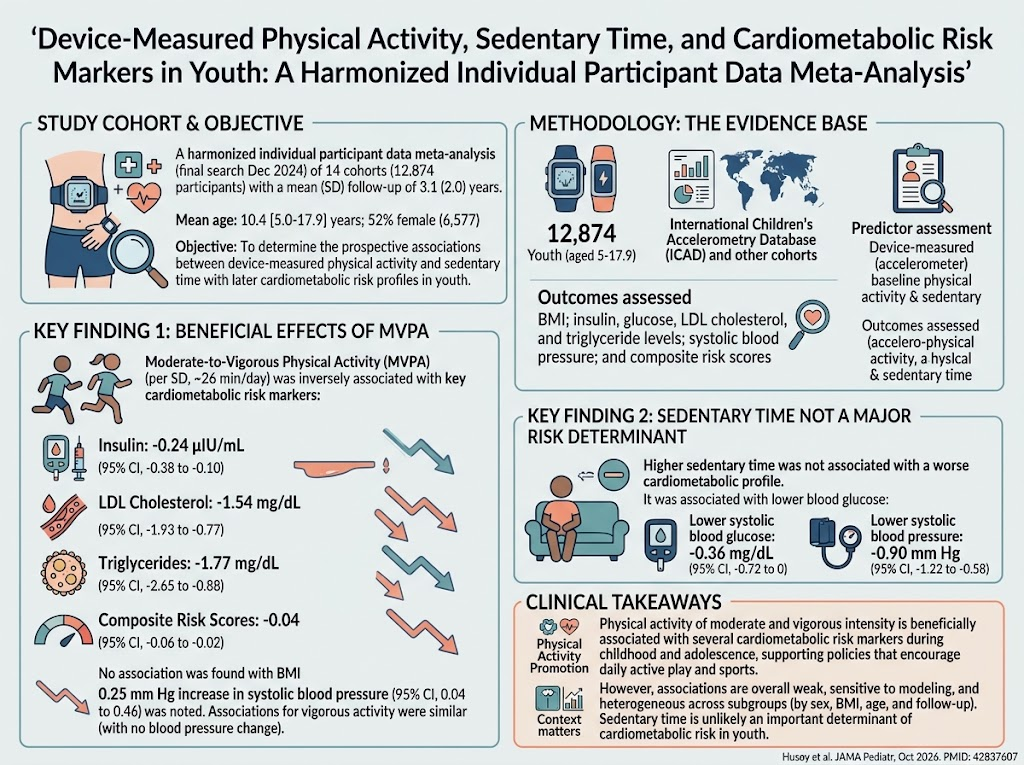
A groundbreaking individual participant data meta-analysis published recently in JAMA Pediatrics (Husøy et al., 2026) offers some clarity. The study pooled data from 14 cohorts, comprising nearly 13,000 children and adolescents aged 5 to 18 years, who wore accelerometers to objectively measure their physical activity and sedentary time at baseline and were followed for an average of three years. These high-quality data allowed the researchers to analyze longitudinal associations of varying intensities of physical activity and sedentary behavior with cardiometabolic risk markers — including body mass index (BMI), insulin, glucose, LDL cholesterol, triglycerides, and systolic blood pressure.
Key Findings on Physical Activity
The analysis showed that moderate to vigorous physical activity (MVPA), quantified as an additional 26 minutes per day, was modestly but significantly associated with:
– Lower insulin levels (-0.24 µIU/mL per SD increase), indicating improved insulin sensitivity.
– Reduced LDL cholesterol levels (-1.54 mg/dL), a favorable change concerning atherosclerosis risk.
– Lower triglyceride levels (-1.77 mg/dL), suggesting improved lipid metabolism.
– Reduced composite cardiometabolic risk scores.
Interestingly, MVPA was not associated with changes in BMI, indicating that metabolic benefits appear independent of weight changes. Also, there was a slight association of MVPA with increased systolic blood pressure, though this finding was sensitive to analysis approaches and not seen with vigorous intensity activity alone.
Findings on Sedentary Time
Contrary to common assumptions, increased sedentary time was not linked with a worse cardiometabolic profile in this cohort. Instead, it was associated with modestly lower blood glucose and systolic blood pressure. These surprising findings suggest sedentary time alone may be a less critical marker of cardiometabolic risk during youth compared to physical activity levels.
Variables Modifying the Associations
The researchers noted that the magnitudes and directions of these relationships were influenced by several factors — including model choice, sex, baseline BMI, age at baseline, and length of follow-up — underscoring the complexity of these associations and the need for nuanced interpretation.
Common Misconceptions About Physical Activity and Sedentary Behavior
- Misconception: Sedentary time is always harmful to youth cardiometabolic health.
Reality: This study suggests sedentary time may not independently elevate cardiometabolic risk in children and adolescents.
- Misconception: Physical activity must cause weight loss to confer cardiometabolic benefits.
Reality: Metabolic improvements from physical activity can occur without BMI changes, reflecting influences beyond weight.
- Misconception: Only vigorous-intensity activity matters.
Reality: Moderate intensity activity also confers clear cardiometabolic benefits, expanding the range of beneficial exercises.
Practical Recommendations for Youth Health
Experts emphasize encouraging consistent moderate to vigorous physical activity daily. This includes:
– Activities such as brisk walking, running, cycling, sports (e.g., soccer, basketball), playing active games, and dancing.
– Avoiding prolonged bouts of inactivity but recognizing that the total amount and intensity of activity matter more than simply sitting less.
– Recognizing that metabolic health benefits are achievable even if weight remains stable, reinforcing the importance of fitness beyond the scale.
Schools, families, and communities should foster environments that support and facilitate physical activity opportunities—for example, through active commuting, access to sports facilities, and limiting excessive screen time without creating anxiety about every moment spent sedentary.
Expert Insights
Dr. Lisa Sherar, a co-author and expert in pediatric exercise science, notes, “Our findings highlight that moderate-to-vigorous activity is crucial during formative years for metabolic health, but the relationship is nuanced. We must communicate that all movement counts and is beneficial, not just intense workouts. Sedentary time, while important to monitor, may not independently dictate risk as previously thought.”
Patient Scenario: Meet Emily
Emily is a 12-year-old girl who enjoys playing video games and reading but also loves riding her bike and occasionally going to soccer practice. Her pediatrician uses an accelerometer to monitor her physical activity levels during a well-child visit. Although Emily’s BMI is normal, the device shows low moderate-to-vigorous activity levels. The physician advises Emily and her family to gradually increase daily physical activities around 30 minutes, like brisk walking or cycling, emphasizing that these will improve her heart health markers even if her weight doesn’t change dramatically. They also discuss that sitting and screen time are fine in moderation, focusing on fun, sustainable active habits.
Conclusion
This landmark meta-analysis reinforces that physical activity of moderate to vigorous intensity is beneficially linked to improved insulin sensitivity, lipid profiles, and overall cardiometabolic risk markers in children and adolescents. These benefits appear independent of body weight and contrast with the minimal impact of sedentary time alone on cardiometabolic risk during youth.
While the associations are modest and influenced by various factors, the findings affirm the importance of encouraging regular, enjoyable physical activity in young populations as an effective investment in long-term cardiovascular health. Future research should continue to explore the mechanisms, refine guidelines, and develop tailored interventions to optimize youth cardiometabolic outcomes.
Funding and ClinicalTrials.gov
Funding was provided by international research institutions and government grants supporting the International Children’s Accelerometry Database and related cohort studies. No specific clinical trials registration applies to this meta-analysis.
References
Husøy A, Dalene KE, Hansen BH, Sherar LB, van Sluijs E, Anderssen SA, Steene-Johannessen J, Bugge A, Damsgaard CT, Wedderkopp N, Resaland GK, Corpeleijn E, Yang L, Hebestreit A, Buck C, Lauria F, Veidebaum T, Hadjigeorgiou C, De Henauw S, Lissner L, Molnár D, Moreno LA, Henderson M, Mathieu ME, Harnois-Leblanc S, Salmon J, Verswijveren SJJM, Castro-Piñero J, Veiga OL, Northstone K, Møller NC, Kristensen PL, Sardinha LB, Kriemler S, Hallal PC, Crochemore-Silva I, Ekelund U, Tarp J, International Children’s Accelerometry Database (ICAD) Collaborators. Device-Measured Physical Activity, Sedentary Time, and Cardiometabolic Risk Markers in Youth: A Harmonized Individual Participant Data Meta-Analysis. JAMA Pediatr. 2026 Oct 6. doi:10.1001/jamapediatrics.2026.42837607. PMID: 42837607.
Additional reading:
– World Health Organization. Guidelines on physical activity and sedentary behaviour. WHO; 2020.
– Strong WB, et al. Evidence based physical activity for school-age youth. J Pediatr. 2005;146(6):732-737.