Highlight
- Dynamic computer-assisted implant surgery (d-CAIS) achieves low angular and linear deviations in fully edentulous patients.
- Mean platform and apex deviations are approximately 1.06 mm and 1.07 mm respectively, indicating high spatial accuracy.
- Patient age, implant jaw location, implant region, healing status, and pterygoid implant placement significantly influence surgical precision.
- Understanding factors associated with increased deviations can optimize planning and improve outcomes in complex implant cases.
Study Background
Fully edentulous patients present a substantial rehabilitative challenge in dental implantology due to the complete absence of teeth, which normally serve as anatomical reference points for implant placement. Traditional freehand placement risks inaccuracies that can compromise prosthetic fit, function, and long-term success. Dynamic computer-assisted implant surgery (d-CAIS) incorporates real-time tracking and guidance systems to enhance implant positioning accuracy. Despite its increasing adoption, there remains limited evidence regarding its precision specifically in fully edentulous patients, particularly in private practice settings where anatomical landmarks are scarce. This study addresses an unmet clinical need to quantify accuracy in this population and to elucidate factors influencing implant placement deviations, informing surgical planning and risk stratification.Study Design
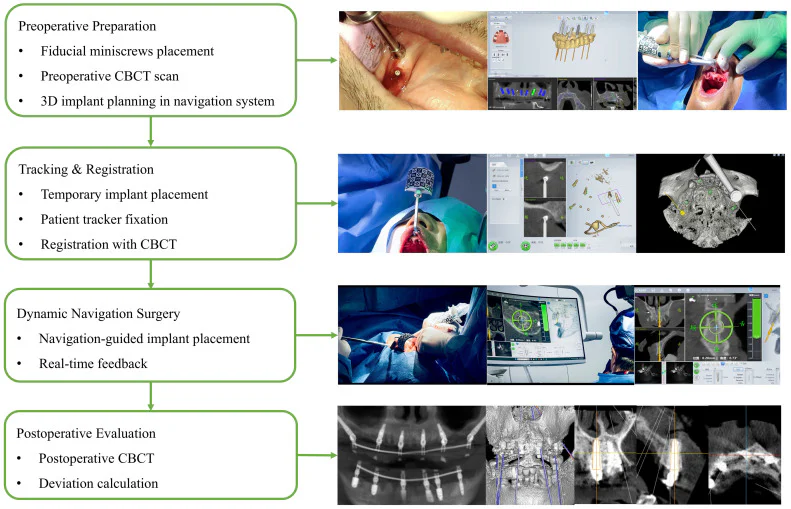
This retrospective cohort study included 107 fully edentulous patients treated with d-CAIS from June 2020 to September 2025 in a private practice environment. A total of 500 dental implants were placed using dynamic navigation technologies. Each patient underwent preoperative and postoperative cone beam computed tomography (CBCT) scans. Postoperative scans were superimposed on preoperative plans to calculate deviations in angular orientation and linear positioning at both implant platform and apex. The primary endpoints were mean angular deviation and mean global linear deviations. Secondary analyses identified patient- and implant-related factors associated with measurement deviations, using generalized estimating equation (GEE) models to account for clustering of multiple implants within patients. Statistical significance was set at p < 0.05.Key Findings
The overall accuracy of d-CAIS in this fully edentulous cohort was demonstrated by a mean angular deviation of 1.87 ± 1.65°. Linear deviations at the implant platform and apex averaged 1.06 ± 0.58 mm and 1.07 ± 0.60 mm, respectively, representing minimal spatial discrepancies relative to planned implant positions. The mean directional apical depth deviation was slightly negative (-0.10 ± 0.84 mm), indicating a small tendency toward shallower implant placement, while the mean absolute apical depth deviation was 0.60 ± 0.59 mm. Notably, implant placement deviations varied significantly with several factors: – Patient age: Older patients showed increased deviations, suggesting potential challenges with bone quality or anatomical considerations impacting navigation fidelity. – Jaw type: Implants placed in the maxilla exhibited larger deviations compared to the mandible, likely due to anatomical complexity and bone density differences. – Implant region: Anterior implants demonstrated greater positional deviations than posterior implants, possibly reflecting limited access or visibility. – Placement site: Post-extraction implant sites had higher deviations than healed sites, indicating the influence of immediate placement conditions. – Pterygoid implants: These presented with significantly increased deviations, underlining the technical difficulty of navigating posterior maxillary zones. These results attest to the robust accuracy of d-CAIS while highlighting patient and surgical anatomy factors that may necessitate enhanced intraoperative vigilance or adjunctive planning.Expert Commentary
This retrospective analysis reinforces dynamic navigation as a reliable modality for implant placement in challenging fully edentulous patients. The reported angular and linear deviations are consistent with or better than previously published benchmarks for guided implant surgery. The utilization of GEE modeling strengthens the validity of associations by appropriately controlling for inter-implant correlations within individuals. Limitations include the study’s retrospective nature and confinement to a single private clinical setting, which may affect generalizability. Additionally, factors such as surgical expertise, navigation system type, and patient-specific bone density were not exhaustively controlled. Prospective multi-center trials incorporating patient-reported outcomes and long-term implant survival data would further consolidate evidence for d-CAIS in this demographic. Biologically, decreased accuracy in the maxilla and post-extraction sites correlates with softer bone substrates and dynamic anatomical changes post-extraction. The increased deviations with age may be attributable to osteoporotic tendencies affecting fixation and tracking fidelity.Conclusion
Dynamic computer-assisted implant surgery offers high precision for implant placement in fully edentulous patients within private practice, overcoming challenges posed by the absence of natural anatomical references. This technique yields minimal angular and linear deviations, comparable with or exceeding traditional navigation methods. Awareness of factors affecting accuracy—such as patient age, jaw, implant location, and site condition—can guide clinicians in tailoring surgical strategies and improving outcomes for complex edentulous rehabilitation. Further research should explore integration with adjunctive tools, cost-effectiveness, and long-term prosthetic success to fully establish clinical benefits.Funding and ClinicalTrials.gov
The original study did not specify funding sources or clinical trial registration.References
1. Block MS, Emery RW. Static or dynamic navigation for implant placement—choosing the method of guidance. J Oral Maxillofac Surg. 2016;74(2):269-277. 2. Tahmaseb A, et al. Computer technology applications in surgical implant dentistry: a systematic review. Int J Oral Maxillofac Implants. 2014;29 Suppl:25-42. 3. Park JH, et al. Accuracy of dynamic navigation compared to that of static surgical guide system for implant placement: a systematic review and meta-analysis. Clin Oral Investig. 2021;25(11):6391-6403. 4. Van de Wiele B, et al. Dynamic navigation—guided implant surgery: A prospective clinical study and comparative analysis. J Prosthet Dent. 2021;125(4):589-594. 5. Vercruyssen M, et al. Assessment of the accuracy of a customized drill guide template system for guided implant surgery: randomized controlled clinical trial. Clin Implant Dent Relat Res. 2014;16(5):738-750.Specialty calculators
For clinical reference; use professional judgment.