Highlight
Distal upper extremity nerve injuries not only cause functional disability but also impose substantial personal financial burden even when patients have insurance coverage. Nearly half of patients report financial hardship, with heightened financial worry linked to previous debt, complexity of surgery, injury location, younger age, and male sex. The findings call for early identification of at-risk patients to provide proactive financial counseling and multidisciplinary support.
Study Background
Upper extremity nerve injuries, particularly those affecting distal nerves in the hand and wrist, contribute significantly to disability and impaired quality of life due to loss of sensation and motor function. This functional impairment often affects daily activities and work capability, thereby incurring socioeconomic consequences. While the clinical and rehabilitation aspects of these injuries are widely studied, the personal financial impact on patients remains inadequately characterized. Given rising healthcare costs and complexity of nerve repair surgeries, evaluating the financial burden and factors that exacerbate it is critical for comprehensive patient care.
Study Design
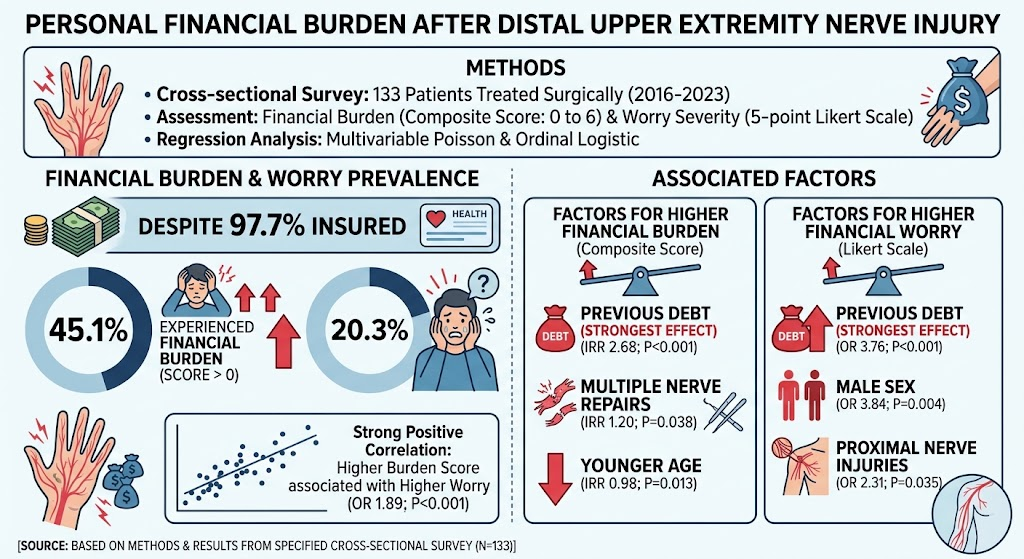
This study employed a cross-sectional survey design, enrolling 133 patients who underwent surgical treatment for upper extremity nerve injuries between 2016 and 2023. The cohort included patients with nerve injuries at various locations, including digital (distal) and more proximal sites. Financial burden was assessed using a composite score ranging from 0 to 6, incorporating factors such as out-of-pocket costs, lost wages, and debts related to the injury and treatment. Financial worry was measured on a 5-point Likert scale, capturing patients’ subjective stress about finances. Multivariable Poisson regression models assessed associations with composite financial burden scores, while ordinal logistic regression was used for financial worry scores. Analyses were stratified by injury location and surgical complexity to discern distinct risk profiles.
Key Findings
The study population was predominantly insured, with 97.7% coverage, yet 45.1% reported experiencing some degree of financial burden post-surgery. Moreover, 20.3% of patients indicated high levels of financial worry. Statistical analysis revealed a significant association between higher financial burden scores and greater financial worry (OR 1.89, P < 0.001), indicating that tangible financial hardship correlates closely with psychological distress related to finances.
Among the investigated risk factors, preexisting debt emerged as the strongest predictor of both financial burden (incidence rate ratio [IRR] 2.68, P < 0.001) and financial worry (odds ratio [OR] 3.76, P < 0.001). This highlights the compounded vulnerability of patients already facing economic challenges prior to injury.
Patients with proximal nerve injuries were more than twice as likely to experience financial worry compared to those with distal injuries (OR 2.31, P = 0.035). Male patients similarly demonstrated significantly greater financial worry (OR 3.84, P = 0.004), suggesting potential gender differences in financial impact or perception.
Additional associations included younger age correlating with higher financial burden scores (IRR 0.98 per year increase, P = 0.013), and patients undergoing multiple nerve repairs had a 20% higher financial burden (IRR 1.20, P = 0.038). These findings indicate that both the complexity of the injury and the patient’s life stage influence financial outcomes.
Expert Commentary
This study contributes essential insights into the often-overlooked economic consequences of upper extremity nerve injuries. Despite widespread insurance coverage, financial hardship remains prevalent, underscoring systemic gaps such as inadequate coverage of indirect costs like lost wages and ancillary expenses. The strong impact of preexisting debt on financial outcomes calls for targeted social and financial interventions early in the treatment course.
The associations with younger age and male sex might relate to differing employment patterns, financial responsibilities, or social determinants of health, meriting further research. Clinicians should recognize these risk factors to implement risk-targeted screening tools that identify vulnerable patients promptly.
Limitations include the cross-sectional design that restricts causal inference, potential selection bias from a surgical cohort, and reliance on self-reported financial measures. Future prospective studies should incorporate detailed economic analyses and patient-reported outcome measures over longer follow-up intervals.
Conclusion
In summary, distal upper extremity nerve injuries lead to substantial personal financial burden and psychological stress related to finances, even among insured patients. This burden is pronounced in younger males, those with proximal injuries, greater surgical complexity, and patients with prior debt. Implementing multidisciplinary approaches including financial counseling, social support services, and early risk identification may help mitigate these burdens and improve overall patient well-being and recovery trajectories.
Funding and ClinicalTrials.gov
The original study did not specify funding sources or clinical trial registration in the abstract. Further details may be accessed through the original publication.
References
1. Moussa O, Raasveld FV, Amin K, Werenski JO, Chen NC, Bhashyam AR, Tuaño KR, Eberlin KR. Personal Financial Burden after Distal Upper Extremity Nerve Injury. Plast Reconstr Surg. 2026 Aug 26;158(3):477-488. PMID: 42647886.
2. Tung TH, Mackinnon SE. Nerve injuries and their repair. In: Green’s Operative Hand Surgery. 7th ed. Elsevier; 2016.
3. Nicholas JM, et al. Financial toxicity associated with injury care: a systematic review. Injury. 2018;49(7):1240-1247.
4. Turvey CL, et al. Socioeconomic impact of hand and upper limb trauma. Hand Clin. 2013;29(3):363-374.