Highlight
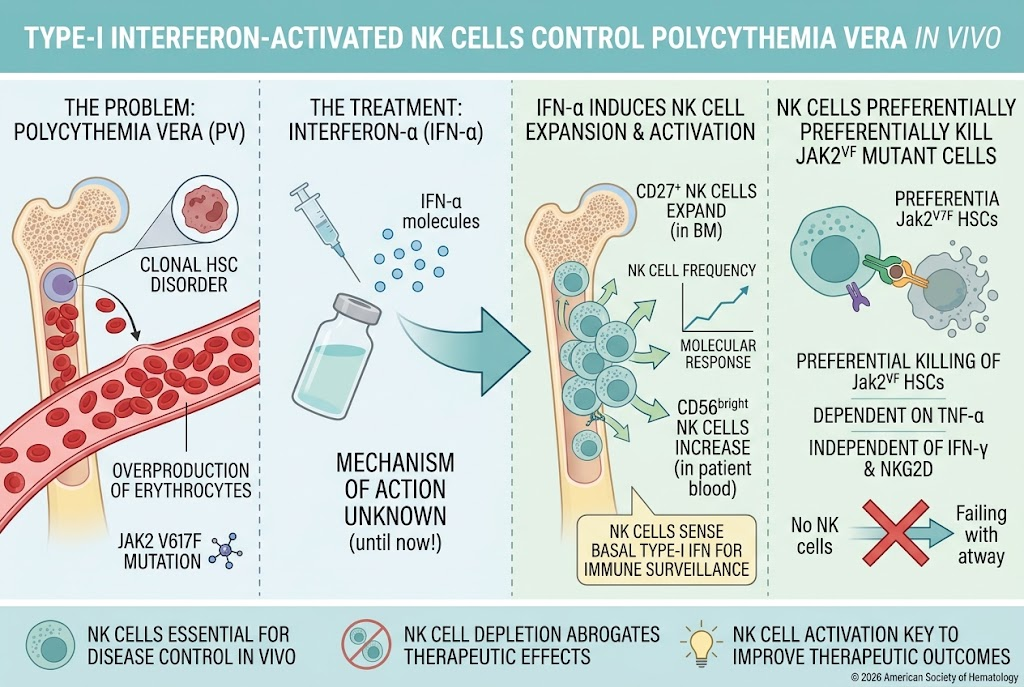
- Type-I interferon (IFN-α) activates NK cells, particularly CD27+ and CD56bright subsets, enhancing immune-mediated control of polycythemia vera (PV).
- NK cell-mediated killing of Jak2VF mutant hematopoietic stem and progenitor cells occurs via a TNF-α-dependent mechanism, independent of IFN-γ or NKG2D pathways.
- Basal sensing of type-I interferon by NK cells is crucial for maintaining disease control even without exogenous IFN-α therapy.
- Depletion or impaired type-I interferon signaling in NK cells accelerates PV progression, underscoring their pivotal role in immune surveillance and therapeutic response.
Study Background
Polycythemia vera (PV) is a chronic myeloproliferative neoplasm characterized by clonal expansion of hematopoietic stem cells (HSCs) harboring the Jak2VF mutation, leading to excessive production of erythrocytes. Clinically, PV is associated with complications such as thrombosis, hemorrhage, and progression to myelofibrosis or acute leukemia. Managing PV involves controlling blood counts and mitigating symptom burden to reduce morbidity and mortality.
Interferon alfa (IFN-α), a type-I interferon, has demonstrated clinical efficacy in PV and other myeloproliferative neoplasms (MPNs) by inducing hematologic and molecular remissions. However, the exact mechanisms by which IFN-α modulates disease progression remain incompletely defined. While IFN-α is known to exert antiproliferative and immunomodulatory effects, the specific roles of innate immune components, particularly natural killer (NK) cells, in mediating therapeutic benefit have not been fully elucidated.
Study Design
The referenced study employed a comprehensive approach combining in vivo, ex vivo, and clinical analyses to dissect the immunological mechanisms underpinning IFN-α therapy in PV. A transgenic mouse model expressing the Jak2VF mutation recapitulated PV pathology, enabling in vivo evaluation of NK cell dynamics and disease progression with and without IFN-α treatment.
In parallel, peripheral blood samples from patients with PV or essential thrombocythemia (ET) undergoing IFN-α therapy were analyzed to assess NK cell subset frequencies and correlate immunophenotypic changes with molecular disease response. Additionally, NK cell depletion experiments and selective deletion of the type-I interferon receptor on NK cells in mice provided mechanistic insights into the importance of NK cells and type-I interferon signaling.
In vitro assays evaluated NK cell cytotoxicity against Jak2VF mutant hematopoietic progenitors and elucidated effector pathways involved in target cell killing.
Key Findings
The study revealed several critical findings:
IFN-α Induces Expansion of Specific NK Cell Subsets
Treatment with IFN-α in the murine PV model led to a marked expansion of CD27+ NK cells within the bone marrow. Likewise, patients receiving IFN-α therapy demonstrated increased frequencies of CD56bright NK cells in peripheral blood. Importantly, the elevation of these NK subsets correlated with improved molecular responses, suggesting their active involvement in disease control.
NK Cells Are Essential Mediators of IFN-α Therapeutic Effect
Functional depletion of NK cells in vivo abrogated the beneficial effects of IFN-α on PV disease parameters, unequivocally identifying NK cells as key effectors of therapy. This was further substantiated by accelerated disease progression in mice lacking type-I interferon receptor expression specifically on NK cells, even in the absence of external IFN-α treatment.
Mechanisms of NK Cell-Mediated Cytotoxicity Against Mutant Hematopoietic Cells
Ex vivo cytotoxicity assays demonstrated that NK cells preferentially targeted Jak2VF mutant HSCs and progenitors. This killing was dependent on tumor necrosis factor-α (TNF-α) secretion but independent of IFN-γ and the activating receptor NKG2D, delineating a unique effector pathway.
Basal Type-I Interferon Signaling Is Required for Immune Surveillance
Evidence indicated that endogenous low-level type-I interferon signaling in NK cells plays an indispensable role in restraining PV progression under steady-state conditions, highlighting the physiological importance of this axis for immune surveillance.
Expert Commentary
This study advances our understanding of IFN-α immunotherapy mechanisms in MPNs by highlighting a critical, previously underappreciated role of NK cells. The identification of CD27+ and CD56bright NK cell expansion as correlates of therapeutic response provides a rational biomarker framework for clinical monitoring.
Notably, the TNF-α-dependent cytotoxicity pathway suggests potential combinatorial therapeutic avenues targeting inflammatory cytokines or enhancing NK cell function. This mechanism is distinct from classical NK cell activation routes and may inform the development of novel immune-modulatory agents.
The demonstration that basal type-I interferon sensing by NK cells is necessary for disease control independent of therapy suggests that strategies augmenting endogenous interferon signaling could further improve patient outcomes.
Limitations include reliance on a murine PV model that, while recapitulating key features, may not fully capture the complexity of human disease. Additionally, the functional heterogeneity of NK cells and the impact of the tumor microenvironment warrant further investigation.
Conclusion
This study elucidates a pivotal role for type-I interferon-activated NK cells in controlling polycythemia vera through targeted elimination of Jak2VF mutant hematopoietic cells via TNF-α-dependent mechanisms. These findings enhance our mechanistic understanding of IFN-α therapy and underscore NK cells as promising immunotherapeutic targets in MPN.
Future research should focus on translating these insights to clinical practice by optimizing NK cell activation, exploiting TNF-α pathways, and identifying predictive biomarkers to personalize IFN-α treatment. This work ultimately opens avenues for novel immunotherapies aimed at durable disease control and improved patient quality of life in PV and related disorders.
Funding and ClinicalTrials.gov
The study was supported by institutional funding from associated German research centers and hematology departments. No clinical trial registration number is provided as this was a preclinical and correlational clinical cohort investigation.
References
1. Lossa J, Schnöder TM, Ronge Z, et al. Type-I interferon-activated NK cells control polycythemia vera in vivo. Blood. 2026;148(11):1454-1465. PMID: 42233405.
2. Scott LM, et al. Jak2 mutations in polycythemia vera. N Engl J Med. 2007;356(5):565-74.
3. Kiladjian JJ, et al. Interferon-alpha therapy for polycythemia vera. Best Pract Res Clin Haematol. 2016;29(3):270-79.
4. Vivier E, et al. Functions of natural killer cells. Nat Immunol. 2008;9(5):503-10.
5. Demaria O, et al. Type I interferons as bridges between innate and adaptive immunity. Nat Rev Immunol. 2019;19(1):21-32.