Background
Chagas disease, caused by the parasite Trypanosoma cruzi, remains one of the most neglected tropical diseases globally, affecting an estimated 7.5 to 10.5 million people primarily in Latin America. It is a chronic condition that profoundly impacts the heart, leading to Chagas cardiomyopathy—a major form of heart disease resulting in heart failure, arrhythmias, and sudden death. Early diagnosis of Chagas disease is crucial as timely antiparasitic treatment can forestall disease progression and improve patient outcomes. However, screening efforts have traditionally been challenging due to limited healthcare access and the often silent nature of early infection.
Routine electrocardiography (ECG), a widely accessible tool in cardiological practice, presents a valuable opportunity to detect previously unrecognized Chagas disease. Recent advancements in artificial intelligence (AI) have opened new avenues to automatically analyze ECGs with enhanced sensitivity to disease signatures that may elude conventional interpretation.
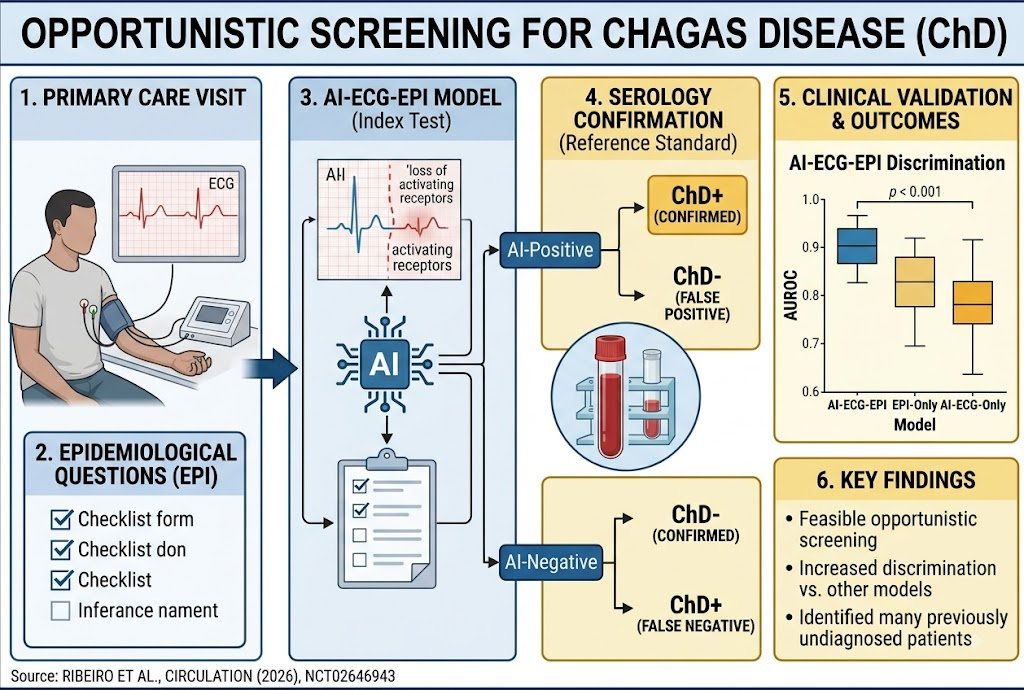
A groundbreaking prospective study conducted in endemic and hyperendemic regions of Brazil evaluated the usefulness of an AI-enabled ECG model, enhanced with epidemiological questions—termed the AI-ECG-EPI model—as a tool for opportunistic Chagas disease screening within a public telecardiology network.
Scientific Evidence: What the Data Show Us
The study, embedded in the Telehealth Network of Minas Gerais, included over 75,000 adults undergoing routine tele-ECGs between October 2023 and September 2024. From these, approximately 59,000 ECGs were analyzed with the AI-ECG-EPI model, which combined ECG data with three key epidemiological questions indicative of Chagas risk.
About 11.5% of individuals screened positive. A subset of these positives, alongside a random sample of negatives, were invited for confirmatory serological testing, considered the reference standard. Among those tested, 36.8% of the AI-ECG-EPI positives had confirmed Chagas disease versus 9.3% of the negatives. The model demonstrated a diagnostic sensitivity of 34.3% and a high specificity of 91.6%, reflecting strong ability to correctly identify individuals without the disease while moderately detecting true cases. Importantly, the AI-ECG-EPI model outperformed models based on epidemiological questioning alone and AI analysis of ECG data without epidemiological input, showing an area under the receiver operating characteristic curve (AUC) of 77.6% compared to 70.0% and 64.5% respectively.
Additionally, the precision-recall analyses and net reclassification improvement indicated more accurate risk stratification. The model performed notably better among women and individuals with Chagas-related cardiomyopathy, suggesting potential for targeted diagnostic efforts.
Practical Implications for Screening and Diagnosis
The integration of AI with standard ECG screening, coupled with simple epidemiological queries, offers a scalable and feasible approach for identifying undiagnosed Chagas disease in primary care settings, particularly in resource-limited endemic regions. This model leverages existing telecardiology infrastructure, which facilitates wide dissemination and continuous screening without overwhelming centralized health systems.
By identifying patients who might otherwise remain undiagnosed, health providers can initiate antiparasitic therapy or specialized cardiac management earlier, possibly reducing morbidity and mortality from Chagas cardiomyopathy.
Case Illustration
Consider Elizabeth, a 52-year-old woman living in rural Minas Gerais. While visiting her local clinic for a routine ECG due to mild fatigue, the AI-ECG-EPI screening flags her as at risk for Chagas disease. Previously asymptomatic and unaware of any exposure, she undergoes serological testing and is diagnosed early. with Chagas infection. Early treatment prevents cardiac complications, and she continues routine monitoring with guidance from her healthcare team.
This scenario highlights the power of opportunistic screening to disrupt the silent progression of a neglected disease.
Expert Insights and Commentary
According to Dr. Ana Ribeiro, lead investigator and cardiologist: “Our study demonstrates that artificial intelligence, when thoughtfully integrated with clinical and epidemiological data, can enhance screening capabilities dramatically. This is particularly impactful in neglected diseases like Chagas, where early detection can alter the trajectory of cardiac health.”
Experts also emphasize community and healthcare worker education, careful validation in varied populations, and ethical deployment of AI technologies to ensure equitable benefits.
Conclusion
The AI-ECG-EPI model presents a promising advance in the fight against Chagas disease by enabling feasible, accurate opportunistic screening during routine heart examinations. This approach harnesses both technological innovation and epidemiological context to identify substantial numbers of previously undiagnosed patients in endemic areas, facilitating earlier intervention and better cardiac outcomes.
Future steps include broader validation, optimization of AI algorithms, and integration into national screening programs to maximize public health impact in endemic regions.
Funding and ClinicalTrials.gov Registration
This research was supported through collaborations within the Telehealth Network of Minas Gerais and funders dedicated to advancing neglected tropical disease control. The trial is registered at ClinicalTrials.gov under the identifier NCT02646943.
References
Ribeiro ALP, Cardoso CS, Taconeli CA, et al. Opportunistic Screening for Chagas Disease Using an Artificial Intelligence-Enabled ECG: Prospective Evaluation of Feasibility and Diagnostic Accuracy. Circulation. 2026 Aug 11; PMID: 42576808. Available at: https://pubmed.ncbi.nlm.nih.gov/42576808/
World Health Organization. Chagas disease (American trypanosomiasis). WHO Fact Sheet. 2023.
Bern C. Chagas disease. N Engl J Med. 2015;373(5):456-466.
Carlier Y, Torrico F, Sosa-Estani S. New diagnostic developments for Chagas disease. Expert Rev Mol Diagn. 2015;15(11):1497-1518.
Esteva A, Robicquet A, Ramsundar B, et al. A guide to deep learning in healthcare. Nat Med. 2019;25(1):24-29.