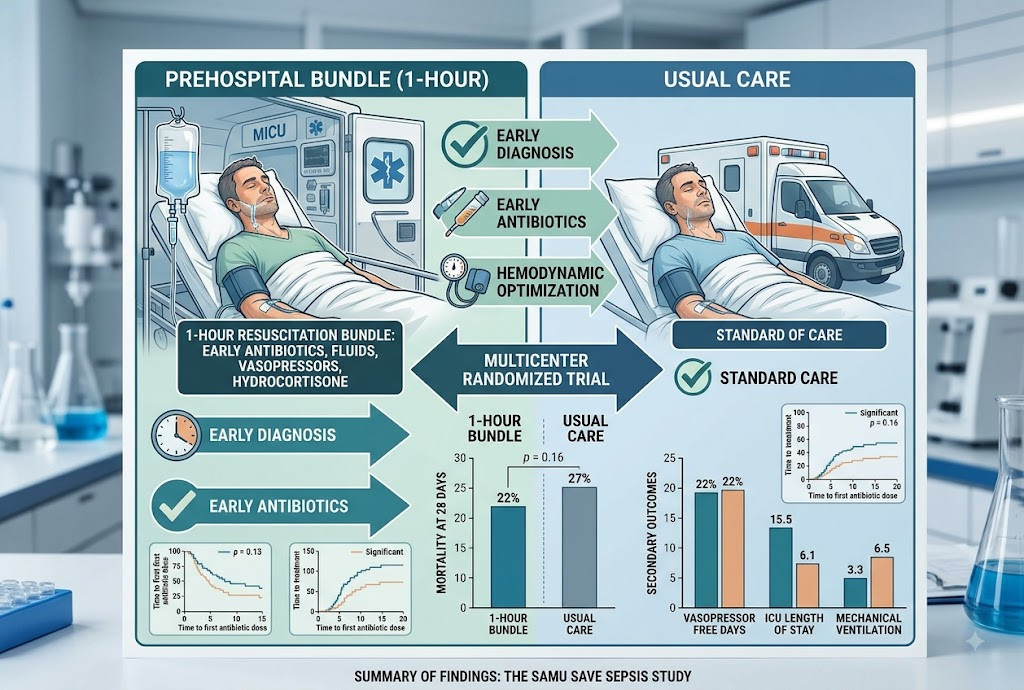
Highlight
The SAMU Save Sepsis study investigated whether a structured 1-hour resuscitation bundle—comprising early antibiotic administration, fluid resuscitation, vasopressor support, and hydrocortisone—delivered prehospital by a mobile ICU (MICU) could reduce mortality in septic shock patients. Despite protocol adherence, no statistically significant reduction in 28-day mortality was observed. Secondary endpoints including ICU outcomes and organ support requirements were also similar. Potential factors influencing these findings include imbalances in patient enrollment and marginal intergroup differences in care.
Study Background
Septic shock is a life-threatening condition marked by circulatory, cellular, and metabolic abnormalities that significantly increase mortality risk. Early recognition and timely initiation of interventions—namely antibiotics, fluid resuscitation, hemodynamic support, and corticosteroids—are cornerstones in improving outcomes. Despite established in-hospital bundles such as the Surviving Sepsis Campaign guidelines recommending interventions within the first hour, there remains uncertainty about benefits when these are delivered even earlier in the prehospital phase. Delays in antibiotic administration and hemodynamic optimization have been correlated with increased mortality, suggesting a potential role for mobile intensive care units (MICUs) to deliver immediate bundle-based therapy.
Study Design
This investigation was a multicenter, open-label, cluster-randomized trial conducted in France between May 2016 and November 2018. Adult patients with suspected septic shock, as identified by the MICU team during prehospital care, were eligible. The clusters were defined by geographic MICU centers. The intervention arm implemented a 1-hour resuscitation bundle consisting of (1) intravenous antibiotics, (2) isotonic saline fluid resuscitation up to 35 mL/kg ideal body weight within the first 60 minutes, (3) initiation of norepinephrine for mean blood pressure (MBP) <65 mm Hg or diastolic blood pressure <40 mm Hg, and (4) IV hydrocortisone (100 mg) if MBP remained <65 mm Hg despite norepinephrine ≥1.5 mg/hr. The control arm received usual prehospital care without this structured protocol. The primary outcome was 28-day all-cause mortality. Secondary outcomes included ICU mortality, hospital discharge mortality, 90-day mortality, days alive and free of vasopressors, ventilatory support, renal replacement therapy, as well as ICU and hospital length of stay.
Key Findings
Out of 398 enrolled patients, 381 (mean age 67 ± 15 years) were analyzed after consent considerations. Among the intervention group (n=103), 23 died within 28 days (22%), whereas in the control group (n=278), there were 76 deaths (27%). The risk ratio for death with the 1-hour bundle was 0.81 (95% CI, 0.61–1.08; p=0.16), indicating no statistically significant mortality benefit. Secondary outcomes, including ICU mortality, hospital mortality, and 90-day mortality, demonstrated no significant differences between groups. Similarly, no differences were observed in duration of vasopressor dependency, mechanical ventilation, renal replacement therapy requirement, or length of stay in the ICU or hospital.
Intracluster correlation coefficient was low at 0.005 ± 0.002, suggesting minimal clustering effect. Notably, enrollment unevenness across centers and modest differences in the early care rendered might have influenced outcome measures, potentially diluting the detectable effect of the resuscitation bundle.
Expert Commentary
The trial contributes valuable insights into the challenges of prehospital septic shock management. Although biologically plausible and supported by in-hospital evidence, the benefits of ultra-early intervention bundles in septic shock remain equivocal when implemented by MICUs. The study’s strength lies in its pragmatic, multicenter design reflecting real-world emergency medical services conditions. Limitations include open-label design, possible variability in bundle implementation fidelity, and patient heterogeneity. Furthermore, the relatively small absolute mortality difference and confidence interval crossing unity suggests potential type II error or insufficient power.
Given that sepsis pathophysiology is complex and patients often present with variable illness severity, early bundle initiation may require further refinement. For example, precise patient selection and stratification based on biomarkers or hemodynamic profiles could enhance targeting. Additionally, future studies might assess whether certain bundle components, such as corticosteroids or vasopressors, contribute more meaningfully when timed prehospital compared to later hospital initiation.
Conclusion
Prehospital initiation of a 1-hour resuscitation bundle including early antibiotics, fluids, vasopressors, and hydrocortisone by MICU teams did not significantly reduce 28-day mortality in adults with septic shock in this multicenter French study. While the concept of ultra-early sepsis interventions remains compelling, practical challenges, patient heterogeneity, and marginal differences in delivered care highlight the need for continued research to optimize timing, patient selection, and protocol components.
Clinicians should continue prioritizing early recognition and standard evidence-based sepsis treatment upon hospital arrival, while emergency medical services evaluate the feasibility and impact of prehospital sepsis protocols.
Funding and Trial Registration
This work was supported by the Service d’Aide Médicale Urgente (SAMU) Save Sepsis study group. The trial was registered on ClinicalTrials.gov (NCT02473263).
References
1. Jouffroy R, Annane D, Elie C, Mira JP, Jilet L, Gueye P, Vivien B, and the SAMU Save Sepsis study group. A 1-Hour Resuscitation Bundle for Prehospital Management of Septic Shock. Crit Care Med. 2026 Aug 10. PMID: 42573415.
2. Rhodes A, Evans LE, Alhazzani W, et al. Surviving Sepsis Campaign: International Guidelines for Management of Sepsis and Septic Shock: 2016. Intensive Care Med. 2017 Mar;43(3):304-377.
3. Seymour CW, Gesten F, Prescott HC, et al. Time to Treatment and Mortality during Mandated Emergency Care for Sepsis. N Engl J Med. 2017 Jun 8;376(23):2235-2244.
4. Annane D, Bellissant E, Bollaert PE, et al. Corticosteroids for Treating Sepsis in Children and Adults. Cochrane Database Syst Rev. 2019. 2019;12(12):CD002243.