Highlight
- Alterations in KRAS and PIK3CA genes independently associate with worse disease-free survival in resected gastric cancer.
- Distinct genomic characteristics differentiate patterns of recurrence: hematogenous, peritoneal, and lymphatic metastases.
- Hematogenous recurrence correlates with increased chromosomal instability and cell cycle regulatory gene alterations.
- Bony metastases arise predominantly from genomically stable, diffuse-type tumors, highlighting histologic-genomic interplay.
Study Background
Gastric cancer remains a significant global health burden, characterized by high mortality largely due to frequent disease recurrence after surgical resection. Despite advances in surgical techniques and systemic therapies, prognosis remains guarded, with recurrence rates reported up to 40-60% depending on stage and treatment. Current clinical risk stratification mainly relies on pathological staging and histology, which incompletely capture biological heterogeneity driving metastatic potential. Molecular profiling of primary tumors holds promise to refine prognostic precision and guide individualized postoperative management by identifying genomic predictors of recurrence risk and metastatic spread patterns.
Study Design
This single-center cohort study enrolled 438 patients with stage I to III gastric adenocarcinoma who underwent curative-intent complete (margin-negative) resection from 2010 to 2024 at an academic quaternary referral center. Inclusion criteria mandated targeted genomic sequencing of formalin-fixed paraffin-embedded (FFPE) primary tumor specimens using the MSK-IMPACT panel, a validated next-generation sequencing assay assessing cancer-associated genomic alterations. Patients were categorized by recurrence status and further stratified by pattern of metastatic spread: hematogenous, peritoneal, or lymphatic. For robustness, cases with less than 2 years’ disease-free follow-up and no recurrence were excluded. The main endpoint was disease-free survival (DFS), correlated with genomic profiles. Secondary analyses explored associations between specific genomic alterations and metastatic patterns. Data analysis occurred from June 2025 to March 2026.
Key Findings
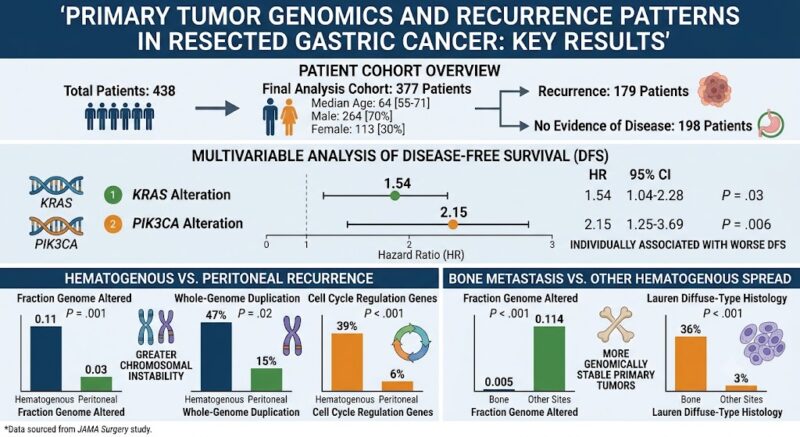
Of the 438 patients, 377 met criteria for primary analysis; median age was 64 years with a predominance of males (70%). Recurrence occurred in 179 patients, while 198 remained disease-free after at least 2 years of follow-up.
Genomic Predictors of Disease-Free Survival
Multivariable Cox regression identified independent associations of KRAS alterations (HR 1.54, 95% CI 1.04-2.28, P=0.03) and PIK3CA alterations (HR 2.15, 95% CI 1.25-3.69, P=0.006) with decreased DFS, indicating these mutations confer higher risk of recurrence post-resection. These alterations involve key oncogenic signaling pathways—RAS/RAF and PI3K/AKT/mTOR—implicated in tumor proliferation and survival, suggesting biological mechanisms for aggressive clinical behavior.
Genomic Determinants of Recurrence Patterns
- Hematogenous Recurrence: Significantly associated with higher chromosomal instability as measured by fraction genome altered (0.11 vs 0.03; P=0.001) and a higher prevalence of whole-genome duplication events (47% vs 15%; P=0.02). Furthermore, these tumors exhibited more frequent alterations in genes regulating the cell cycle (39% vs 6%; P<0.001) relative to those with peritoneal recurrence, indicating a more genomically disrupted tumor biology favoring distant dissemination via bloodstream.
- Peritoneal Recurrence: Tumors demonstrated lower chromosomal instability and cell cycle gene alterations compared to hematogenous metastases, suggesting distinct genomic landscapes may underlie this local spread.
- Bone Metastasis: Subset analysis revealed bone metastases arose from genomically stable tumors with very low fraction genome altered (0.005 vs 0.114; P<0.001) and were enriched for diffuse-type histology by Lauren classification (36% vs 3%; P<0.001) compared to other hematogenous sites. This underscores the interplay between histologic subtype and genomic stability in dictating metastatic tropism.
Expert Commentary
This landmark study extends our understanding of how primary tumor genomics influence both prognosis and metastatic behavior in gastric cancer. The independent prognostic significance of KRAS and PIK3CA mutations highlights the potential utility of targeted molecular diagnostics in postoperative risk stratification. Identification of distinct genomic signatures linked to metastasis patterns supports a tailored surveillance paradigm, potentially allowing focused imaging based on high-risk molecular profiles. Notably, the finding that bone metastases emerge from genomically stable yet diffusely infiltrative tumors challenges the notion that genomic chaos uniformly drives metastasis, emphasizing the heterogeneity of metastatic mechanisms.
Limitations include the single-institution design, which may limit generalizability, and the lack of functional genomic analyses or prospective validation cohorts. Additionally, the study focused on targeted gene panels rather than comprehensive whole-genome sequencing, which could capture broader mutational contexts.
Conclusion
This study robustly establishes that specific genomic alterations in primary gastric tumors—particularly mutations in KRAS and PIK3CA—and genomic hallmarks such as chromosomal instability and cell cycle gene disruptions, are associated with differential risk and patterns of distant recurrence. Integration of genomic profiling into clinical pathways may refine personalized postoperative surveillance and inform perioperative therapeutic decision-making to improve long-term outcomes in gastric cancer patients.
Funding and ClinicalTrials.gov
The original study did not specify funding sources or ClinicalTrials.gov registration number in the abstract. Interested readers should consult the primary publication for detailed disclosures.
References
1. Coffey MR, Xu J, Atri P, et al. Primary Tumor Genomics and Patterns of Distant Recurrence in Resected Gastric Cancer. JAMA Surg. 2026 Aug 5. PMID: 42555007.
2. Cancer Genome Atlas Research Network. Comprehensive molecular characterization of gastric adenocarcinoma. Nature. 2014 Sep 11;513(7517):202-209.
3. Lauren P. The two histological main types of gastric carcinoma: diffuse and so-called intestinal-type carcinoma. Acta Pathol Microbiol Scand. 1965;64:31-49.
4. Smyth EC, Nilsson M, Grabsch HI, van Grieken NC, Lordick F. Gastric cancer. Lancet. 2020 Aug 1;396(10251):635-648.