Highlight
- Over half of adults with type 1 diabetes experience elevated financial toxicity linked to disease management.
- Approximately one-third report cost-related nonadherence behaviors, including insulin rationing.
- Young adults (≤ 30 years) show significantly higher rates of cost-related nonadherence compared to older adults.
- Private insurance and financial toxicity strongly predict cost-related nonadherence, while common social determinants of health do not fully explain risk in younger adults.
Study Background
Type 1 diabetes (T1D) is a chronic autoimmune condition requiring lifelong insulin therapy and comprehensive health management to prevent acute and long-term complications. While advances in therapy have improved clinical outcomes, the rising costs of insulin and associated supplies have intensified economic burdens for patients. Financial toxicity, the distress or hardship posed by healthcare expenses, is increasingly recognized as a barrier to adherence and optimal disease control. Cost-related nonadherence (CRN), including reducing insulin doses or delaying care due to cost constraints, may lead to poor glycemic control and increased morbidity in T1D adults.
Understanding the prevalence and drivers of financial toxicity and CRN among adults with T1D is critical to develop effective interventions. This study builds on concerns about the disproportionate impact of cost pressures on younger adults transitioning to independent management, a demographic potentially vulnerable to socioeconomic disparities affecting adherence.
Study Design
This investigation is a secondary analysis of baseline data obtained from a larger randomized controlled trial targeting adults with diabetes who report unmet social needs. From the parent cohort, the analysis focuses on a subsample of 130 adults diagnosed with type 1 diabetes.
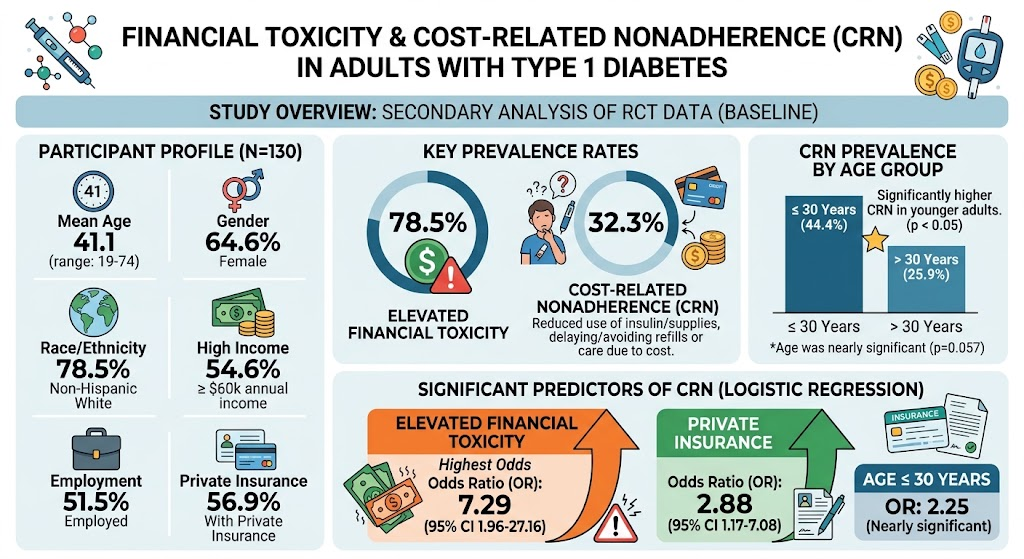
Participants had a broad age range (19–74 years), predominantly female (64.6%), mostly non-Hispanic White (78.5%), and over half had annual incomes of at least $60,000. Employment status, insurance coverage, financial toxicity, and CRN behaviors were assessed. CRN was operationalized as any self-reported cost-driven behaviors such as using less insulin, reducing medications or supplies, or delaying prescriptions and healthcare visits.
Demographic and social determinants of health (SDOH) factors were examined for associations with CRN. Logistic regression modeled predictors of CRN prevalence.
Key Findings
More than half (78.5%) of participants reported elevated financial toxicity related to diabetes care, reflecting substantial economic strain. Concurrently, nearly one-third (32.3%) endorsed at least one CRN behavior, signaling a worrisome prevalence of cost-driven nonadherence in this population.
Age emerged as a key differentiator; 44.4% of young adults (≤ 30 years) reported CRN compared to 25.9% in those older than 30 years, reaching statistical significance (p < 0.05). Notably, financial toxicity was strongly associated with CRN (odds ratio [OR] 7.29, 95% confidence interval [CI] 1.96–27.16). Surprisingly, private insurance was also linked with higher CRN risk (OR 2.88, 95% CI 1.17–7.08), suggesting underinsurance or high out-of-pocket costs despite coverage.
Although age did not achieve conventional statistical significance in the regression (p = 0.057), young adults were 2.25 times more likely to report CRN. Traditional social determinants (income level, employment status, race/ethnicity) were not significantly associated with CRN, indicating other factors may influence adherence in young adults.
Expert Commentary
These findings highlight the pervasive challenge of financial toxicity in adults with T1D, reinforcing that economic barriers remain a critical threat to optimal diabetes management. The unexpectedly higher risk of CRN among privately insured individuals underscores systemic issues in insurance adequacy, including high deductibles and co-pays for insulin and supplies. This aligns with previous research showing that insurance coverage does not uniformly protect against financial burden in chronic disease care.
The disproportionate vulnerability of young adults to CRN deserves particular attention. Transitioning to independent living and managing complex insulin regimens amid educational, vocational, and social life changes likely intensify adherence challenges compounded by financial stress. The lack of association between conventional SDOH factors and CRN in this age group suggests nuanced psychosocial and systemic drivers warrant further investigation.
Limitations include the study’s reliance on self-reported adherence behaviors, potential selection bias from the parent trial cohort enriched for social needs, and limited generalizability due to demographic homogeneity. Further longitudinal and qualitative studies are needed to elucidate mechanisms, including medication access, provider interactions, and financial counseling efficacy.
Conclusion
Financial toxicity is a prevalent and pressing issue in the adult T1D community, directly linked to cost-related nonadherence and potentially adverse health outcomes. Young adults with T1D are especially susceptible to CRN, independent of traditional social determinants, highlighting the need for targeted strategies such as improved insurance design, cost transparency, patient education, and supportive transitional care models. Addressing financial barriers should be integral to clinical diabetes care to prevent avoidable morbidity and improve long-term health trajectories.
Funding and ClinicalTrials.gov
Details regarding funding sources and the associated parent randomized controlled trial registration are not specified in the provided data.
References
1. Wentzell K, Zhong C, Mooney C, O’Connor C, Patel MR. Financial Toxicity and Cost-Related Nonadherence in Adults with Type 1 Diabetes. J Gen Intern Med. 2026 Aug 26. PMID: 42649458.
2. An increasing body of literature documents the financial burdens associated with insulin costs and their impact on adherence, e.g., Herkert D, Vijayakumar P, Luo J, et al. Cost-Related Insulin Underuse Among Patients with Diabetes. JAMA Intern Med. 2019;179(1):112–114.
3. Social determinants influencing diabetes care adherence: Walker RJ, et al. The impact of social determinants of health on diabetes outcomes. Curr Diabetes Rep. 2014;14(4):532.
4. Insurance coverage adequacy in chronic disease management: Cefalu WT, et al. Addressing the affordability crisis of insulin therapy. Diabetes Care. 2020 Oct;43(10):2387-2398.