Highlight
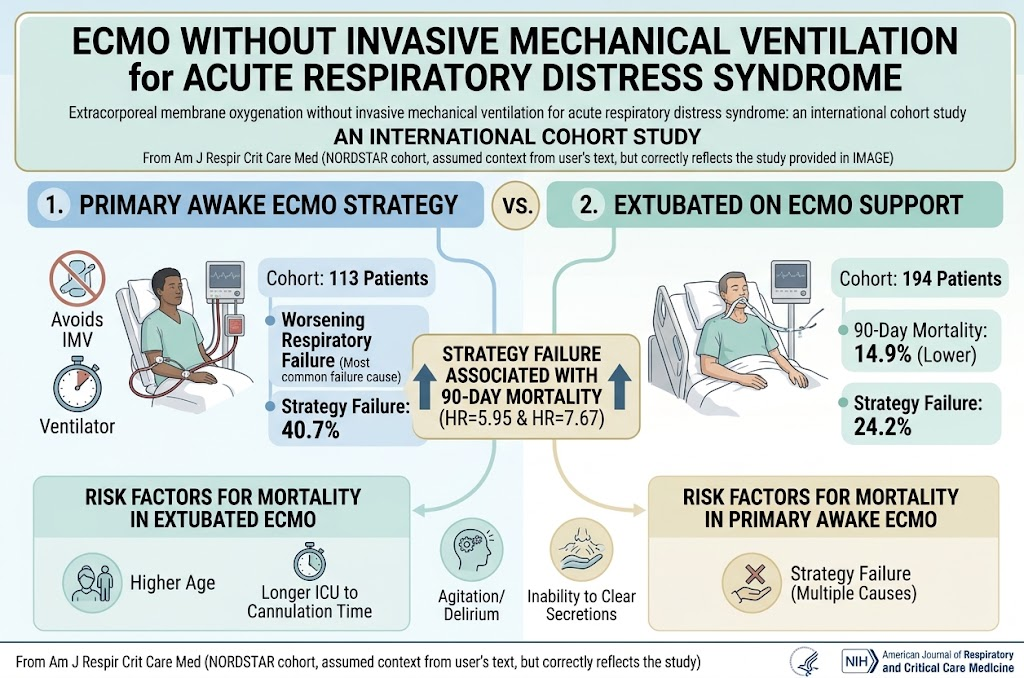
- ECMO without invasive mechanical ventilation (IMV) is a challenging but emerging strategy for ARDS management, evaluated in this large international retrospective cohort.
- Primary awake ECMO and extubated ECMO represent two distinct clinical approaches with differing baseline patient profiles, failure rates, and mortality outcomes.
- Strategy failure, most commonly due to respiratory deterioration, is strongly associated with increased 90-day mortality in both strategies.
- Age and timing of ECMO initiation are important predictors of mortality, reinforcing the need for careful patient selection and timing for ECMO support in ARDS.
Study Background
Acute respiratory distress syndrome (ARDS) is a severe inflammatory lung condition characterized by refractory hypoxemia and impaired gas exchange necessitating intensive respiratory support. Conventional management relies heavily on invasive mechanical ventilation (IMV), which, while lifesaving, may contribute to ventilator-induced lung injury and associated complications. Extracorporeal membrane oxygenation (ECMO) provides an alternate method of oxygenation and carbon dioxide removal by circulating blood through an extracorporeal circuit, offering lung rest. Traditionally, ECMO is combined with IMV; however, interest has grown in the use of ECMO alone or with early extubation to minimize ventilation-associated risks. This approach remains particularly challenging due to patient instability, the need for sedation, and risks of respiratory and neurological deterioration without airway protection. Thus, robust clinical data evaluating these less conventional ECMO strategies are scarce.
Study Design
This international, multicenter, retrospective cohort study enrolled 307 adult patients with ARDS treated using ECMO without invasive mechanical ventilation, across 14 centers in 8 countries from 2015 to 2024. Two clinical strategies were evaluated: “primary awake ECMO,” where patients were cannulated and kept off IMV from the outset, and “extubated ECMO,” where patients initially on IMV were extubated while remaining on ECMO support. The primary outcome was all-cause mortality at 90 days post-ECMO initiation. Secondary outcomes included rates and causes of strategy failure, defined as the need to re-intubate or initiate IMV, and clinical variables associated with survival.
Key Findings
Among the cohort, 113 patients received primary awake ECMO and 194 underwent extubation on ECMO. Ninety-day mortality was 30.1% in the primary awake ECMO group versus 14.9% in the extubated ECMO group, indicating better survival in patients who were extubated during ECMO compared to those who avoided IMV entirely.
Strategy failure occurred frequently and early, mainly within the first 10 days, in 40.7% of the primary awake ECMO group and 24.2% of the extubated ECMO group. Multivariate analyses demonstrated that strategy failure strongly predicted 90-day mortality with hazard ratios of 5.95 (95% CI, 2.63–13.46) in primary awake ECMO and 7.67 (95% CI, 3.44–17.11) in extubated ECMO, underscoring strategy failure as a critical adverse event regardless of initial approach.
Other independent predictors of mortality included higher patient age in the extubated ECMO group and longer duration from ICU admission to ECMO cannulation in the primary awake ECMO group, suggesting both patient factors and timing of ECMO onset influence outcomes.
The leading cause of strategy failure was progression of respiratory failure, followed by agitation or delirium in the primary awake ECMO group, and inability to clear airway secretions in the extubated ECMO group. These findings highlight specific challenges in managing ECMO patients off IMV, such as maintaining airway protection, controlling agitation, and preventing respiratory deterioration.
Expert Commentary
This study offers important insights into the feasibility and risks of avoiding invasive mechanical ventilation in ARDS patients supported with ECMO. The lower mortality observed in the extubated ECMO cohort compared to primary awake ECMO patients likely reflects differences in patient selection, severity, or underlying physiology. The high rate and early timing of strategy failure emphasize the critical need for vigilant monitoring and readiness to reintroduce mechanical ventilation if indicated.
Current guidelines for ECMO in ARDS primarily endorse its use as adjunctive support alongside invasive mechanical ventilation; therefore, this study challenges traditional practice and suggests that selected patients may benefit from alternative ventilation strategies. However, the retrospective design and heterogeneity in management across international centers limit generalizability. Additionally, detailed data on sedation protocols, mobilization, and respiratory mechanics would aid mechanistic understanding.
Future prospective controlled trials are warranted to refine criteria for patient selection, timing of cannulation, and protocols for awake or extubated ECMO strategies. Integration of multidisciplinary care including critical care physicians, respiratory therapists, and neuropsychiatric support is paramount to optimize outcomes and mitigate causes of strategy failure.
Conclusion
Extracorporeal membrane oxygenation without invasive mechanical ventilation, via primary awake ECMO or extubation during ECMO, represents promising but complex strategies in ARDS management. This large international cohort study underscores distinct patient profiles, failure rates, and mortality risks associated with each approach. Strategy failure emerged as a significant determinant of poor prognosis, reinforcing the importance of careful patient monitoring, timely intervention, and comprehensive supportive care. While these findings support the potential role of non-invasive ventilation strategies combined with ECMO, further controlled studies are needed to establish best practices and improve clinical outcomes.
Funding and Trial Registration
The study was conducted by the ECMO-No-VENT-ARDS Investigators under the European Chapter of the Extracorporeal Life Support Organization (Euro-ELSO). Specific funding sources were not detailed in the publication. This retrospective cohort study did not report clinicaltrials.gov registration.
References
Roncon-Albuquerque R, Petit M, Veiga T, et al. Extracorporeal membrane oxygenation without invasive mechanical ventilation for acute respiratory distress syndrome: an international cohort study. Am J Respir Crit Care Med. 2026 Sep 1;212(9):2187-2198. PMID: 42092985.
Combes A, Brodie D, Bartlett R, Brochard L, et al. Position paper for the organization of ECMO programs for acute respiratory failure in adult patients. Intensive Care Med. 2014;40(4):541-556.
Tonna JE, Abrams D, Brodie D, et al. Management strategies for patients with acute respiratory distress syndrome on extracorporeal membrane oxygenation: A survey of the Extracorporeal Life Support Organization. ASAIO J. 2021;67(6):648-657.
Munshi L, Walkey A, Goligher E, et al. Venovenous extracorporeal membrane oxygenation for acute respiratory distress syndrome: A systematic review and meta-analysis. Lancet Respir Med. 2019;7(2):163-172.
Highlighting the need for multidisciplinary care, Prasad LK et al. critically discuss sedation and mobilization during awake ECMO in ARDS patients, pointing to agitation management and secretion clearance as key challenges (Crit Care 2022;26:147).