Highlight
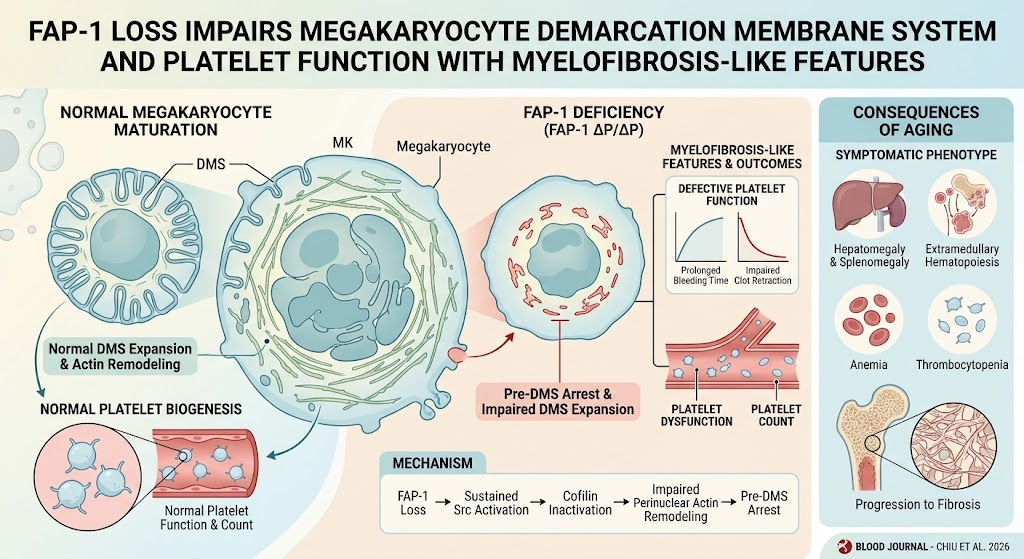
- FAP-1 loss causes impaired demarcation membrane system (DMS) development leading to defective megakaryocyte maturation and platelet production.
- FAP-1 deficiency results in sustained Src activation and cofilin inactivation, disrupting actin remodeling critical for DMS expansion.
- Aged FAP-1-deficient mice develop myelofibrosis-like features including bone marrow fibrosis, extramedullary hematopoiesis, and cytopenias.
- Src inhibition with dasatinib ameliorates megakaryocyte and platelet abnormalities, highlighting a potential therapeutic target relevant to primary myelofibrosis patients with reduced FAP-1 expression.
Study Background
Myelofibrosis (MF) is a clonal hematopoietic stem cell disorder characterized by progressive bone marrow fibrosis, extramedullary hematopoiesis, and abnormal megakaryocyte proliferation and differentiation. Platelet dysfunction and hemorrhagic complications further complicate patient management. The molecular mechanisms linking megakaryocyte maturation defects, platelet abnormalities, and fibrotic transformation in MF remain incompletely understood. Fas-associated phosphatase 1 (FAP-1), a nonreceptor protein tyrosine phosphatase implicated in diverse signaling pathways, has an unclear in vivo role in megakaryopoiesis and fibrosis pathogenesis. Understanding FAP-1’s function could uncover novel targets for therapeutic intervention in MF and related platelet disorders.
Study Design
This investigation employed a murine model with targeted deletion of the FAP-1 gene (FAP-1ΔP/ΔP) to examine the impact on megakaryocyte development, platelet function, and fibrotic features over time. Detailed bone marrow histology, ultrastructural analyses, and functional platelet assays assessed the mechanistic defects. The study also incorporated bone marrow transplantation to establish hematopoietic-intrinsic effects, and pharmacologic inhibition of Src kinase with dasatinib to probe pathway specificity and therapeutic potential. Complementary analyses in patients with primary MF evaluated FAP-1 expression correlations with megakaryocyte abnormalities and Src activation, bridging murine findings to clinical relevance.
Key Findings
Megakaryocyte hyperplasia with defective DMS development: FAP-1-deficient mice exhibited early and marked megakaryocyte hyperplasia characterized by arrest at the pre-DMS stage, revealing a critical role for FAP-1 in demarcation membrane system expansion—a prerequisite for proplatelet formation. Ultrastructural imaging showed disrupted membrane invagination and abnormal actin cytoskeleton remodeling around the perinuclear region.
Platelet dysfunction and hemorrhagic phenotypes: Defective proplatelet formation translated into impaired platelet function, manifested as prolonged bleeding times and reduced clot retraction capacity. Platelet defects were consistent with mechanistic disruption of cytoskeletal dynamics essential for platelet activation and aggregation.
Myelofibrosis-like features with aging: Approximately 50% of aged FAP-1ΔP/ΔP mice developed symptomatic disease including extramedullary hematopoiesis, hepatosplenomegaly, anemia, and thrombocytopenia. Histopathological evaluation revealed a spectrum from prefibrotic marrow changes to frank fibrosis resembling human MF pathology.
Hematopoietic cell-intrinsic etiology and partial transplantability: Bone marrow transplantation experiments showed that megakaryocyte and fibrotic abnormalities were intrinsic to hematopoietic cells harboring FAP-1 deficiency and could be partially transferred to wild-type recipients, confirming cell-autonomous mechanisms.
Mechanistic insights—Src kinase and cofilin signaling: FAP-1 loss resulted in sustained activation of Src kinase and inactivation of cofilin, a key regulator of actin filament dynamics. This molecular dysregulation impaired the perinuclear actin remodeling necessary for DMS expansion, underpinning the megakaryocyte maturation blockade.
Therapeutic modulation with dasatinib: Pharmacological inhibition of Src partially rescued megakaryocyte and platelet defects in FAP-1-deficient mice, supporting the specificity of the Src-cofilin axis in the pathogenesis and highlighting the potential of Src inhibitors in treating MF-associated abnormalities.
Clinical relevance in primary myelofibrosis patients: Patient bone marrow samples showed reduced FAP-1 expression correlated with pre-DMS megakaryocyte accumulation, abnormal DMS and actin cytoskeleton organization, and enhanced Src activation. These parallels reinforce translational significance and potential for targeted therapy development.
Expert Commentary
This study elegantly delineates a novel molecular pathway whereby FAP-1 regulates megakaryocyte maturation and platelet function through modulation of Src and cofilin-dependent actin remodeling. The identification of pre-DMS developmental arrest as a key mechanistic bottleneck advances current understanding of platelet biogenesis in MF. Importantly, the demonstration that dashed Src inhibition alleviates functional defects offers a translational avenue worthy of clinical exploration.
However, limitations include partial penetrance of the fibrotic phenotype and reliance on a murine model that may not capture the full complexity of human MF. Future studies should investigate the interplay of FAP-1 with other signaling networks and evaluate combination therapeutic strategies. Larger patient cohorts are needed to validate FAP-1 as a biomarker and therapeutic target.
Conclusion
The loss of FAP-1 disrupts an essential Src-cofilin-actin remodeling pathway during megakaryocyte DMS development, resulting in defective platelet production and function, and ultimately driving myelofibrosis-like pathology. This study integrates molecular, cellular, and clinical evidence to establish FAP-1 as a critical regulator of hematopoietic homeostasis and a promising target for therapeutic intervention in platelet dysfunction and MF. Pharmacologic targeting of Src kinase represents a rational approach to mitigate bleeding complications and fibrosis progression in affected patients, warranting further clinical investigation.
Reference
Chiu MF, Yeh KH, Chen PJ, Chou WC, Lin CW, Chang KP, Lin CC, Yeh SH. FAP-1 loss impairs megakaryocyte demarcation membrane system and platelet function with myelofibrosis-like features. Blood. 2026 Sep 10;148(11):1440-1453. doi: 10.1182/blood.2025031490. PMID: 42296014.