Patient Information
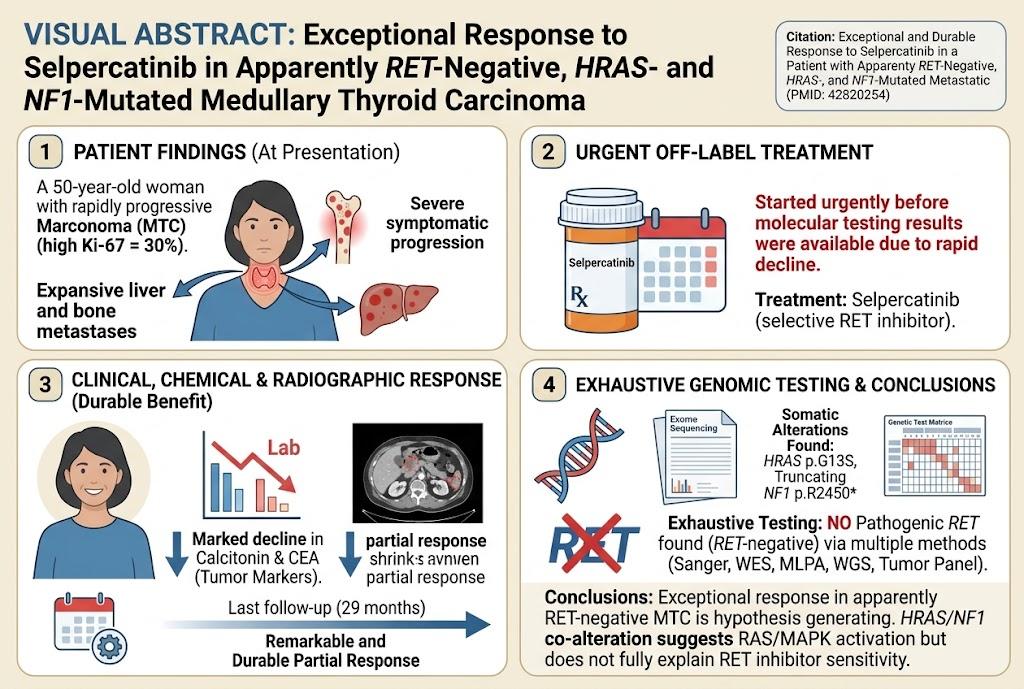
A 50-year-old woman presented with rapidly progressive medullary thyroid carcinoma (MTC). The patient reported symptoms consistent with symptomatic tumor burden, although specific presenting symptoms on admission were not detailed. Her disease was marked by a high proliferative index (Ki-67 = 30%) and extensive metastasis to the liver and bone. She had no prior history suggesting hereditary cancer syndromes or previous malignancies noted in the evaluation.
Diagnosis
MTC diagnosis was established based on histopathologic confirmation, with a notably elevated Ki-67 proliferative index indicative of aggressive tumor behavior. Imaging studies revealed diffuse liver and bone metastases, highlighting advanced disease. Initial molecular testing aimed to identify RET alterations, which are commonly implicated in MTC and guide targeted therapy, but surprisingly, no pathogenic or actionable RET variants were detected despite comprehensive analysis.
Advanced molecular investigations included multiple germline and somatic assessments: RET Sanger sequencing, germline whole-exome sequencing, tumor DNA and RNA panel testing, RET multiplex ligation-dependent probe amplification (MLPA), and tumor whole-genome sequencing. Collectively, these tests confirmed the absence of RET mutations, copy number variations, indels, or RET fusions.
Only somatic mutations of HRAS (p.G13S) and a truncating NF1 mutation (p.R2450*) were identified. These alterations implicate aberrations in the RAS/MAPK signaling pathway but do not directly suggest sensitivity to RET inhibition.
Differential Diagnosis
In the context of a thyroid neoplasm presenting with high calcitonin and carcinoembryonic antigen (CEA) levels, MTC was the primary diagnosis. Other thyroid malignancies such as poorly differentiated thyroid carcinoma or anaplastic carcinoma were unlikely given the pathology and biomarker profile.
Given the negative RET status, other mutations underlying MTC were considered. RAS mutations (HRAS in this case) are documented in a subset of RET-negative sporadic MTC. The NF1 mutation raised considerations of neurofibromatosis type 1–related tumorigenesis; however, clinical features consistent with neurofibromatosis were not noted. Alternative malignancies with calcitonin expression were excluded based on clinical and pathological data.
Treatment and Management
Due to the patient’s rapid symptomatic progression and metastatic tumor burden, treatment with selpercatinib was initiated urgently on an off-label basis prior to completion of molecular profiling results. Selpercatinib is a selective RET kinase inhibitor approved for RET-mutated MTC, with well-documented efficacy in that molecular subtype.
Early clinical response included rapid symptomatic improvement. Biomarkers demonstrated marked declines in calcitonin and carcinoembryonic antigen (CEA), consistent with biochemical response. Radiographic imaging confirmed a remarkable and persistent partial response to selpercatinib, which was maintained for 29 months at the last follow-up.
Supportive care measures and monitoring for adverse events associated with selpercatinib were assumed per standard clinical protocols. The patient continued under close oncologic surveillance.
Outcome and Prognosis
The patient experienced exceptional and durable clinical benefit from selpercatinib despite lacking detectable RET alterations. Radiographic assessments documented a sustained partial response lasting over two years (29 months). Such a durable response extends beyond typical expectations in metastatic MTC patients without targetable RET mutations.
Her quality of life improved in concordance with biochemical and radiologic responses. Long-term prognosis remains guarded given metastatic disease, but this case illustrates potential effective targeted therapy in a previously untargetable molecular profile.
Discussion
This case is unprecedented in demonstrating a striking and prolonged response to the selective RET inhibitor selpercatinib in a patient with metastatic MTC lacking RET gene alterations. Selpercatinib has earned regulatory approval for RET-mutated MTC based on its high efficacy and safety profile; however, its role in RET-negative disease has not been established.
Molecular testing repeatedly confirmed the absence of RET mutations, copy number alterations, or fusions. The detected somatic HRAS p.G13S and NF1 truncation mutations implicate activation of the RAS/MAPK pathway, which is mechanistically distinct from RET-driven oncogenesis. Sensitivity of such tumors to RET inhibition is unexpected and points toward unidentified mechanisms of action of selpercatinib or functional crosstalk, potentially through off-target effects or alterations in RET signaling complexes.
This finding is hypothesis generating and warrants confirmation in larger cohorts or clinical trials. It suggests that some patients with apparent RET-negative MTC may still benefit from selective RET inhibitors, emphasizing the importance of clinical judgment and potential off-label use in rapidly progressive disease with limited options.
The case reinforces the need for comprehensive molecular profiling but also cautions against exclusive reliance on these results to rule out targeted therapies where clinical urgency and preliminary benefit are evident.
Further research into the molecular underpinnings of selpercatinib sensitivity beyond RET alterations may reveal novel therapeutic targets or biomarkers. Clinicians treating advanced MTC should remain attentive to emerging evidence and consider individualized approaches in select cases.
References
1. Alzahrani AS, Benito A, Alghamdi B, et al. Exceptional and Durable Response to Selpercatinib in a Patient with Apparently RET-Negative, HRAS-, and NF1-Mutated Metastatic Medullary Thyroid Carcinoma. Thyroid. 2026 Oct 1; [Epub ahead of print]. doi:10.1177/10507256261493665.
2. Wells SA Jr, Santoro M. Targeting the RET pathway in thyroid cancer. Clin Cancer Res. 2019;25(17):5381-5389.
3. Romei C, Ciampi R, Elisei R. RET gene mutations and polymorphisms in human diseases. J Clin Endocrinol Metab. 2016;101(3):959-964.
4. Cabanillas ME, Jimenez C, Thomas D. Targeted therapy for advanced thyroid cancer: kinase inhibitors and beyond. Endocr Relat Cancer. 2019;26(6):R255-R270.
5. Hu MI, Gagel RF. New therapies for medullary thyroid cancer: focus on tyrosine kinase inhibitors. Drugs. 2018;78(1):77-88.