Highlight
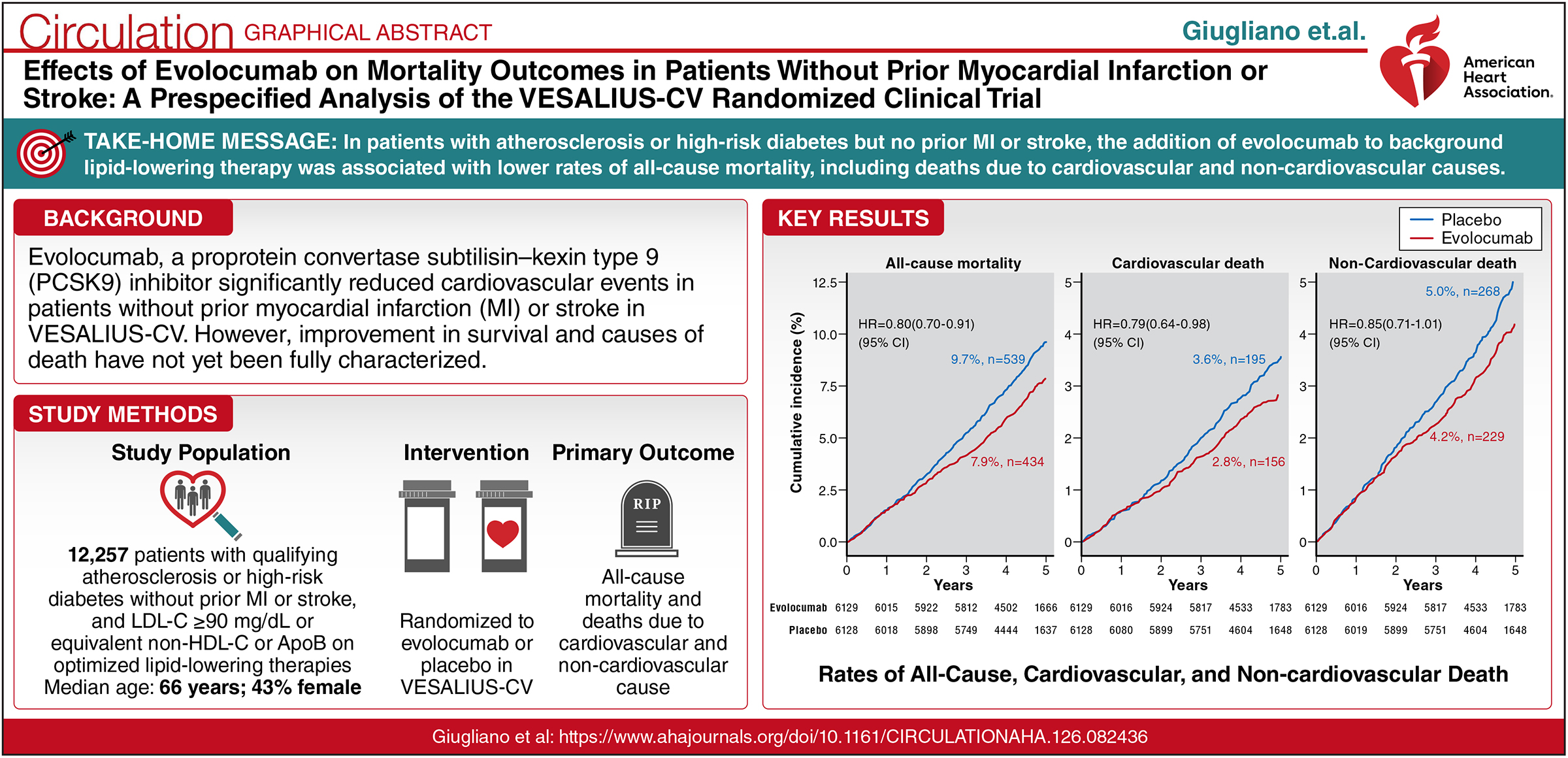
The VESALIUS-CV trial’s prespecified analysis shows that evolocumab, a PCSK9 inhibitor, reduces 5-year all-cause mortality by 20% among patients at high cardiovascular risk without prior myocardial infarction or stroke. Mortality benefits were consistent across cardiovascular and non-cardiovascular deaths, with the majority of the non-CV mortality reduction attributed to prevention of nonfatal cardiovascular events. These findings extend the evidence for lipid-lowering therapy to improve survival in primary prevention patients, including those with high-risk diabetes without established atherosclerosis.
Study Background
Cardiovascular disease (CVD) remains the leading cause of morbidity and mortality worldwide. While secondary prevention strategies focusing on patients with prior myocardial infarction (MI) or stroke are well established, there remains an unmet need to reduce adverse outcomes in high-risk patients without such prior events. Elevated low-density lipoprotein cholesterol (LDL-C) is a major modifiable risk factor, and proprotein convertase subtilisin-kexin type 9 (PCSK9) inhibitors like evolocumab have emerged as potent lipid-lowering agents. Although previous trials have demonstrated reduced cardiovascular events with PCSK9 inhibitors, data specifically characterizing effects on mortality in primary prevention populations have been limited. The VESALIUS-CV trial was designed to address this gap by evaluating the effects of evolocumab on cardiovascular outcomes in patients with atherosclerosis or high-risk diabetes but no previous MI or stroke, with a prespecified focus on mortality outcomes.
Study Design
VESALIUS-CV was a multicenter, randomized, double-blind, placebo-controlled clinical trial enrolling 12,257 patients with a median age of 66 years (43% women). Inclusion criteria required patients to have either documented atherosclerosis or high-risk diabetes without prior MI or stroke and baseline LDL-C levels ≥90 mg/dL (or equivalent thresholds for non-high-density lipoprotein cholesterol and apolipoprotein B). Patients were randomized to receive evolocumab or placebo on top of standard background lipid-lowering therapy. The primary focus of this prespecified analysis was on mortality endpoints, including all-cause mortality, cardiovascular (CV) death, non-CV death, and deaths of undetermined cause. A median follow-up of 4.6 years allowed comprehensive outcome assessment. Additionally, multistate modeling was employed to evaluate the role of nonfatal CV events (MI, ischemic stroke, ischemia-driven revascularization) as potential mediators in the relationship between evolocumab therapy and non-CV mortality.
Key Findings
During the median 4.6 years of follow-up, a total of 973 deaths (7.9% of participants) occurred. Of these, 36% were cardiovascular, 51% non-cardiovascular, and 13% of undetermined cause. Evolocumab treatment resulted in a significant 20% reduction in all-cause mortality compared with placebo (5-year Kaplan-Meier rates 7.9% vs 9.7%; hazard ratio [HR] 0.80, 95% confidence interval [CI] 0.70–0.91; P=0.0005).
Cardiovascular deaths were reduced by 21% (HR 0.79; 95% CI 0.64–0.98), with 2.8% mortality in the evolocumab group versus 3.6% in placebo. Non-CV deaths showed a trend toward reduction (HR 0.85; 95% CI 0.71–1.01), with absolute rates of 4.2% vs 5.0%. Deaths of undetermined cause were also significantly lower with evolocumab (HR 0.64; 95% CI 0.45–0.92). The mortality benefit was consistent across subgroups defined by age, sex, race, geographic region, qualifying atherosclerosis versus high-risk diabetes, baseline LDL-C, and background lipid therapy. This broad consistency reinforces the applicability of the findings to diverse clinical populations at elevated cardiovascular risk.
Multistate modeling provided mechanistic insight on non-CV mortality reduction, indicating that 78% (bootstrap interquartile range 71–92%) of the observed decrease in non-CV death with evolocumab was mediated by prevention of nonfatal CV events occurring before death. Notably, incident nonfatal MI, ischemic stroke, and arterial revascularizations were strongly associated with increased risk of subsequent non-CV mortality, especially within the first year post-event.
These results highlight that improving cardiovascular health through LDL-C lowering not only prevents direct cardiovascular deaths but also reduces non-CV deaths potentially linked to the systemic consequences of cardiovascular events.
Expert Commentary
The VESALIUS-CV trial’s findings mark an important advance in the clinical management of high-risk patients without prior MI or stroke. Traditionally, PCSK9 inhibitors have been primarily indicated for secondary prevention or familial hypercholesterolemia. This study extends strong evidence that early intervention with evolocumab can improve survival through both direct reduction of cardiovascular mortality and indirect downstream benefits on non-cardiovascular mortality.
Mechanistically, PCSK9 inhibitors potentiate LDL receptor recycling, resulting in profound LDL-C lowering. The observed mortality reduction aligns with the known biology linking LDL-C to atherosclerotic progression and plaque instability. Furthermore, the association between nonfatal cardiovascular events and subsequent non-CV mortality underscores the interconnected nature of vascular events and systemic health decline.
Limitations include the select trial population enriched for high cardiovascular risk, which may limit generalizability to lower-risk groups. The median follow-up of 4.6 years, although adequate for primary outcome assessment, restricts evaluation of longer-term mortality benefits and safety. Additionally, while the multistate modeling provides valuable insights, causality linking event prevention to reduced non-CV death requires cautious interpretation.
Conclusion
The VESALIUS-CV trial substantiates the survival benefit of evolocumab in patients at high cardiovascular risk without previous myocardial infarction or stroke. The robust 20% reduction in all-cause mortality, driven substantially by prevention of cardiovascular events, supports expanding PCSK9 inhibitor usage into selected primary prevention populations, including those with high-risk diabetes and elevated LDL-C. Clinicians should consider evolocumab as a valuable addition for comprehensive risk reduction in such patients, while ongoing research will clarify long-term benefits and broader applicability.
Funding and ClinicalTrials.gov
The VESALIUS-CV trial was funded by relevant industry and academic collaborations, with registration at ClinicalTrials.gov under identifier NCT03872401.
References
Giugliano RP, Bohula EA, Bellavia A, et al. Effects of Evolocumab on Mortality Outcomes in Patients Without Previous Myocardial Infarction or Stroke: A Prespecified Analysis of the VESALIUS-CV Randomized Clinical Trial. Circulation. 2026 Aug 31. PMID: 42670293. Available at: https://pubmed.ncbi.nlm.nih.gov/42670293/