Highlight
• A single 2 g oral dose of azithromycin given to laboring women did not improve neurodevelopmental outcomes in children with birth asphyxia at 24 months.
• Neurodevelopment was assessed using BSID-III and ASQ-3 tools in a multisite, international cohort.
• No significant differences were detected in cognitive, language, or motor domains or across geographical subgroups.
• The study offers critical evidence regarding the safety and lack of neurodevelopmental benefit of intrapartum azithromycin for asphyxiated neonates.
Study Background
Birth asphyxia—defined by inadequate oxygen delivery to the neonate during labor and delivery—is a major contributor to neonatal mortality and long-term neurodevelopmental impairment worldwide, particularly in low- and middle-income countries. Prompt and effective interventions to improve neurological outcomes in affected infants remain a major clinical challenge. Intrapartum administration of antibiotics like azithromycin has been proposed not only for its antimicrobial properties but also for potential anti-inflammatory effects that might mitigate brain injury resulting from hypoxia.
The Azithromycin Prevention in Labor Use Study (A-PLUS) originally aimed to evaluate whether maternal intrapartum azithromycin could reduce neonatal infections. This neurodevelopmental follow-up study seeks to address whether such intervention confers benefits in neurodevelopmental domains among neonates with documented birth asphyxia.
Study Design and Methods
This prospective neurodevelopmental follow-up enrolled neonates born at or beyond 34 weeks gestation with clinical signs of birth asphyxia, defined as a 5-minute Apgar score less than 7 or the need for bag-and-mask ventilation at birth. The cohort derived from mothers randomized in A-PLUS to receive either a single oral 2 g dose of azithromycin or placebo during labor.
Follow-up spanned six sites across five countries—two in India, plus Pakistan, Zambia, Democratic Republic of Congo, and Guatemala—representing diverse geographic and socioeconomic contexts. At approximately 24 months corrected age, children underwent neurodevelopmental assessment using the Bayley Scales of Infant and Toddler Development, Third Edition (BSID-III), focusing on cognitive (CCS), language (LCS), and motor (MCS) composite scores. Additionally, parents completed the Ages & Stages Questionnaires, third edition (ASQ-3) to capture developmental milestones in five domains.
Examiners were masked to treatment allocation. Generalized linear models adjusted for confounders including site, gestational age, and baseline maternal and child characteristics were used for outcome comparison.
Key Findings
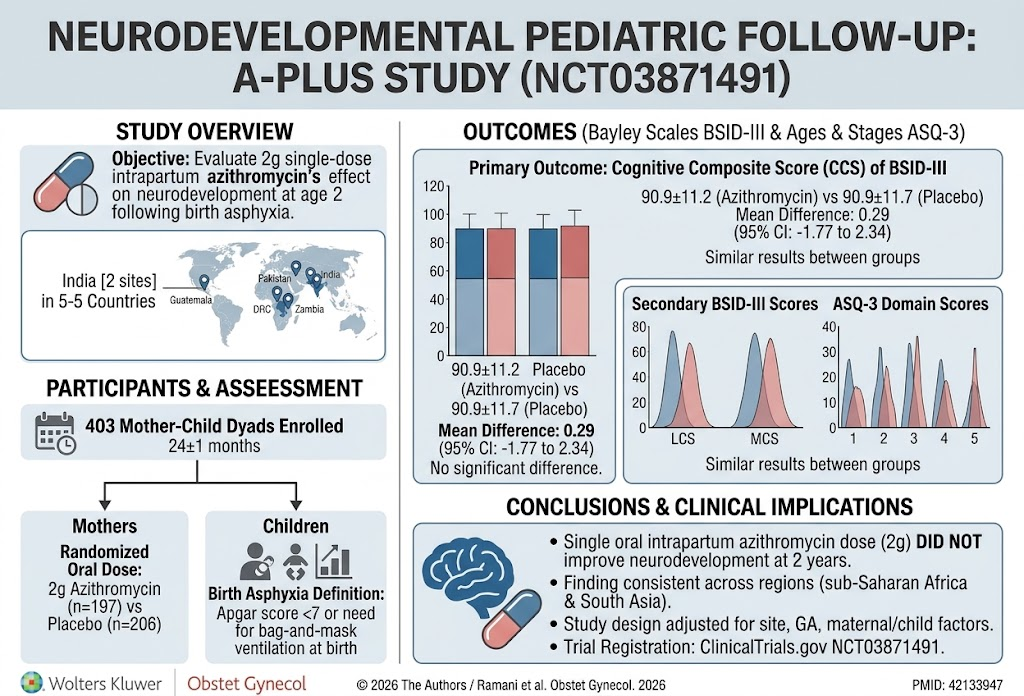
The study screened 529 eligible mother-infant pairs and enrolled 403 dyads (197 azithromycin, 206 placebo) who completed neurodevelopmental evaluation at 24±1 months.
The primary endpoint, BSID-III Cognitive Composite Score, was equivalent between groups (azithromycin mean 90.9±11.2 vs placebo 90.9±11.7; mean difference 0.29; 95% CI -1.77 to 2.34), indicating no statistical or clinically meaningful difference. Secondary outcomes, including Language and Motor Composite Scores, similarly showed no significant intergroup differences.
Parental ASQ-3 assessments across communication, gross motor, fine motor, problem solving, and personal-social domains aligned with BSID-III findings—no differences were observed.
Subgroup analyses comparing sub-Saharan African and South Asian cohorts did not reveal regional disparities in treatment effect. These results collectively suggest that intrapartum azithromycin does not influence neurodevelopmental trajectories at two years in neonates with asphyxia.
Expert Commentary
This multisite follow-up robustly addresses an important clinical question in global maternal-child health. The randomized design, masking, and comprehensive neurodevelopmental batteries strengthen the validity of findings. The lack of benefit contrasts with hypotheses that antibiotic-associated anti-inflammatory effects might confer neuroprotection after hypoxic insult.
Limitations include the restriction to infants surviving to two years with complete follow-up, possibly biasing toward healthier survivors. Also, a single azithromycin dose during labor may not adequately modulate neuroinflammation. Further mechanistic studies are needed to elucidate pathways linking intrapartum treatments to longer-term outcomes.
Current guidelines do not endorse routine antibiotic use for neuroprotection in birth asphyxia, and these findings reinforce the need for alternative neuroprotective strategies alongside optimized resuscitation and supportive care.
Conclusion
This international neurodevelopmental follow-up study concludes that a single oral intrapartum dose of 2 g azithromycin administered to mothers during labor does not improve cognitive, language, or motor outcomes at two years in children who experienced birth asphyxia. These findings contribute key evidence against the neurodevelopmental benefit of intrapartum azithromycin in this context, underscoring the importance of continuing to explore other interventions to mitigate birth asphyxia sequelae.
Future research should investigate comprehensive multisystem approaches, including neuroprotective agents, enhanced perinatal care protocols, and postnatal early intervention programs in resource-limited settings to improve outcomes for affected neonates.
Funding and Trial Registration
This study was supported by the contributors of the ABC Study Group and linked to ClinicalTrials.gov registration NCT03871491.
References
1. Ramani M, Carlo WA, Mwenechanya M, et al. Neurodevelopmental Pediatric Follow-Up After the Azithromycin Prevention in Labor Use Study. Obstet Gynecol. 2026 May 14;148(3): e177-e185. PMID: 42133947.
2. Lawn JE, Cousens S, Zupan J. 4 million neonatal deaths: When? Where? Why? Lancet. 2005 Mar 5-11;365(9462):891-900.
3. Shankaran S, Laptook AR, Ehrenkranz RA, et al. Whole-body hypothermia for neonates with hypoxic-ischemic encephalopathy. N Engl J Med. 2005 Oct 13;353(15):1574-84.
4. Ambalavanan N, Carlo WA. Adjunct therapies for neonatal hypoxic-ischemic encephalopathy. Clin Perinatol. 2011 Mar;38(1):615-27.