 Highlight
• Near-infrared autofluorescence (NIRAF) imaging improves intraoperative parathyroid gland identification during total thyroidectomy.
• Despite better visualization, NIRAF does not significantly reduce postoperative hypoparathyroidism rates at 3 or 12 months.
• Subgroup analysis suggests potential benefit in cases with central lymph node dissection.
• NIRAF use does not prolong surgery duration or adversely affect biochemical markers.
Study Background
Postoperative hypoparathyroidism is the most frequent complication following total thyroidectomy, characterized by decreased parathyroid hormone (PTH) secretion leading to hypocalcemia. Clinical manifestations range from mild symptoms to severe neuromuscular excitability and may require ongoing calcium and vitamin D supplementation. Preservation of parathyroid gland function during surgery is critical to minimize this risk.
Traditional methods rely on visual identification and careful tissue handling by the surgeon. However, inadvertent damage or removal of parathyroid glands remains common, contributing to transient or permanent hypoparathyroidism.
Near-infrared autofluorescence imaging capitalizes on the intrinsic fluorescence properties of the parathyroid tissue under near-infrared light, potentially allowing real-time intraoperative visualization without the need for exogenous dyes. This technology has attracted interest as a tool to enhance parathyroid gland preservation and improve postoperative outcomes.
Study Design
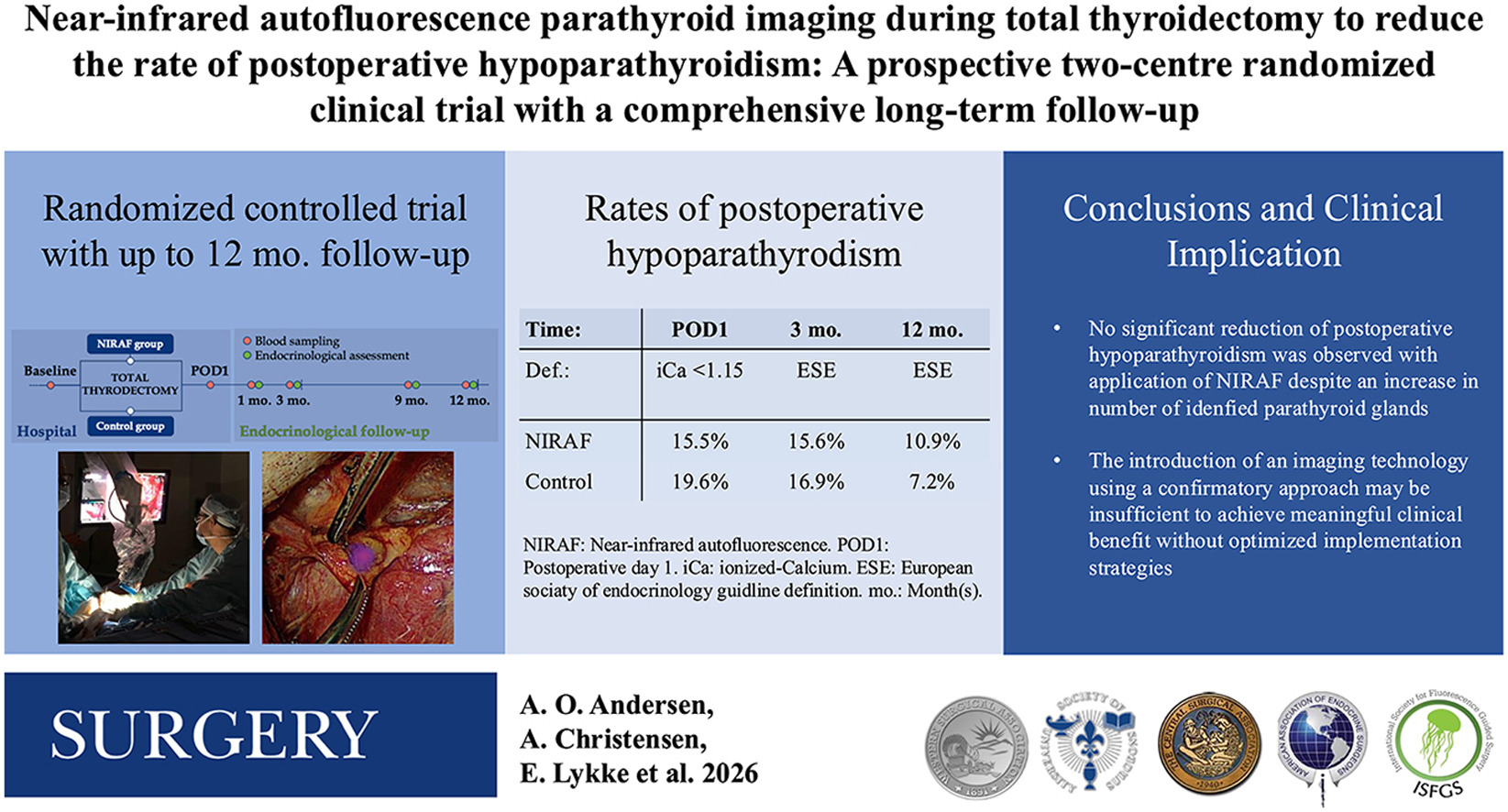
The present prospective randomized clinical trial was conducted at two centers in Denmark. A total of 189 patients scheduled for total thyroidectomy were randomized to undergo surgery with or without the aid of near-infrared autofluorescence imaging.
Data collection included serial measurements of ionized calcium and parathyroid hormone preoperatively, on postoperative day 1, and at 1, 3, 9, and 12 months postoperatively. Hypoparathyroidism was defined using three criteria: (1) the European Society of Endocrinology guideline, (2) ionized calcium below 1.15 mmol/L, and (3) parathyroid hormone levels below the lower reference limit.
Primary endpoints focused on hypoparathyroidism rates at 3 and 12 months post-surgery. Secondary endpoints included the number of identified parathyroid glands, surgical duration, signal-to-background fluorescence ratios, and PTH/ionized calcium ratios.
Key Findings
Of the 189 randomized patients, 93 underwent surgery with near-infrared autofluorescence (NIRAF) assistance and 96 without (control group). There was no significant difference in the primary endpoint: hypoparathyroidism rates at 3 months (NIRAF, 15.6% vs. control, 16.9%; p=0.97) and at 12 months across all definitions employed.
Importantly, the mean number of parathyroid glands identified intraoperatively was significantly higher in the NIRAF group (3.1 glands) compared to control (2.8 glands), with a p-value of 0.045. The average signal-to-background fluorescence ratio of the best-imaged parathyroid glands was 2.3 (maximum) and 1.9 (mean), confirming the technology’s efficacy in enhancing gland visualization.
Surgical time was not significantly extended by the use of NIRAF technology. Additionally, parathyroid hormone to ionized calcium ratios did not differ significantly between groups, indicating no adverse biochemical impact from the intervention.
Notably, a higher fraction of patients in the control group required calcium and vitamin D supplementation at 3 months post-surgery (71.8% vs. 59.0%), although this difference was not statistically significant (p=0.16).
Subgroup analysis revealed a trend towards greater benefit of NIRAF during total thyroidectomy augmented by central lymph node dissection, suggesting that in more complex surgical scenarios, improved visualization might translate to better parathyroid preservation.
Expert Commentary
While the trial robustly demonstrates that near-infrared autofluorescence enhances the ability to identify and visualize parathyroid glands intraoperatively, this did not translate into a measurable reduction of hypoparathyroidism rates at intermediate or long-term follow-up.
Possible explanations include that, despite improved identification, inadvertent thermal, vascular, or mechanical injury to the glands may still occur. Additionally, other factors such as auto-transplantation and individual patient variability affect parathyroid function.
Currently, the European Society of Endocrinology and other expert guidelines emphasize meticulous surgical technique as the cornerstone for parathyroid preservation. NIRAF may serve as an adjunct, especially in complex surgeries, but should not replace surgical expertise.
Limitations of this study include its sample size and the possibility that subtle benefits occur that the study was underpowered to detect, especially in specific patient subgroups. Further multicenter studies with larger cohorts and evaluation of cost-effectiveness are warranted.
Conclusion
This rigorous two-center randomized trial confirms that near-infrared autofluorescence significantly improves parathyroid gland identification during total thyroidectomy without adding operative time or affecting biochemical markers of parathyroid function. However, it does not significantly reduce the incidence of postoperative hypoparathyroidism at 3 or 12 months.
Until further evidence clarifies particular patient groups or surgical scenarios that may derive clear clinical benefit, the routine use of NIRAF as a standard tool in total thyroidectomy remains to be established. Surgeons should continue to prioritize proven preservation techniques augmented by intraoperative adjuncts tailored to individual clinical contexts.
Funding and Registration
The study was conducted at two Danish centers with funding and institutional support as per the original publication. Clinical trial registration details are accessible via the cited PubMed record.
References
Andersen AO, Christensen A, Lykke E, et al. Near-infrared autofluorescence parathyroid imaging during total thyroidectomy to reduce the rate of postoperative hypoparathyroidism: A prospective two-center randomized clinical trial with a comprehensive long-term follow-up. Surgery. 2026 Jul 16;198:110454. PMID: 42744538. https://pubmed.ncbi.nlm.nih.gov/42744538/
Alvarez F, Lombardi CP, D’Amore A, et al. Intraoperative identification and preservation of parathyroid glands: role of autofluorescence imaging. Endocrine. 2021;73(2):298-306.
Hyun SM, Kim S, Kim YA. Effectiveness of Near-Infrared Autofluorescence Imaging for Parathyroid Gland Identification during Thyroid and Parathyroid Surgery: A Systematic Review and Meta-analysis. Ann Surg Oncol. 2020;27(13):4709-4718.