Highlights
- Empirical valganciclovir treatment in infants with severe HIV-associated pneumonia showed a significant reduction in early mortality (day 15) in a large multicentre randomized controlled trial (EMPIRICAL).
- The 1-year mortality reduction trend with valganciclovir did not reach conventional statistical significance but indicated clinical benefit, especially when excluding early deaths within 48 hours.
- Safety analyses demonstrated no increased risk of severe adverse events with valganciclovir treatment in this vulnerable population.
- Contrastingly, empirical tuberculosis treatment did not improve mortality outcomes over current microbiologically and clinically guided strategies.
- Pharmacokinetic data revealed most infants do not achieve adult target ganciclovir exposure levels at standard dosing, but exposure variability was not predictive of virologic response, supporting the dosing regimen used.
Background
Pneumonia remains the leading cause of mortality among infants living with HIV in sub-Saharan Africa, with rates approaching 35-40% despite standard antibiotic and Pneumocystis jirovecii prophylaxis. Traditional management targets bacterial pathogens and Pneumocystis but understates the substantial burden of cytomegalovirus (CMV) co-infection, an under-recognized contributor to morbidity and mortality in this population. CMV infection exacerbates lung disease and potentially accelerates HIV and tuberculosis (TB) progression. Diagnosis of CMV pneumonia is challenging, rendering empirical treatment a compelling strategy. Additionally, tuberculosis often coexists in children with HIV-associated pneumonia, complicating treatment strategies. The EMPIRICAL trial was designed to rigorously assess whether empirical valganciclovir treatment targeting CMV and/or empirical TB therapy improves survival outcomes compared to standard care (SOC).Key Content
EMPIRICAL Trial Design and Population
The EMPIRICAL trial was a large, open-label, group-sequential, 2×2 factorial, randomized controlled superiority trial conducted from 2020 to 2024 across 19 hospitals in Côte d’Ivoire, Malawi, Mozambique, Uganda, Zambia, and Zimbabwe. It enrolled 563 infants aged 28 to 365 days hospitalized with severe HIV-associated pneumonia. Participants were randomized equally to receive (i) SOC only, (ii) SOC plus 15 days of oral valganciclovir (16 mg/kg every 12 hours), (iii) SOC plus 6 months of tuberculosis treatment, or (iv) both valganciclovir and tuberculosis treatment combined. SOC included WHO-recommended antibiotics and treatment for Pneumocystis jirovecii pneumonia (cotrimoxazole and steroids). The primary endpoint was all-cause mortality at day 15 and over 1 year in an intention-to-treat analysis.Empirical Valganciclovir Treatment Efficacy
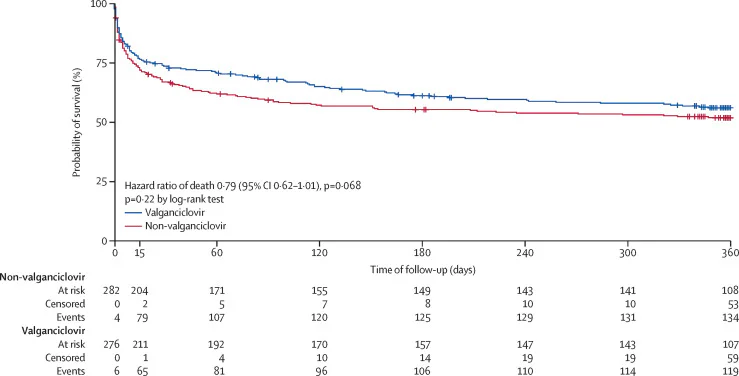
Analysis of 558 eligible infants (276 receiving valganciclovir regimens) demonstrated no statistically significant difference in all-cause mortality by day 15 comparing valganciclovir to non-valganciclovir groups (23% vs. 27%, rate ratio 0.81, 95% CI 0.61-1.08; p=0.15) or at 12 months (43% vs 48%, hazard ratio 0.88, 95% CI 0.74-1.05; p=0.15). However, a time-varying effects model revealed a significant reduction in hazard of death at day 15 associated with valganciclovir (adjusted hazard ratio 0.60, 95% CI 0.41-0.87; p=0.0063), and a trend toward lower hazard over 1 year (HR 0.79; p=0.068). Excluding deaths within 48 hours of treatment initiation strengthened the one-year mortality reduction borderline to statistical significance (HR 0.76; p=0.0500). These findings suggest early survival benefits of valganciclovir, likely reflecting its antiviral impact during acute illness. No interactions were found between valganciclovir and tuberculosis treatment (adjusted HR for interaction 1.19, p=0.48).Safety Profile
Severe adverse events occurred with similar frequency in groups with and without valganciclovir (odds ratio 0.64; 95% CI 0.35-1.16). Toxicity did not increase with valganciclovir, supporting its tolerability in this highly vulnerable population.Empirical Tuberculosis Treatment Findings
A parallel publication from EMPIRICAL evaluated empirical TB treatment (eTB-T), comparing survival to microbiologically and clinically guided strategies. No mortality benefit was demonstrated at day 15 or 1 year (48% vs 43% mortality, adjusted HR 1.12, p=0.39). Many infants in the non-eTB-T groups initiated TB therapy later during follow-up, potentially blunting differences. Adverse events, including transaminase elevations and anemia, were common but balanced between groups.Pharmacokinetic and Pharmacodynamic Insights
A sub-study evaluated valganciclovir pharmacokinetics in infants receiving 16 mg/kg twice daily. Among 87 evaluable infants, only 35% reached adult target ganciclovir exposure (AUC0-12h 40-60 h·mg/L), with 47% below and 18% above. Reduced renal function correlated with higher drug exposure. Importantly, ganciclovir exposure did not correlate with CMV viral load reduction or toxicity, suggesting that the dosing regimen, although yielding variable exposures, was clinically effective. These results advocate for the current dosing strategy in this setting pending further optimization.Context from Prior Studies and Clinical Guidelines
Historical data show poor outcomes and high failure rates in HIV-infected infants treated for pneumonia with standard WHO antibiotics alone, emphasizing the need for additional targeted therapies. Autopsy studies reveal a high prevalence of unrecognized CMV and TB co-infections driving mortality. Pneumococcal conjugate vaccine studies highlight complex bacterial and TB co-infections, supporting comprehensive treatment approaches.Expert Commentary
The EMPIRICAL trial provides pivotal evidence supporting empirical valganciclovir use in infants with severe HIV-associated pneumonia in Africa, a population with extremely high mortality despite optimized SOC. The significant early mortality reduction with valganciclovir plausibly reflects suppression of CMV-driven pulmonary pathology and immune activation, which exacerbate clinical deterioration. The lack of apparent effect on overall 1-year mortality may partly be due to late deaths from advanced HIV, other opportunistic infections, and comorbidities, underscoring multifactorial mortality drivers beyond CMV. The borderline significance after excluding early deaths hints at the benefit of timely intervention. Importantly, valganciclovir was well-tolerated with no excess severe adverse events, alleviating concerns regarding its use in fragile infants with HIV. In contrast, empirical TB treatment did not improve survival compared to a guided approach, suggesting that indiscriminate TB therapy may not confer benefit and highlights the necessity of accurate TB diagnostics despite challenges. The high proportion of infants initiating TB therapy during follow-up indicates clinicians’ responsiveness to emerging test results or clinical suspicion, which might have diluted the effect. Pharmacokinetic findings are notable for wide variability and limited attainment of adult drug exposure targets, yet the lack of correlation with virologic or clinical outcomes is reassuring and suggests that pediatric dosing of valganciclovir, while improvable, is clinically adequate in this context. The trial’s robust design, multicenter implementation across multiple African countries, and comprehensive follow-up strengthen the validity and generalizability of findings. Limitations include open-label design, challenges in definitive CMV pneumonia diagnosis, and potential confounding from comorbid conditions. The factorial design permitted evaluation of independent effects and interactions. Guidelines may soon incorporate empirical valganciclovir therapy in similar high-burden settings, but further studies on CMV diagnostics, long-term neurodevelopmental outcomes, and optimal dosing are warranted.Conclusion
The EMPIRICAL trial marks a milestone in managing severe HIV-associated pneumonia in African infants by demonstrating that empirical treatment with valganciclovir reduces early mortality without increasing adverse effects. By contrast, empirical tuberculosis treatment lacks mortality benefit over guided therapy. This evidence justifies integrating valganciclovir into treatment protocols for infants with severe HIV-associated pneumonia in resource-limited settings and prompts revisiting pneumonia management paradigms in this population. Future research should optimize valganciclovir dosing, explore synergistic therapies, refine diagnostic tools for CMV and TB, and address long-term outcomes to further improve infant survival.References
- Moraleda C, Tagarro A, Domínguez-Rodríguez S, et al. Empirical treatment with valganciclovir in infants living with HIV and hospitalised with severe pneumonia in Africa: a multicentre, open-label, factorial, randomised, controlled, superiority trial. Lancet. 2026;408(10568):2097-2108. PMID: 42468541.
- Moraleda C, Tagarro A, Domínguez-Rodríguez S, et al. Empirical tuberculosis treatment in infants living with HIV hospitalised with severe pneumonia in Africa (EMPIRICAL): a multicentre, randomised, open-label, 2×2 factorial, controlled superiority trial. Lancet. 2026;408(10568):2109-2124. PMID: 43020097.
- Domínguez-Rodríguez S, Moraleda C, Tagarro A, et al. Pharmacokinetics and pharmacodynamics of valganciclovir in infants with severe HIV-associated pneumonia in Africa: a sub-study of the EMPIRICAL randomised controlled trial. EClinicalMedicine. 2026;94:103899. PMID: 42016921.
- Mujuru H, Mvalo T, Chabala C, et al. Statistical analysis plan for the ’empirical treatment against cytomegalovirus and tuberculosis in HIV-infected infants with severe pneumonia’ clinical trial. Trials. 2025;26(1):144. PMID: 40307889.
- Moraleda C, et al. Empirical treatment against cytomegalovirus and tuberculosis in HIV-infected infants with severe pneumonia: study protocol for a multicenter, open-label randomized controlled clinical trial. Trials. 2022;23(1):531. PMID: 35761406.
- Nunes MC, et al. Role of Streptococcus pneumoniae in hospitalization for acute community-acquired pneumonia associated with culture-confirmed Mycobacterium tuberculosis in children: a pneumococcal conjugate vaccine probe study. Pediatr Infect Dis J. 2010;29(12):1099-1104. PMID: 21155174.
- Berkley JA, et al. Failure of standard antimicrobial therapy in children aged 3-59 months with mild or asymptomatic HIV infection and severe pneumonia. Bull World Health Organ. 2006;84(4):269-275. PMID: 16628299.
Specialty calculators
For clinical reference; use professional judgment.