Highlight
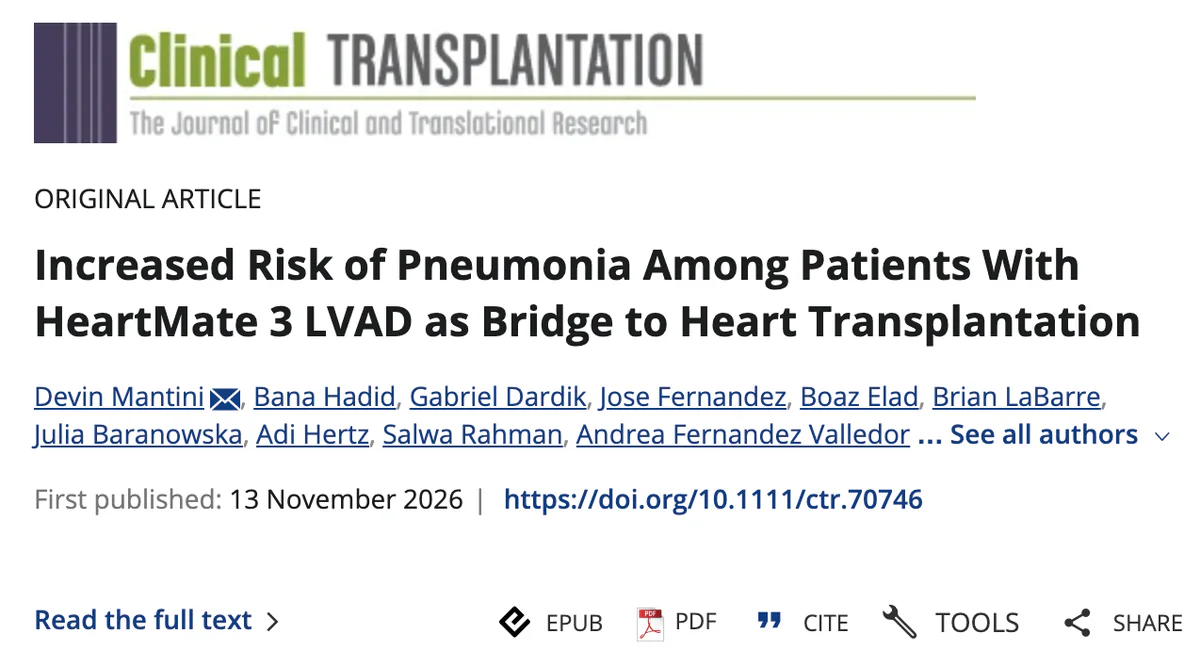
• The HeartMate 3 (HM3) left ventricular assist device (LVAD) is associated with a significantly increased incidence of pneumonia following heart transplantation (HT) compared to patients bridged without LVAD.
• HM3 patients demonstrated a 79% higher pneumonia rate during the index hospitalization and an 83% increased risk of pneumonia within one year post-HT.
• Independent of other factors, HM3 use predicts post-HT pneumonia, with prolonged ICU stays and extended mechanical ventilation duration observed.
• Among HM3 patients, previous coronary artery bypass grafting further elevates pneumonia risk, suggesting additive vulnerabilities.
Study Background
Heart transplantation remains the definitive therapy for end-stage heart failure. Left ventricular assist devices (LVADs), including the contemporary HeartMate 3 (HM3), are widely employed as bridges to transplantation, providing hemodynamic support while patients await donor organs. The HM3, characterized by its centrifugal continuous-flow technology and compact design, is surgically implanted in close proximity to pulmonary structures. This anatomical relationship raises clinical concern that device explantation during transplant may predispose patients to pulmonary complications, including pneumonia. Pneumonia is a notable contributor to morbidity and mortality in post-transplant patients, but the differential risk associated with specific LVAD types like HM3 remains underexplored. This study aimed to quantify pneumonia incidence post-HT in patients bridged with HM3 compared to those receiving transplantation without LVAD support, addressing an important unmet clinical knowledge gap.
Study Design
This retrospective cohort study included all adult heart transplant recipients at New York Presbyterian Hospital-Columbia University Medical Center from 2016 to 2022. Patients were stratified into two groups: those bridged to HT with the HM3 LVAD and a control group comprising patients who underwent HT without any LVAD bridging device. The primary endpoint was the incidence of pneumonia during the initial transplant hospitalization (index hospitalization). Secondary endpoints included pneumonia incidence up to one year post-transplant, lengths of intensive care unit (ICU) stay, and duration of mechanical ventilation. Data on baseline characteristics, such as age, sex, race, comorbidities including chronic obstructive pulmonary disease (COPD), asthma, pulmonary hypertension, and coronary artery bypass grafting (CABG) history, were collected. Statistical analyses involved Fisher’s exact test and Wilcoxon rank-sum tests for categorical and continuous variables, respectively, with multivariable logistic regression modeling to identify independent predictors of post-HT pneumonia.
Key Findings
The study analyzed 281 patients, with 82 bridged using the HM3 device and 199 controls without LVAD bridging. Both groups were comparable with respect to average age at transplantation and racial distribution. The HM3 cohort had a higher proportion of males and a greater prevalence of COPD or asthma but lower rates of pulmonary hypertension.
Pneumonia incidence during the index hospitalization was significantly higher in the HM3 group (43%) than in controls (24%), representing a 79% relative increase (p=0.004). This elevated risk persisted beyond the immediate hospitalization, with an 83% increase in pneumonia incidence up to one year post-HT (55% in HM3 vs. 30% controls, p=0.001). Correspondingly, HM3 patients experienced prolonged ICU stays and extended mechanical ventilation duration, indicating more complicated postoperative courses.
Multivariate logistic regression identified HM3 use as an independent predictor of post-transplant pneumonia with an odds ratio of 2.19 (95% CI, 1.21–3.99, p=0.010). Among HM3 recipients, prior CABG conferred additional pneumonia risk, underscoring the contribution of preexisting surgical history to post-transplant infection susceptibility. Other baseline factors including COPD/asthma were accounted for in the analysis, bolstering the significance of the HM3 device itself as a risk factor.
Expert Commentary
The findings highlight a clinically important association between HM3 LVAD bridging and subsequent pneumonia risk following heart transplantation. The anatomical proximity of the HM3 device to pulmonary tissues and the technical challenges inherent in its explantation likely contribute to increased pulmonary inflammation, impaired lung mechanics, and vulnerability to infection. The longer ICU stay and ventilation needs reflect the clinical sequelae of such pulmonary complications.
While LVADs have revolutionized care for advanced heart failure, not all devices confer the same risk profile. The HM3’s specific design and implantation characteristics merit consideration in perioperative planning. Further prospective studies could elucidate mechanistic links, including local tissue injury, immune modulation, and microbiome alterations following HM3 explantation. Additionally, tailored strategies such as intensified antimicrobial prophylaxis, refined surgical lung-protective approaches, and enhanced postoperative respiratory care protocols may mitigate pneumonia risk.
Limitations of this study include its retrospective nature and single-center design, which may limit generalizability. Nonetheless, the robust statistical approach and clinically relevant magnitude of risk warrant attention in clinical practice and future guidelines.
Conclusion
This study establishes that the use of the HeartMate 3 LVAD as a bridge to heart transplantation independently increases the risk of pneumonia post-transplantation. Enhanced vigilance, improved prophylactic antibiotic strategies, and optimized surgical techniques should be considered to reduce pneumonia-associated morbidity in this vulnerable population. These findings offer a crucial insight to transplant teams balancing device selection and perioperative care approaches to improve outcomes in advanced heart failure patients undergoing transplantation.
Funding and ClinicalTrials.gov
The original study did not specify funding sources or clinical trial registration.
References
1. Mantini D, Hadid B, Dardik G, et al. Increased Risk of Pneumonia Among Patients With HeartMate 3 LVAD as Bridge to Heart Transplantation. Clinical Transplantation. 2026 Nov;40(11). doi:10.1111/ctr.14500. PMID: 43024223.
2. Mehra MR, et al. The International Society for Heart and Lung Transplantation Guidelines for Mechanical Circulatory Support. J Heart Lung Transplant. 2020;39(4):255-273.
3. Kirklin JK, et al. Fifth INTERMACS Annual Report. J Heart Lung Transplant. 2019;38(5):493-503.
Specialty calculators
For clinical reference; use professional judgment.