Highlight
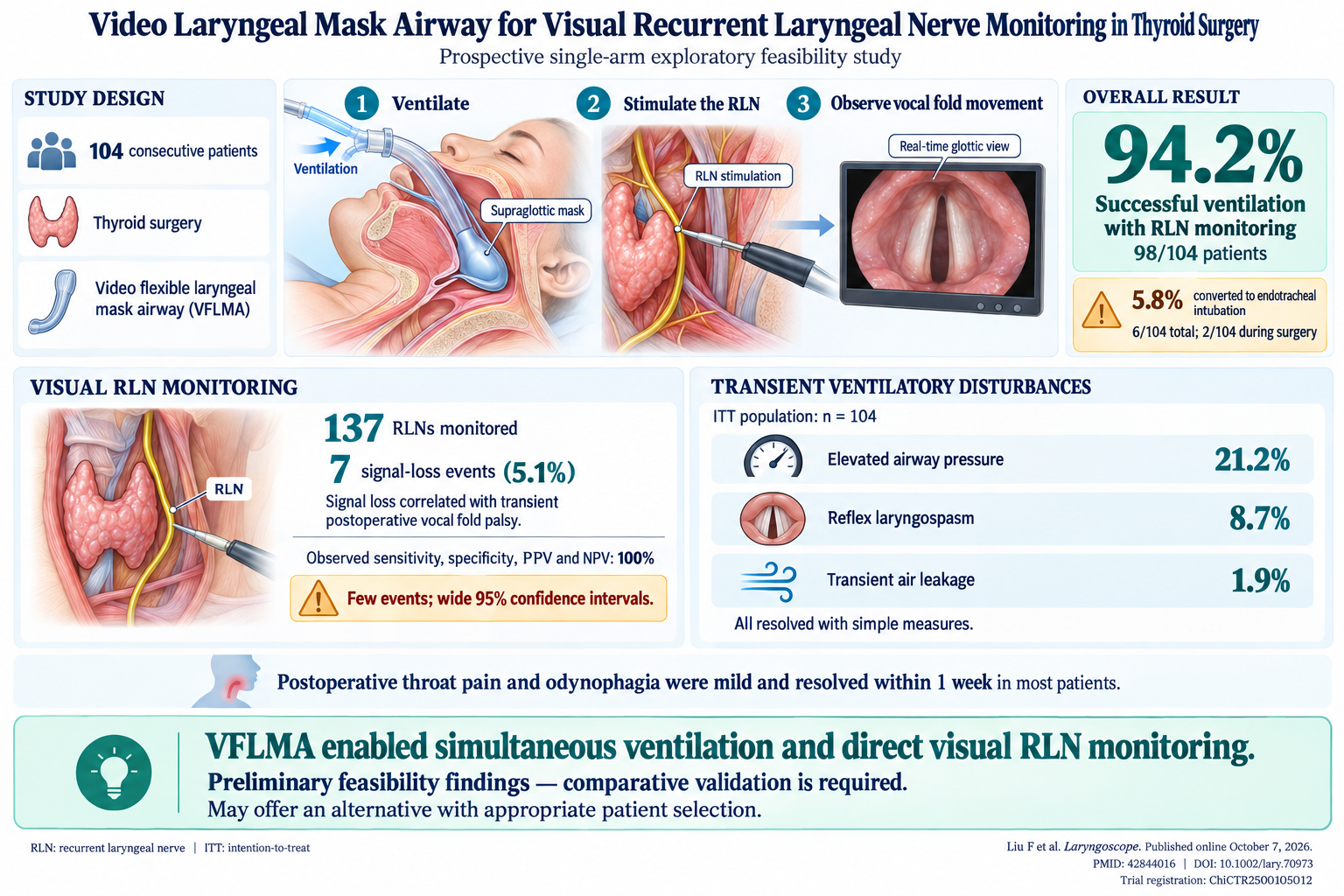
This exploratory study demonstrates the feasibility of using a video flexible laryngeal mask airway (VFLMA) during thyroid surgery to achieve simultaneous airway ventilation and direct visual monitoring of the recurrent laryngeal nerve (RLN). Effective ventilation and RLN visualization were achieved in 94.2% of cases, with nerve monitoring showing high sensitivity and specificity for detecting transient vocal fold palsy. Respiratory adverse events were mild and manageable. This novel approach may offer a valuable alternative for RLN monitoring, warranting further comparative validation.
Study Background
Thyroid surgery carries a well-recognized risk of injury to the recurrent laryngeal nerve (RLN), which can result in vocal fold palsy manifesting as dysphonia, aspiration, or airway compromise. Intraoperative nerve monitoring (IONM) has been incorporated to reduce the incidence of RLN injury by providing real-time functional assessment during surgery. Traditional methods rely on electromyographic endotracheal tubes for indirect RLN monitoring, necessitating accurate tube placement and often precluding visual confirmation.
The advent of video flexible laryngeal mask airway (VFLMA) devices with real-time glottic visualization offers the potential to simultaneously maintain airway patency and enable direct visual RLN monitoring intraoperatively. However, the clinical feasibility, safety, and diagnostic performance of VFLMA for RLN monitoring during thyroidectomy remain underexplored.
Study Design
This prospective, single-arm clinical study enrolled 104 consecutive patients undergoing thyroid surgery. Inclusion criteria focused on adult patients suitable for thyroidectomy requiring airway management compatible with the VFLMA system. After anesthesia induction, the VFLMA was inserted, allowing continuous visualization of the glottis and recurrent laryngeal nerve area while providing mechanical ventilation.
The primary endpoint was the successful use of VFLMA for effective ventilation coupled with direct visual RLN monitoring. Secondary endpoints assessed the diagnostic performance of visual RLN monitoring—defined as detection of vocal cord movement upon nerve stimulation—and perioperative respiratory adverse events including elevated airway pressure, laryngospasm, and air leakage.
Key Findings
Effective ventilation together with reliable RLN visual monitoring was accomplished in 98 of 104 patients (94.2%). Six patients (5.8%) required conversion to endotracheal intubation, with only two conversions (1.9%) occurring intraoperatively. A total of 137 RLNs were monitored visually across patients.
Electrophysiological signal loss occurred in 7 out of 137 monitored nerves (5.1%), all correlating with transient postoperative vocal fold palsy. The visual monitoring method demonstrated excellent diagnostic accuracy, with observed sensitivity and specificity at 100%; however, confidence intervals were wide owing to the limited number of adverse events. This indicates strong predictive value of the VFLMA-enabled direct visualization for transient RLN dysfunction.
Perioperative respiratory adverse events were reported but manageable: elevated airway pressure occurred in 21.2% of cases, reflex laryngospasm in 8.7%, and transient air leakage in 1.9%. All respiratory disturbances resolved with simple, noninvasive measures. Postoperative throat pain and odynophagia were mild and generally resolved within one week.
Expert Commentary
Direct visual monitoring of the RLN represents a significant advance over traditional IONM techniques relying solely on electromyographic signals. The ability to observe vocal cord movement real-time during nerve stimulation adds a valuable layer of safety, particularly in complex thyroid surgeries.
While the VFLMA system showed a high airway management success rate, the modest incidence of respiratory events highlights the importance of careful patient selection and skilled anesthetic technique. Additionally, the study’s single-arm design and relatively small number of nerve injury events limit definitive conclusions on efficacy and safety.
Further randomized controlled trials comparing VFLMA to conventional endotracheal intubation with electromyographic monitoring are needed to validate these promising findings. Investigation into long-term voice outcomes and cost-effectiveness will also be informative for clinical adoption.
Conclusion
This first prospective feasibility study illustrates that the video flexible laryngeal mask airway can simultaneously facilitate effective airway ventilation and direct visual recurrent laryngeal nerve monitoring during thyroid surgery. The VFLMA method demonstrated high diagnostic accuracy for transient RLN impairment with manageable respiratory adverse events, suggesting it as a viable alternative airway and monitoring approach.
These preliminary results are hypothesis-generating and encourage further comparative investigation to establish the clinical utility, safety profile, and patient selection criteria for VFLMA-based RLN monitoring in thyroidectomy. The potential to improve intraoperative nerve safety with real-time visual feedback represents a meaningful advancement in endocrine and airway surgery.
Funding and Trial Registration
This study was registered at www.chictr.org.cn under the identifier ChiCTR2500105012. The publication does not specify funding sources, indicating independent or institutionally supported research.
References
Liu F, Huang J, Chen X, Wang T, Zhou H, Yan Y, Wu L, Jin C, Xi C, Wang G. Video Laryngeal Mask Airway for Visual Recurrent Laryngeal Nerve Monitoring in Thyroid Surgery. Laryngoscope. 2026 Oct 7. doi: 10.1002/lary.70973. Epub ahead of print. PMID: 42844016.