Contemporary hip arthroscopy techniques incorporating capsular repair and knotless labral repair/reconstruction significantly improve postoperative outcomes compared to early methods.
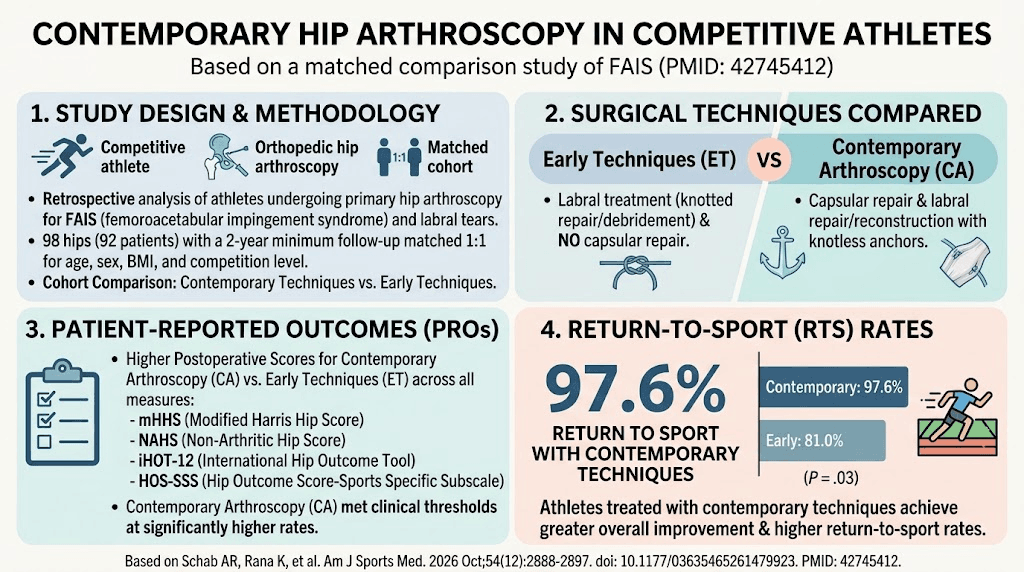
Competitive athletes treated with modern arthroscopy demonstrated higher postoperative scores on validated hip function scales and greater rates of returning to sport.
Return-to-sport rates with contemporary techniques reached 97.6%, markedly exceeding the 81.0% seen with early techniques.
This retrospective matched cohort study supports evolution in surgical practice as beneficial for active patients with femoroacetabular impingement syndrome.
Study Background
Femoroacetabular impingement syndrome (FAIS) is a frequent cause of hip pain and dysfunction in active individuals, especially competitive athletes. This condition results from abnormal contact between the femoral head and acetabular rim, leading to labral tears, cartilage damage, and, if untreated, early osteoarthritis. Hip arthroscopy has become the preferred surgical approach addressing FAIS and associated labral pathology due to its minimally invasive nature. However, surgical techniques have evolved substantially over the last two decades. Early methods often involved labral debridement or knot-tying repairs without addressing capsular integrity, while contemporary strategies emphasize labral preservation through repair or reconstruction using knotless anchors combined with capsular repair to restore joint stability. Determining if these technical advancements translate into improved functional outcomes and higher return-to-sport (RTS) rates in athletes is critical for optimizing care.
Study Design
This study was a retrospective cohort analysis comparing two surgical technique eras: contemporary arthroscopy (CA) and early technique (ET) groups. Included were 92 competitive athletes (98 hips) undergoing primary hip arthroscopy for FAIS and labral tears who reported sports participation within 12 months before surgery. The CA group received arthroscopy featuring capsular repair and labral treatment via repair or reconstruction with knotless anchors. The ET group underwent labral treatment with knotted repair or debridement without capsular repair. Propensity score matching (1:1) was conducted to balance cohorts by age, sex, body mass index (BMI), and competitive level. Minimum follow-up was 2 years. Outcomes assessed included patient-reported outcome measures (PROs) — the modified Harris Hip Score (mHHS), Non-Arthritic Hip Score (NAHS), International Hip Outcome Tool–12 (iHOT-12), Hip Outcome Score-Sports Specific Subscale (HOS-SSS) — rates of meeting clinically important thresholds, secondary surgeries, and RTS rates.
Key Findings
Both groups demonstrated significant postoperative improvements relative to their preoperative baseline PROs. However, the contemporary arthroscopy group attained significantly higher postoperative scores across all primary measures: mHHS, NAHS, iHOT-12, and HOS-SSS (p < 0.05). Moreover, a greater proportion of patients in the CA group met or exceeded established minimal clinically important differences and patient-acceptable symptom states for these scores, indicating meaningful functional and symptomatic recovery.
Return-to-sport data revealed a remarkable difference: 97.6% of athletes in the CA cohort returned to competitive sport compared with 81.0% in the ET cohort (p = 0.03). This suggests that improvements in surgical technique and capsular management critically enhance the likelihood of resuming athletic activities at a competitive level postoperatively.
Secondary surgery rates were not explicitly highlighted in the abstract; thus, interpretation regarding safety or revision risk remains limited and warrants further inquiry.
Expert Commentary
This study reinforces the paradigm shift in FAIS surgical treatment favoring labral preservation and capsular repair. Biomechanically, capsular repair restores anterior and rotational hip stability, which may help to decrease microinstability contributing to pain and impaired function. Knotless labral anchors provide secure fixation while potentially reducing soft tissue irritation commonly associated with knotted repairs. Moreover, reconstructing irreparable labral tissue may optimize the hip’s fluid seal and load distribution.
The marked improvement in return-to-sport rates seen with contemporary methods aligns with improved hip mechanics and patient confidence. These findings resonate with evolving guideline recommendations advocating for capsular repair where feasible and labral preservation over debridement.
Study limitations include its retrospective design, potential selection biases despite matching, and omission of long-term outcomes beyond two years. Additionally, the influence of rehabilitation protocols, surgeon experience, and specific sports disciplines on outcomes requires elucidation. Nonetheless, the evidence strongly supports adoption of contemporary arthroscopic techniques to enhance athlete recovery.
Conclusion
Contemporary hip arthroscopy techniques for FAIS, characterized by capsular repair and knotless labral repair or reconstruction, yield superior patient-reported outcomes and higher likelihood of returning to competitive sport when compared to early surgical methods lacking these elements. This reinforces the importance of evolving surgical principles emphasizing joint preservation and stability to optimize outcomes in active patient populations. Future prospective, multicenter studies with longer follow-up will be essential to validate durability of these benefits and further refine patient selection and perioperative care pathways.
Funding and Clinical Trials Registration
No specific funding or clinical trial registration details were provided in the published abstract.
References
1. Schab AR, Rana K, Wallace I, et al. Outcomes and Return-to-Sport Rates of Competitive Athletes Treated for Femoroacetabular Impingement Syndrome With Contemporary Hip Arthroscopy Techniques: A Matched Comparison to Early Techniques. Am J Sports Med. 2026;54(12):2888-2897. PMID: 42745412.
2. Byrd JWT. Hip arthroscopy for femoroacetabular impingement: Background, indications, and outcomes. Instr Course Lect. 2013;62:397-414.
3. Domb BG, Linder D, Finley Z, et al. Hip arthroscopy capsular management: A survey of high-volume hip arthroscopic surgeons. Arthroscopy. 2018;34(11):3164-3171.
4. Nwachukwu BU, McCormick FM, Abdullah N, et al. Return to sport after hip arthroscopic surgery for femoroacetabular impingement syndrome: A systematic review. Am J Sports Med. 2017;45(5):1114-1121.
5. Philippon MJ, Schenker ML, Briggs KK. Arthroscopic labral reconstruction in the hip: indications, techniques, and outcomes. Sports Med Arthrosc Rev. 2013;21(3):116-121.