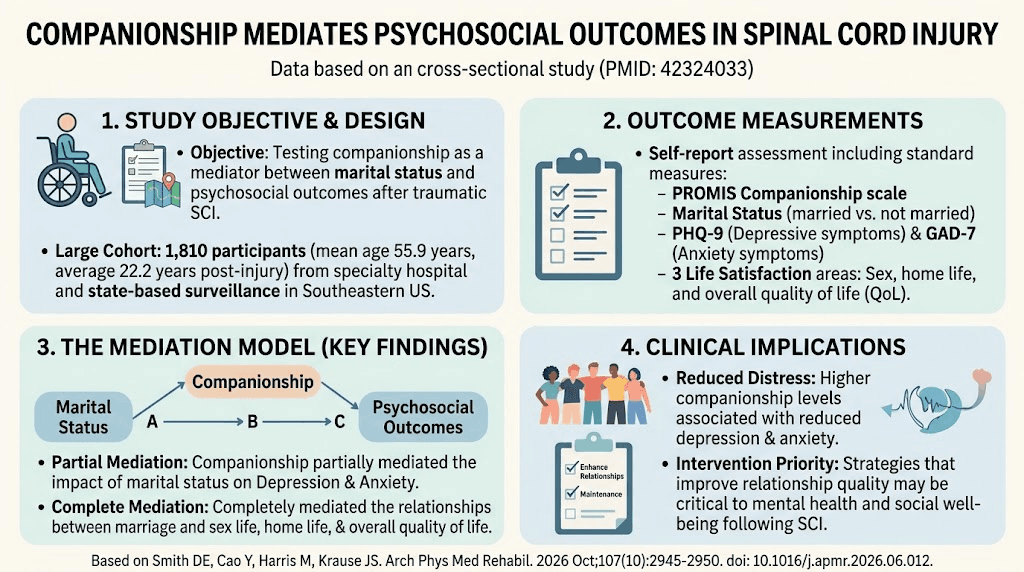
Companionship significantly mediates the relationship between marital status and psychosocial outcomes in individuals with spinal cord injury (SCI).
Higher perceived companionship correlates with reduced depression and anxiety symptoms in this population.
Companionship fully mediates the link between marital status and life satisfaction outcomes such as sex life, home life, and overall quality of life.
Interventions enhancing relationship quality may be essential for improving mental health and social well-being after SCI.
Study Background
Individuals with spinal cord injury face not only profound physical challenges but also significant psychosocial burdens. The abrupt lifestyle changes, loss of independence, and altered social roles contribute to heightened risks of depression, anxiety, and reduced quality of life. Prior research has recognized marital status as a social determinant influencing mental health and life satisfaction, yet the pathways underlying these relationships remain unclear in the SCI population. Companionship—a measure of perceived emotional and social support—may offer a critical link that explains how marital status impacts psychosocial outcomes. Understanding this mediation could refine strategies for psychosocial interventions beyond simply focusing on marital status.
Study Design
This cross-sectional, self-report study involved 1810 adults with traumatic SCI recruited from a specialty hospital and a state-based surveillance system in the Southeastern United States. Participants had an average age of 55.9 years and a mean duration of injury of 22.2 years. The study assessed demographic, injury-related, and socioeconomic variables to control for confounding influences.
The main variables included marital status (married vs. not married), companionship measured by the PROMIS Companionship scale, depressive symptoms via the Patient Health Questionnaire-9 (PHQ-9), anxiety symptoms assessed with the Generalized Anxiety Disorder-7 (GAD-7) scale, and three life satisfaction domains: sex life, home life, and overall quality of life. No interventions were applied as this was an observational study.
Key Findings
The analysis demonstrated that companionship partially mediated the relationship between marital status and depression as well as anxiety symptoms. Notably, individuals who were married reported higher companionship scores, which were associated with lower depression and anxiety symptom severity. This partial mediation suggests that other factors may also contribute to the benefits of being married but companionship holds significant influence.
More strikingly, companionship fully mediated the relationship between marital status and life satisfaction measures—including satisfaction with sex life, home life, and overall quality of life. This finding indicates that the positive effects of marriage on these subjective life domains operate primarily through the quality and presence of companionship rather than marital status itself.
Quantitatively, participants with higher companionship scores exhibited significantly reduced PHQ-9 and GAD-7 scores, reflecting fewer depressive and anxiety symptoms. Concurrently, these participants reported greater satisfaction across all three quality of life metrics. These outcomes underscore companionship as a critical psychosocial resource.
Expert Commentary
This study contributes important insights into social determinants of mental health in SCI populations by elucidating companionship’s mediating role. The findings align with psychosocial theories emphasizing social support as a buffer against psychological distress. Clinicians and rehabilitation specialists should note that marital status alone is insufficient as a predictor of mental health outcomes; the perceived emotional quality of relationships—captured by companionship—is the key driver.
Limitations include the cross-sectional design, which restricts causal inference, and reliance on self-reported data, which may introduce bias. Future longitudinal studies could clarify temporal relationships and explore interventions that specifically enhance companionship or social connectedness.
Additionally, as the cohort was predominately from Southeastern U.S. institutions, generalizability to other demographic groups or geographical regions warrants consideration. Nevertheless, this research sets a foundation for integrating social support enhancement strategies into holistic SCI rehabilitation and mental health care programs.
Conclusion
The study underscores companionship as a pivotal mediator linking marital status with mental health and life satisfaction outcomes in individuals with spinal cord injury. Enhancing relationship quality and companionship could be a viable target for psychosocial interventions aimed at mitigating depression and anxiety while improving participants’ overall well-being and life satisfaction. Rehabilitation programs and mental health services should prioritize fostering supportive social connections, regardless of marital status, to promote resilience and quality of life in this vulnerable population.
Funding and ClinicalTrials.gov
This study was conducted at the Medical University in the Southeastern United States. Specific funding sources and clinical trial registrations were not reported in the abstract.
References
Smith DE, Cao Y, Harris M, Krause JS. Companionship as a Mediator of the Relationship Between Marital Status and Psychosocial Outcomes: Findings in Individuals With Spinal Cord Injury. Arch Phys Med Rehabil. 2026 Jun 21;107(10):2945-2950. PMID: 42324033.
Additional relevant literature:
1. Krause JS. Social support and SCI outcomes: a review. J Spinal Cord Med. 2013;36(2):98-107.
2. Bombardier CH, Tate DG, Ehde DM, et al. Physical activity, depression, and life satisfaction after SCI. Arch Phys Med Rehabil. 2017;98(9):1903-1910.
3. Cutrona CE, Russell DW. The provisions of social relationships and adaptation to stress. Adv Pers Relat. 1987;1:37-67.