Highlight
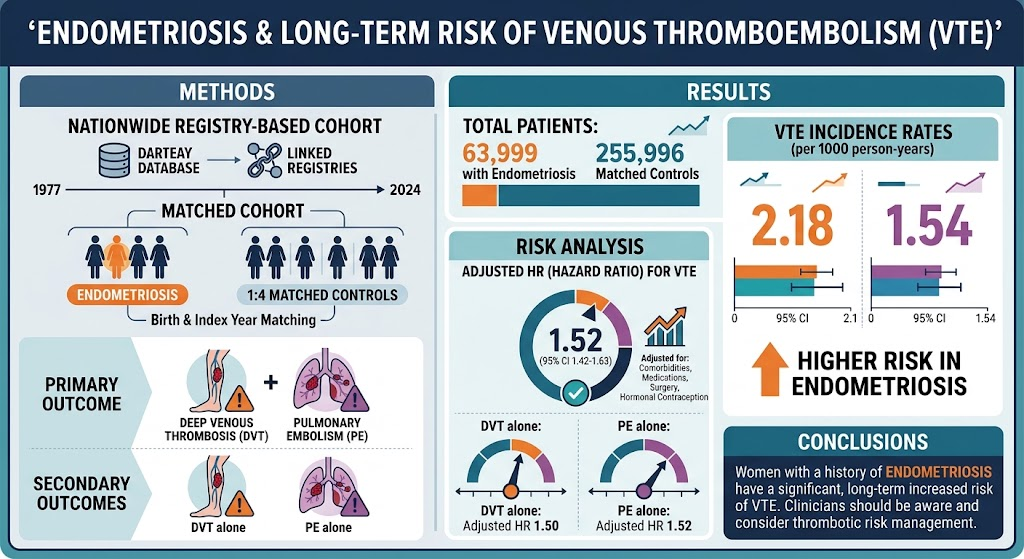
• Women with endometriosis exhibit a 52% higher long-term risk of venous thromboembolism (VTE) compared to matched controls.
• Increased VTE risk encompasses both deep venous thrombosis and pulmonary embolism.
• Associations remain significant after adjusting for comorbidities and hormone therapy.
• Findings emphasize the importance of thrombotic risk awareness in clinical management of endometriosis.
Study Background
Endometriosis, characterized by the ectopic presence of endometrial-like tissue outside the uterus, affects approximately 10% of women of reproductive age globally. Beyond causing chronic pelvic pain and infertility, emerging evidence implicates endometriosis in systemic inflammatory states and endothelial dysfunction. Such pathophysiological changes may predispose to thrombotic events. Venous thromboembolism (VTE), including deep venous thrombosis (DVT) and pulmonary embolism (PE), represents a significant cause of morbidity and mortality worldwide. However, the relationship between endometriosis and VTE risk has remained poorly defined due to limited and inconsistent data. This nationwide Danish cohort study aimed to delineate the long-term risk of VTE in women diagnosed with endometriosis, providing important epidemiological and clinical insights.
Study Design
This was a nationwide, registry-based cohort study conducted in Denmark encompassing data from 1977 through 2024. The cohort consisted of 63,999 women identified with a diagnosis of endometriosis, matched in a 1:4 ratio to 255,996 control women from the general population without endometriosis. Matching criteria included birth year and index year to minimize confounding by age and calendar time. The primary endpoint was incident VTE, defined as a composite outcome of deep venous thrombosis or pulmonary embolism documented in nationwide registries. Secondary endpoints included the occurrence of each VTE subtype separately. Covariates used for adjustment included comorbidities, gynecological and abdominal surgical histories, medication use (notably hormonal contraception), and other potential confounders derived from comprehensive Danish health registries.
Key Findings
At baseline, women with endometriosis demonstrated a higher prevalence of comorbid conditions, increased medication use, and more frequent histories of abdominal or gynecological surgeries compared to matched controls, reflecting a greater overall healthcare burden. During follow-up, the incidence rate of VTE was 2.18 per 1000 person-years (95% CI 2.10–2.26) in the endometriosis group, versus 1.54 per 1000 person-years (95% CI 1.51–1.58) among controls.
Cox proportional hazards analyses revealed that endometriosis was associated with a significantly elevated risk of VTE. The unadjusted hazard ratio (HR) was 1.43 (95% CI 1.36–1.50), which remained robust and slightly increased after multivariate adjustment for confounders (adjusted HR 1.52; 95% CI 1.42–1.63). Subgroup analyses showed comparable independent risk for deep venous thrombosis (adjusted HR 1.50; 95% CI 1.38–1.63) and pulmonary embolism (adjusted HR 1.52; 95% CI 1.36–1.70).
These associations persisted despite adjustment for hormonal contraceptive use, a known modifiable VTE risk factor, underscoring the intrinsic prothrombotic milieu associated with endometriosis.
Expert Commentary
This large-scale, long-term cohort study provides compelling epidemiological evidence linking endometriosis to an increased risk of venous thromboembolism. The findings strongly support a paradigm wherein systemic inflammation and endothelial activation associated with endometriosis contribute to hypercoagulability. The chronic inflammatory state accompanying endometriosis may activate coagulation cascades and impair fibrinolytic balance, thereby elevating VTE risk. Clinical awareness of this link is critical for risk stratification and management.
These findings highlight the need for multidisciplinary care approaches integrating gynecology, hematology, and primary care to optimize thromboprophylaxis strategies, especially in high-risk subsets such as women undergoing surgery or hormonal treatments. Clinicians should maintain vigilance for VTE symptoms in endometriosis patients and consider individualized risk-benefit assessments when prescribing hormonal therapies.
However, as an observational registry-based study, residual confounding by unmeasured factors cannot be entirely excluded. The study population predominantly includes Danish women, somewhat limiting generalizability to more diverse ethnic populations. Future research should aim to elucidate mechanistic pathways and evaluate preventive interventions targeting VTE risk in this population.
Conclusion
The Danish nationwide cohort study robustly establishes that endometriosis confers a significantly increased long-term risk of venous thromboembolism, including both DVT and PE, independent of hormonal contraception and comorbid conditions. These results underscore the imperative for heightened clinical vigilance regarding thrombosis in women with endometriosis. Integrating thrombotic risk assessment into routine endometriosis management may improve patient safety and outcomes.
Additional prospective studies and mechanistic investigations are warranted to clarify pathophysiological pathways and develop effective thromboprophylaxis protocols tailored to this population.
Funding and ClinicalTrials.gov
Information regarding funding sources and clinical trial registration was not provided in the published abstract. Future reports may delineate these details.
References
1. Ryde HV, Reinert MS, Hartwell D, et al. Endometriosis and long-term risk of venous thromboembolism: a Danish nationwide study. European Heart Journal. 2026 Aug 8; PMID: 42568051.
2. Vázquez-Martínez ER, et al. Endometriosis as a chronic systemic inflammatory disease: Pathophysiological link with cardiovascular risk and thrombosis. Frontiers in Immunology. 2020.
3. Pomp ER, et al. Risk of venous thrombosis in association with endometriosis. Thrombosis Research. 2010.
4. Kanda E, et al. The relationship between endometriosis and blood coagulation/fibrinolysis abnormalities. Reproductive Biology and Endocrinology. 2018.